A partial reckoning

By Robert McLachlan

Climate action continues in Aotearoa New Zealand

As 2025 winds to a close, I am writing from the Rodney district north of Auckland – Rodney being famous as the home of the Rodney & Otamatea Times which published this banger in 1912. (Andy Revkin of the New York Times brought it to wide attention in 2016.)

The 1912 article had been rediscovered a few years earlier thanks to “Papers Past”, a project of the National Library of New Zealand to scan old newspapers, that began in 2001 and continues to this day. As for the Rodney Times, founded in 1901, it ceased publication in July this year, along with many other New Zealand community newspapers.

The “coal consumption” story itself is a caption from an article by Frances Molina in the March 1912 issue of Popular Mechanics, a model popular science article of the day. It concludes with a reflective passage that could stand today:

This rapid publication of worldwide science news was possible because New Zealand had been connected to the rest of the world by undersea telegraph cable in 1876. Other science news on 14 August 1912: the world’s deepest bore dug in Silesia at 7348 ft; nickel kitchen implements; how camphor is made; a skipping machine which turns the rope and counts your skips (I can see that being a winner today); a Swiss proposal to build a tunnel linking the Black and Caspian Seas (an idea that reappeared in 2025); and (this one is real genius) a way of preventing buckets of water spilling on trains, namely a wooden lid.

I dabble a little in social media and, in my experience at least, what fires engagement is not outrage but good news, like New Zealand showing a possibly record-breaking run of days with zero coal- or gas-fired electricity:

No coal or gas-fired electricity reported in New Zealand on 20-21 or 23-31 December 2025. (There’s still about 0.9% of fossil co-generation, not shown.) Source: em6

Or this one, which also went off, showing super-exponential growth of solar power in New Zealand:
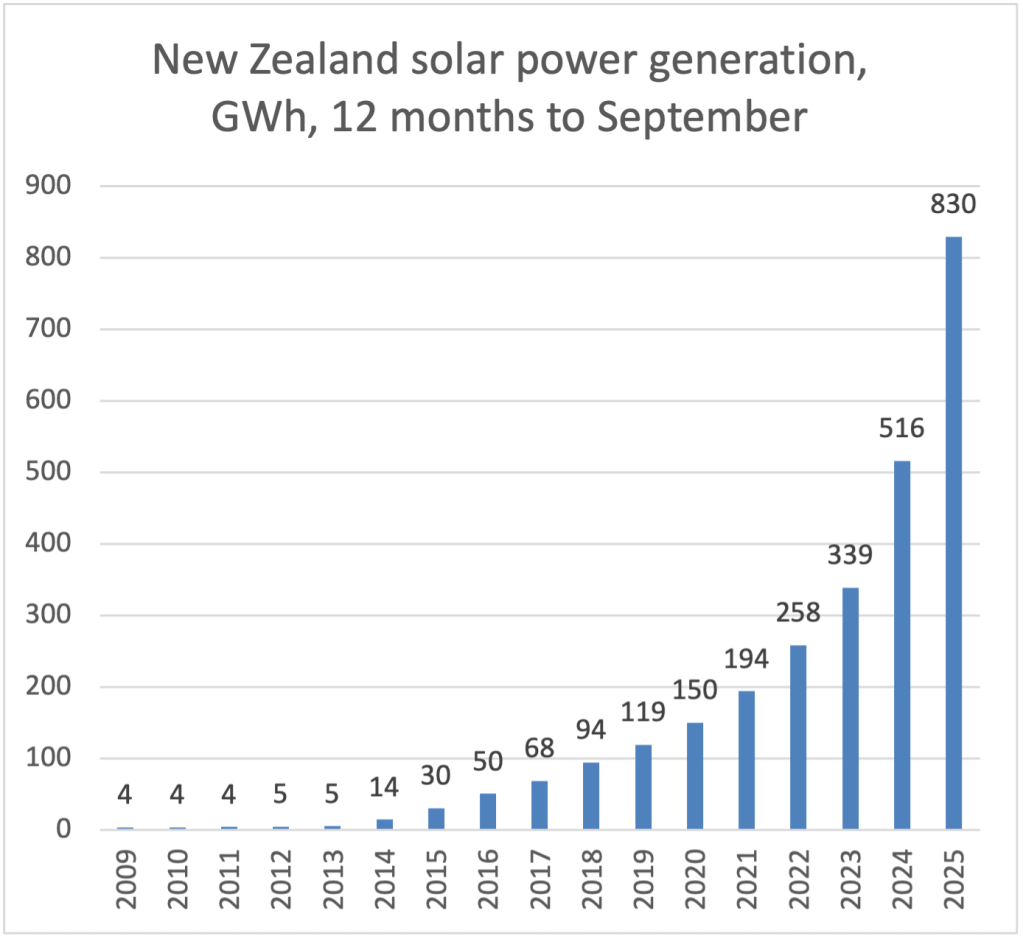
NZ grid-tied solar power grew 31% in 2023, 52% in 2024, 61% in 2025. Long may it continue. Still only 1.9% of total power generation to there is plenty of remaining scope. The 4th quarter of 2025 is likely to come in at the lowest emissions and highest renewable proportion on record. Utility solar was 41.2 GWh in Q2, 62.9 in Q3; distributed solar 128 in Q2, 148.5 in Q3. Source: MBIE Energy Quarterly. The lifecycle emissions of solar are 99% less than coal.

But posts showing bad news tend to do poorly:

Emissions from domestic fossil fuel combustion to September 2025. 70% of these are from oil, which (although still below peak) are flat.

However, that last graph is perhaps the most important, for today is the last day of the first emissions budget period, which ran from 2022 to 2025. The system of emissions budgets was set up by the Climate Change Response (Zero Carbon) Amendment Act 2019, which unleashed a wave of low-carbon investment across the country. Even Fonterra, which only a couple of years earlier was still obscuring their role as the country’s largest coal burner, began to change. Officially, thanks to some dodgy accounting, we are on track to meet the first budget, although the final reckoning (including agriculture and forests) will not be in for another year.

We do, however, have nearly complete data for energy emissions. These show a dramatic change after the Zero Carbon Act changes had time to kick in:

2018-1960.9 Mt CO22% below 2007 peak
2020-2159.5 Mt CO2–2%
2022-2354.0 Mt CO2–9% (!!!)
2024-2553.9 Mt CO2no change; progress halted

The progress in 2022-23, the first half the budget period, is impressive. (However, 1/3 of the reduction was due to the closure of the Marsden Point oil refinery, which shouldn’t count as the emissions were shifted offshore.) Progress appears to have halted in the second half, and although climate action hasn’t completely halted, the constant barrage of anti-climate action and rhetoric from the government is having an effect.

Which brings me to my point. Top-10 lists are a year-end classic. But in this case it seems more appropriate to nominate the…

Government’s bottom 10 climate actions of 2025

And how hard it is to choose. I’ll start by ruling out things that are merely said, like Shane Jones’s comment on anti-coal protesters that “The high tide mark of this unicorn kissing green drivel is over,” or two out of three Government coalition partners proposing to leave the Paris Agreement. It’s hard to draw the line, though, as words have an effect too – like the Climate Change Minister telling Federated Farmers that we have no legal obligation or liability to meet the Paris targets. I’m looking at real actions that will likely lead to the most actual damage, either direct (by increasing pollution) or indirect (by fostering division). (A few sins of omission will also crop up.)

10. ETS failure. The Government may say the ETS is its main tool to control emissions, but the market says otherwise – the price of carbon credits has dropped from a high of $87 in September 2022 to $37 now. Each Government announcement seems to result in a slump: doubling the free allocation to Reio Tinto, rejecting advice to review free allocations, uncoupling the ETS from the Paris target, cutting the number of companies that must report their emissions by 55%. Since 2022, none of the 12 ETS auctions have cleared completely; 2 have partially cleared.

9. No action on aviation emissions. The First Emissions Reduction Plan included an item to prepare a plan to decarbonise domestic aviation. (While other actions were repeated, this one was not.) There has been no work on this. Instead, the group Sustainable Action Aotearoa (set up by the ERP) has been sidelined and their work on updating our State Action Plan for the International Civil Aviation Organisation stopped.

8. The Carbon Neutral Public Sector got the chop. This one is a repeat, as National already chopped it once before, in 2009.

7. No Energy Plan. In ERP1, we were promised a comprehensive Energy Plan by December 2024. There is no sign of it yet, only some brief, piecemeal documents and a series of anti-climate energy initiatives. (LNG terminal, anyone?)

6. Offshore oil & gas exploration to be restarted, with a $200 million public sweetener and going gentler on the industry’s clean-up requirements.

5. Overseas climate financing, largely to the Pacific, which was $450 million in 2024, was cut to $100 million.

4. An end to bipartisanship. In major changes announced for the formerly bipartisan Zero Carbon Act, the Climate Change Commission will no longer provide advice on Emissions Reduction Plans, and the Government will be able to amend Plans at any time without consultation. Between the loss of bipartisanship and the erosion of the system of checks, balances, and communication between the Commission, Government, and public, the Act is under threat.

3. Clean Vehicle Standard gutted. This one is close to my heart as I have been following this story at least since the incoming John Key government killed fuel economy standards for the first time, in 2009. We all know how the feebate was boosted into a fake culture war, and how the Standards themselves were then drastically weakened for future years. Now the penalties that car importers must pay for not meeting the standards have themselves been cut by 80% for 2026 & 2027 – the same method used by Donald Trump to get rid of US standards. The move was supported by patsy modelling from the Ministry, which claimed the move would have almost no effect on emissions. The industry had taken no action at all to try and meet the targets, instead seeing a way forward through lobbying. It appears that any pro-climate faction within the industry bodies has been defeated, and the hand of the industry to dictate its own regulations strengthened. The extra costs in fuel and climate damage run to many hundreds of millions of dollars. EV sales, which fell 70% in 2024, are stagnant, and road transport emissions (which fell after Covid, partly as a result of working from home) are tracking up again.

2. No action on CO2 target. The Climate Commission advised the Government to strengthen the 2050 CO2 target to net –20 MtCO2 per year, including international aviation and shipping. All advice was rejected.

And the very bottom Government climate action of 2025 is…

1. 2050 target weakened. The Zero Carbon Act was amended under urgency with no public input – even the public gallery was closed – to weaken the 2050 methane target under a spurious “no additional warming” excuse. As Christina Hood has written, this increases our total emissions by the equivalent of 500 years of operation of the Huntly power station and takes our 2050 target nearly back to 2011 levels of ambition.

Look at that, out of numbers already! I didn’t even have time to discuss the ongoing saga over the lip service paid to our 2030 Paris Agreement target, or over our new 2035 target which fails on multiple levels.

I may be writing from Rodney, but I live in Manawatū, where our property has just suffered its most catastrophic wind damage in at least three decades. Quoted in the Otago Daily Times about the catastrophic wind storm that swept Southland and South Otago on 23 October, Dr Nathan Melia said that weather and climate models struggle to predict such events, but that “studies of European wind storms indicate that climate change will increase the frequency of strong jets.”

I’m sorry I don’t have more good news for you to round out 2025. I will leave the last work to James Renwick, quoted in the above ODT article:

Asked if he can think of anything positive New Zealand is doing about climate change, anything to feel proud of, Victoria University of Wellington climate scientist Prof James Renwick looks bemused.

“As a former climate change commissioner, and an academic in the field, I can’t really.

“We were doing some great things a few years ago, but the current government has pulled back on the good things the previous government set up. And now they’re gradually undermining the commission and the Zero Carbon Act, and the agriculture sector is getting an absolute free ride. But they’re spending, what, $50 billion on new roads?”
New Zealand’s Strategic Foreign Policy Assessment

by Heidi O’Callahan

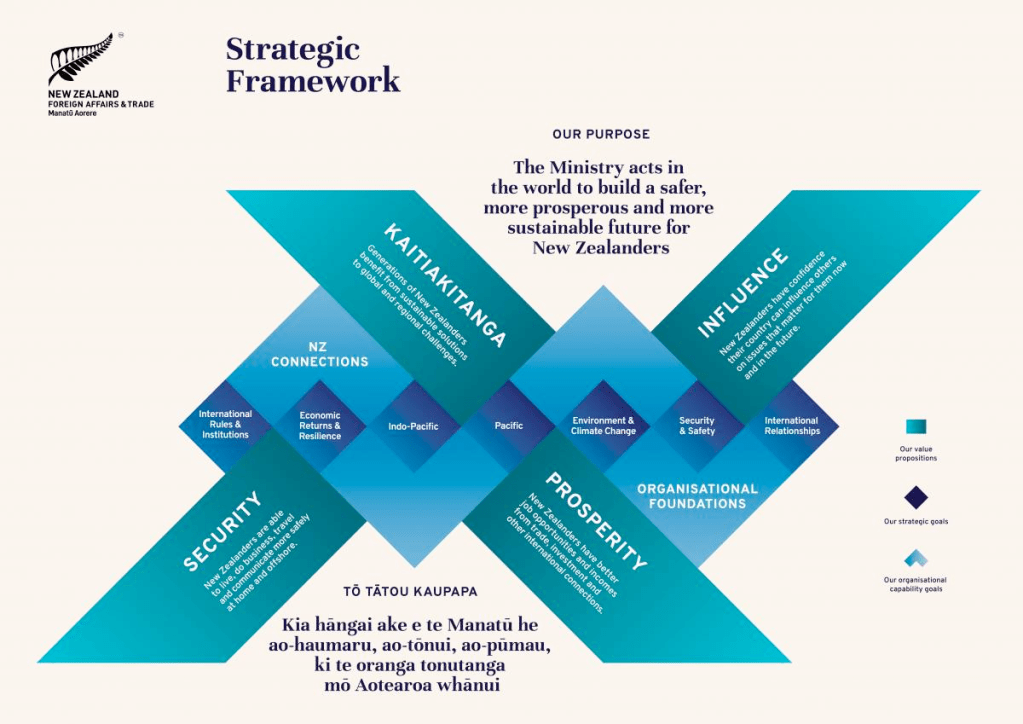
A graphic from the previous Assessment, conducted in 2023 under the previous government.

[The Ministry of Foreign Affairs and Trade is undertaking its triennial Strategic Foreign Policy Assessment. The Ministry writes: The Assessment will examine the international context New Zealand will navigate in the decade to 2036, and what this means for us. The Assessment will consider the most important changes and drivers we see happening in the world, what they mean for New Zealand, what those changes mean for our relationships, and what they mean for our region — the Pacific and the Indo-Pacific.Heidi O’Callahan’s submission is below. She would love to read other people’s submissions that tackle other (climate-exacerbated) topics, like overfishing, war, peacekeeping, humane treatment of refugees, terrorism, the scam economies and cyber security.

Submissions can be made at https://www.surveymonkey.com/r/J7J8P9V. Submissions close at 5pm on 24 December 2025.]


What are the big international issues you think New Zealand will have to navigate over the next 10 years, and what are the opportunities you think New Zealand can pursue?


The big international problems we must navigate are biodiversity loss and climate change,
as well as the poverty, inequity, migration, societal breakdown and geopolitical instability
exacerbated by these problems. To navigate these issues successfully requires accepting
the root cause: an unsustainable economic paradigm of exploitation centred on the pursuit of
economic growth.


Above all, our economy needs to operate within planetary limits; it must become more
circular, socially-positive, and ecologically regenerative. Our best opportunities for
international trade lie in low-carbon, high-value intellectual innovation. The current industries
of bulk commodities (timber, milk products, meat, etc) and international tourism must be
scaled back significantly. The scale of these industries cannot be justified on a climate basis,
and their pollution and transport impacts are directly damaging to New Zealanders’ health,
accessibility and freedoms.


What do you consider New Zealand’s foreign policy needs to do to protect and advance our interests in the world over the next 10 years?


Our government needs to act domestically to protect and advance our interests, if our
foreign policy is to have a chance of helping us on the international front. We are currently
witnessing the opposite; the government is introducing policy and legislation that is directly
undermining our safety and wellbeing. This is happening across all spheres: Te Tiriti,
transport, agriculture, education, health, climate, housing and social wellbeing are examples.
In climate alone, the government has 1) unethically scrapped policies designed to reduce
emissions, 2) reduced the climate targets on the basis of no evidence, 3) decided against
bringing agriculture into the ETS and 4) indicated they will baulk at paying the bill for
international credits to cover emissions that such a climate-ignorant set of actions creates
(despite buying credits being the centrepiece of the National Party’s otherwise non-existent
climate policy.)


MFAT cannot operate with any integrity on the international stage alongside such appalling
government backsliding. So, while New Zealand’s foreign policy needs to support
international climate regulations and rules that force wealthier countries like us to reduce
emissions rapidly and pay for our past damage, it is hard for MFAT staff to be taken seriously
when representing a hypocritical government.


Nor will MFAT succeed at advancing our economic interests or pursuing opportunities; the
government’s climate denial will exclude us from markets and keep us out of key
international decision-making.


It’s not just in climate we are becoming a laughing stock. The GPS on Transport attracted
derision and ridicule from international experts. The UN Committee for the Elimination of
Racial Discrimination highlighted how quickly New Zealand is going backwards under this
racist government.


New Zealand’s foreign policy should advance real climate justice, climate action, the
commitment to international agreements on improving transport safety, reducing racial,
gender and age discrimination, the pursuit of improving the wellbeing of people in all
countries (especially indigenous people, and the educational and health opportunities for
girls and women), the promotion of sustainable practices and ecological regeneration, and
above all, the dismantling of the economic paradigm that has led to the destruction of water,
soil, air, natural and human resources.


But to pursue advancing these issues, diplomats should be able to draw on robust examples
of domestic New Zealand practices, with truth and integrity. Currently, they cannot.


For you, your community, organisation or business: What matters most in the world beyond New Zealand? What places and international relationships matter most? What do you think are New Zealand’s greatest strengths and weaknesses in our international engagement?


We should pursue strong and respectful relationships with our Pacific neighbours.
One important matter “in the world beyond New Zealand” is reducing hypermobility. The
majority of people in the world have never set foot in an aeroplane. Yet a small minority
continue to fly, with enormous climate impact, and we are all subsidising them to do so.
Flying is one of the most inequitable and destructive activities humans can indulge in. Our
foreign policy should seek international mechanisms and agreements to achieve substantial
reductions in aviation. As a country with apparently much to lose (but also much to gain in
other ways) from reducing international aviation, New Zealand is actually in a strong position
to lead this international work, through demonstration of substantial systemic change. New
Zealand needs to shrink our international tourism industry, and take steps to prevent our
wealthy people from travelling so much. Our government must stop promoting New Zealand
as a destination, stop allowing airport expansions, introduce taxes to prevent recreational
and other avoidable flights, and support the transition to sustainable industries, including
sustainable bike-, rail-, and coach-based domestic tourism.


The international relationships that matter most are in implementing and honouring the
various UN conventions and agreements – on traffic safety, on climate, on wellbeing and
health, etc. It seems, currently, that this government is rejecting the authority of the UN,
willingly forgetting what atrocities led to the creation of the UN in the first place!


Currently, the most important international relationships my community has is with experts
from other countries to help us try to make gains in evidence-based transport, agricultural,
energy and climate policies for New Zealand. Currently, much community effort is being
spent trying to undo or mitigate aggressive and regressive government actions that have no
basis in evidence or accepted practices. It is very sad to see this waste of human toil and
effort, which could be being used to build a better New Zealand.


Also important are the relationships with international experts on democracy. New Zealand’s
poor democratic practices are stifling our progress. Deliberation and informed
decision-making are the basis of good democracy. New Zealand will not thrive and we will
not make the most of opportunities while most decisions are being made on the basis of
misinformed opinions, corporate lobbying, misguided pursuits of economic growth, and
populism.


New Zealand’s foreign policy should promote the international development of a body of
knowledge about modern democracy. Such an international resource would be useful for all
kinds of decision-making, and could help dispel the damaging myth that “one person one
vote” is a sufficient basis for democracy.


New Zealand’s greatest strength in our international engagement is the goodwill built up over
many decades by good diplomacy and leadership. While there has been a low bar for what a
“good” country should do to improve the welfare of poorer countries and to pursue
development goals, at least New Zealand often tried to be one of the more enlightened
OECD countries. Internationally, the standard must improve. Unfortunately, New Zealand is
not stepping up. The goodwill is evaporating rapidly.


Our biggest weakness in international relationships is the lack of integrity in our domestic
policies.


Do you have any other thoughts on the international context you would like the team to consider?


How the climate changes depends on emissions right now and over the next few years. Net
zero by 2050 is necessary but by then it will be largely irrelevant; the important point is the
emissions trajectory to get there. Bureaucrats and leaders believe they face difficult
decisions currently and rarely prioritise emissions reductions. Yet the different climate
pathways will determine the options in front of future decision-makers, who will have fewer
resources to be able to draw upon, will be functioning in more urgent circumstances, and are
likely to be working within weaker institutions.


When this is fully understood, it is clear that decision-making is unlikely to get any easier!
We must stick to ethical action that will help decision-makers in the future. We must invest to
pursue rapid and significant emissions reductions, and rapidly transform our systems so they
are low carbon. We must acknowledge that the true social cost of carbon is orders of
magnitude higher than what our ETS scheme uses; much larger than what Europe is using.
We must be responsible international neighbours, and ensure poor countries don’t have to
make decisions between climate action and social or economic health.


None of this can be delayed while climate deniers have their turn at power plays in politics.
Quality foreign policy, in the absence of quality domestic policy, is akin to “polishing a turd”.