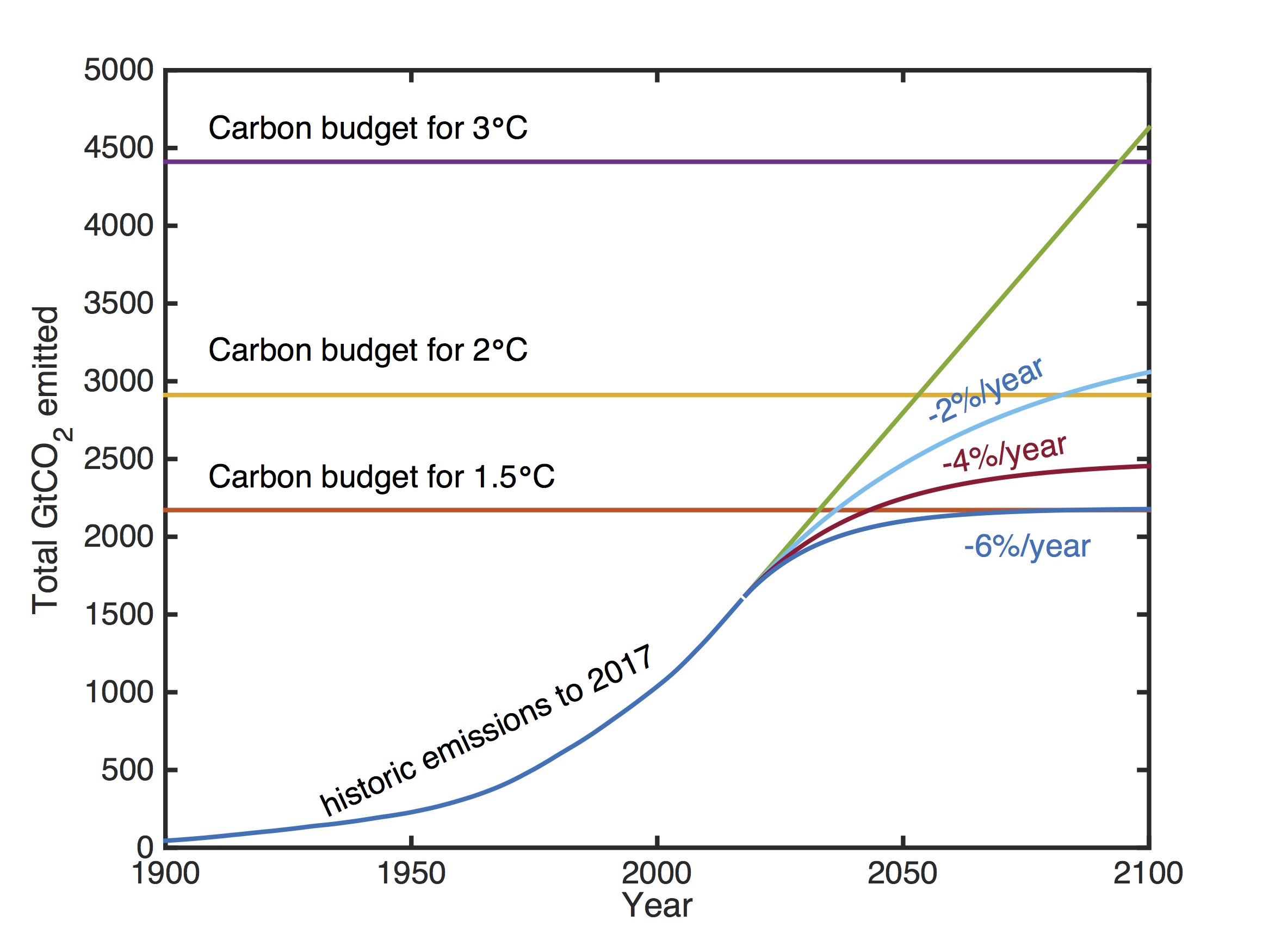
Cimate change is a complex issue and there are many views as to the best way forward. One point, however, risks getting lost in the details: to address climate change, we have to stop burning fossil fuels. Total warming is basically determined by the total amount of fossil fuels burnt. The graphic below shows the total CO2 emitted since the beginning of the industrial revolution:
Historic CO2 emissions from globalcarbonproject.org; budgets from IPCC 1.5C report.
The massive increase in burning fossil fuels starting around 1960, now called the Great Acceleration, is clearly visible, as is the rise of China from 2005. You can see how we have eased off on the accelerator in the last few years. Now we need to slam on the brakes.
We may miss the 1.5C target, we may even miss the 2C target; somewhere in this range risks triggering the melting of all of Greenland and Antarctica, with associated 70 metres of sea level rise over a few thousand years. (Already, late in the 20th century, the large grounded ice sheets began peeling off the sea floor, destabilised and melted from below.) But whatever point we reach, we will still need to continue to focus on stopping burning fossil fuels.
Yes, agricultural emissions are important too, both in New Zealand and globally. One large dairy cow emits the equivalent greenhouse gases as one large car. But the cow earns money and produces a useful product, while most cars do not earn money – they are a large money sink and, in many cases, more of a consumer item. New Zealand spends $5 billion a year importing fossil fuels, a terrifically bad investment. Whatever happens with agriculture does not avoid the primary need to stop burning fossil fuels.
Yes, planting trees can help, effectively taking carbon out of the air and storing it in solid form above ground for as long as the bush or plantation lasts. Planting trees can buy us a little time while we stop burning fossil fuels.
For individuals, the best course of action is straightforward. For transport, switch from burning petrol or diesel to walking, cycling, public transport, or an EV – already cheaper on total cost of ownership than petrol or diesel for most New Zealand drivers. If you burn gas, switch to electricity or (for space heating) wood. Avoid unnecessary air travel. A few individuals doing these things doesn’t help much on the emissions front, but it builds a community of experience, awareness, and support which will help our whole society stop burning fossil fuels.
For businesses, the best course of action is to adopt a carbon management plan, certified by (for example) Enviro-Mark Solutions, a New Zealand company with growing export earnings that has been extensively reviewed and validated by international studies. There are two options: carboNZero, which means that your entire operation is carbon neutral, and CEMARS (Certified Emissions Measurement and Reduction Scheme), which ensures a measured reduction in emissions over time.
The results can be startling. Auckland International Airport reduced emissions 35 per cent in 5 years with significant cost savings. Kāpiti Coast District Council is well over halfway towards reducing emissions by 80 per cent by 2021, with cost savings of $1.3m per year. The Warehouse is CEMARS certified. Even large, carbon-intensive companies like Mainfreight are strongly focused on reducing their emissions.
In the words of University of Auckland physicist Richard Easther, “If you’re in charge of something in 2019, you’re in charge of the climate. If your job has anything to do with transport, what’s your plan to ‘decarbonise’, starting right now?” For many sectors, including land freight, city buses, and rubbish trucks, imports of diesel road vehicles can stop right now.
After 30 years of climate change discussion, planning, and action, the burning of fossil fuels is still on the increase in New Zealand. It needs to stop.
Robert McLachlan and Steve Trewick. This article appeared first on stuff.co.nz on 29 January 2019. See original article.
We congratulate Stuff for its series on climate change. But one area has received relatively little attention – that of flying.
Though aviation is emission-profligate and the fastest growing source of emissions, it presents particular challenges. You can replace your petrol-driven car with a modern electric car. But flying is more complex, as there is no easy way of reducing its heavy dependence on fossil fuels in the foreseeable future.
For New Zealand, it is especially challenging. It has been estimated that, at any point in time, more than one million New Zealand residents are living or travelling overseas.
More than a quarter of New Zealanders were born overseas, many retaining close links to friends and family in their country of origin. Keeping in touch with whānau is a strong driver of the wish to fly. In addition, within New Zealand we don’t have fast rail linking our major centres, and low-cost long-distance bus travel is currently of poor quality. Our rapidly expanding tourism industry also depends on people often travelling long distances to get here.
The problem is that flying is an important contributor to our greenhouse gas emissions. This impact is forecast to increase in absolute terms and as a proportion of New Zealand’s total emissions.
The increase comes about through the rapidly growing popularity of long-distance travel, as well as a massive growth in airfreight driven in part by online retailing. (The Auckland airport company is currently planning for 40m passengers a year to pass through its facility by 2040.) The increase in flight emissions counteracts the reduction in greenhouse emissions that other sectors of the economy are working towards, including farming.
So what is the size of the challenge? New Zealand’s international aviation emissions, unregulated by the Paris Agreement, were 3.4m tonnes of CO₂ equivalent in 2016, up 152 per cent from 1990. There is insufficient land to produce enough biofuel and it’s a major challenge to go electric, even for short flights.
What can we do to change the trajectory?
Individuals can choose to fly less. Inspired by Sweden’s #flygfritt 2019challenge to be flight-free, Britain has launched its #flightfree2019 campaign. There is now a Fly-less Kiwis Facebook group.
Businesses, government agencies and universities can reduce their dependence on flying through video conferencing, virtual workshops and by examining the necessity of each trip. They can stop the practice of giving employees airpoints for personal use, a tax-free incentive to fly.
We can remove wider incentives including airpoints, flybuys, finance company loans for international travel, and subsidies for regional airlines.
We can improve low-carbon forms of travel within New Zealand, for example with high-speed trains between Auckland, Hamilton and Tauranga, and improved long-distance bus services.
As Wellington lawyer Tom Bennion states in Chris Watson’s book Beyond Flying, “Air travel is the ultimate low-hanging fruit in terms of a significant step that individuals can take immediately to prevent catastrophic climate change.”
This article appeared first on Stuff.co.nz on 12 December 2018. See original article.
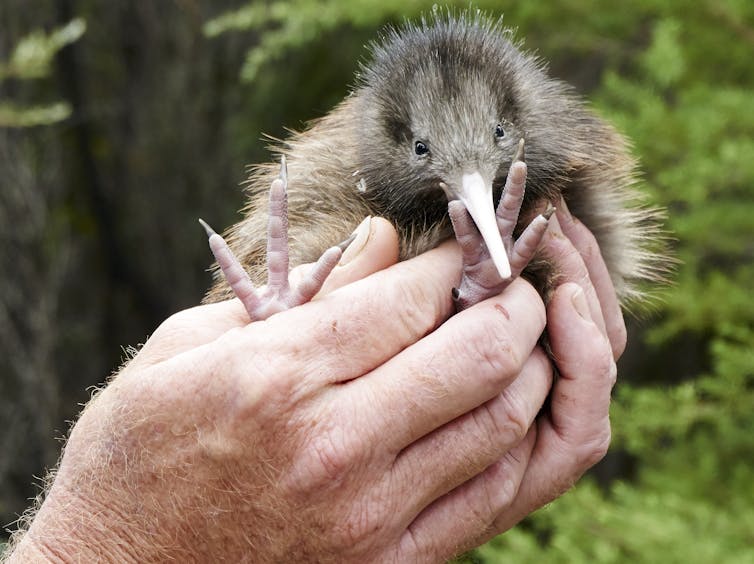
There are five species of kiwi in New Zealand. Their total number is currently at around 70,000 but the populations may have declined by two thirds in 20 years.
The recently released 2018 Living Planet report is among the most comprehensive global analyses of biodiversity yet. It is based on published data on 4,000 out of the 70,000 known species of mammals, birds, fish, reptiles and amphibians.
Rather than listing species that have gone extinct, the report summarises more subtle information about the vulnerability of global biodiversity. The bottom line is that across the globe, the population sizes of the species considered have declined by an average of 60% in 40 years.
New Zealand is a relatively large and geographically isolated archipelago with a biota that includes many species found nowhere else in the world. One might think that it is buffered from some of the effects of biological erosion, especially since people only arrived less than 800 years ago. But as we show, the impact on wildlife has been catastrophic.
Describing biological diversity
The diversity of life may seem incomprehensible. Carolus Linnaeus began his systematic work to describe earth’s biological diversity in the 18th century with about 12,000 plants and animals. Since then, 1.3 million species of multi-cellular creatures have been described, but the size of the remaining taxonomic gap remains unclear.
Species do not exist in isolation. They are part of communities of large and microscopic organisms that themselves drive diversification. Charles Darwin observed in his usual understated way:
It is interesting to contemplate an entangled bank, clothed with many plants of many kinds, with birds singing on the bushes, with various insects flitting about, and with worms crawling through the damp earth, and to reflect that these elaborately constructed forms, so different from each other, and dependent on each other in so complex a manner, have all been produced by laws acting around us.
Global decline of wild places
The main threat to biodiversity remains overexploitation of resources, leading to loss of habitat. Human overconsumption can only get worse in coming decades, and this will likely escalate the impact of invasive species, increase the rate of disease transmission, worsen water and air pollution and add to climate change.
This is the Anthropocene, the era of human domination of many global-scale processes. By the early 1990s, just 33 million of the earth’s 130 million square kilometres of ice-free land remained in wilderness. By 2016, it was down to 30 million. Most of this is either desert, taiga or tundra. In other words, humans and their cities, roads and farms occupy 77% of the available land on earth.
By 2050, wild lands are projected to contract to 13 million square kilometres, leaving ever less space for wild animals and plants. In terms of resources consumed, there is huge inequity. Preliminary estimates of the biomass of all life on earth reveal that humans, their pets and their farm animals outweigh wild land mammals by 50 to one. Poultry outweigh all wild birds 2.5 to one.
New Zealand: at the bottom of the cliff
In New Zealand, a lot of attention is paid to iconic, rare species, such as kiwi and kākāpo. However, in 2017, the Parliamentary Commissioner for the Environmentreported that the proportion of forest land occupied by birds found only in New Zealand had declined in the North Island from 16% to 5% between 1974 and 2002. In the South Island, it declined from 23% to 16%.
These figures are consistent with other studies on animal populations. For example, kiwi, which currently number 70,000, may have declined by two thirds in 20 years. Thus there is a risk that continued biodiversity decline overall will see more and more species requiring last-ditch efforts to save them, with healthy populations confined to heavily protected and often fenced sanctuaries.
New Zealand is unusual in that introduced, invasive predators are a major threat and are widely seen as the predominant threat to native animals. However, land use change in New Zealand has been rapid, extensive and catastrophic for biodiversity and ecosystem resilience. The New Zealand situation is at best the global story writ small.
As the last substantial land area to be settled by humans, the land experienced an alarming rate of habitat loss. Indeed, deforestation was considered a necessity and the “homestead system” in Auckland saw tenants turned off the land if they failed to clear sufficient native bush.
Native bush in New Zealand has been reduced by about three quarters from its former 82% extent across the landscape. What remains is heavily modified and not representative of former diversity. For example, in the Manawatū-Whanganui region, ancient lowland kahikatea forest has been reduced to less than 5% of its former extent, and between 1996 and 2012, 89,000 hectares of indigenous forest and scrub was converted to exotic forest and exotic pasture. When a habitat is removed, the organisms that live in it go, too.
Unfortunately, biodiversity threats are, if anything, even more pervasive and difficult to address than fossil fuel emissions. In climate change, it is broadly agreed that rising seas, acidifying oceans and destabilised weather patterns are bad. There is no such universal understanding of the importance of biodiversity.
To address this, the report details the importance of biodiversity to human health, food production and economic activity – the “ecosystem services” that nature provides to humans. The intrinsic value of nature to itself is hardly mentioned. This is not a new debate. The 1992 UN Convention on Biological Diversity is founded on “the intrinsic value of biological diversity”, while the Rio Earth Summit of the same year stated that “human beings are at the centre of concerns for sustainable development.”
The issue should not be confined to ecologists, philosophers, and diplomats. It needs to be addressed or we may find that future generations value nature even less than present ones do. In 2002, Randy Olsen popularised the concept of the shifting baseline, which means that people progressively adjust to a new normal and don’t realise what has been lost:
People go diving today in California kelp beds that are devoid of the large black sea bass, broomtailed groupers and sheephead that used to fill them. And they surface with big smiles on their faces because it is still a visually stunning experience to dive in a kelp bed. But all the veterans can think is, “You should have seen it in the old days”.
New Zealand is considering whether or not agricultural greenhouse gases should be considered as part of the country’s transition to a low-emission economy.
New Zealand could become the first country in the world to put a price on greenhouse gas emissions from agriculture.
Leading up to the 2017 election, the now Prime Minister Jacinda Ardern famously described climate change as “my generation’s nuclear-free moment”. The promised zero carbon bill is now underway, but in an unusual move, many provisions been thrown open to the public in a consultation exercise led by Minister for Climate Change James Shaw.
More than 4,000 submissions have already been made, with a week still to go, and the crunch point is whether or not agriculture should be part of the country’s transition to a low-emission economy.
Zero carbon options
Many of the 16 questions in the consultation document concern the proposed climate change commission and how far its powers should extend. But the most contentious question refers to the definition of what “zero carbon” actually means.
The government has set a net zero carbon target for 2050, but in the consultation it is asking people to pick one of three options:
net zero carbon dioxide – reducing net carbon dioxide emissions to zero by 2050
net zero long-lived gases and stabilised short-lived gases – carbon dioxide and nitrous oxide to net zero by 2050, while stabilising methane
net zero emissions – net zero emissions across all greenhouse gases by 2050
The three main gases of concern are carbon dioxide (long-lived, and mostly produced by burning fossil fuels), nitrous oxide (also long-lived, and mostly produced by synthetic fertilisers and animal manures) and methane (short-lived, and mostly produced by burping cows and sheep). New Zealand’s emissions of these gases in 2016 were 34 million tonnes (Mt), 9Mt, and 34Mt of carbon dioxide equivalent (CO₂e), respectively.
All three options refer to “net” emissions, which means that emissions can be offset by land use changes, primarily carbon stored in trees. In option 1, only carbon dioxide is offset. In option 2, carbon dioxide and nitrous oxide are offset and methane is stabilised. In option 3, all greenhouses gases are offset.
Gathering support
Opposition leader Simon Bridges has declared his support for the establishment of a climate change commission. DairyNZ, an industry body, has appointed 15 dairy farmers as “climate change ambassadors” and has been running a nationwide series of workshops on the role of agricultural emissions.
Earlier this month, Ardern and the Farming Leaders Group (representing most large farming bodies) published a joint statement that the farming sector and the government are committed to working together to achieve net zero emissions from agri-food production by 2050. Not long after, the Climate Leaders Coalition, representing 60 large corporations, announced their support for strong action to reduce emissions and for the zero carbon bill.
However, the devil is in the detail. While option 2 involves stabilising methane emissions, for example, it does not specify at what level or how this would be determined. Former Green Party co-leader Jeanette Fitzsimons has argued that methane emissions need to be cut hard and fast, whereas farming groups would prefer to stabilise emissions at their present levels.
This would be a much less ambitious 2050 target than option 3, potentially leaving the full 34Mt of present methane emissions untouched. Under current international rules, this would amount to an overall reduction in emissions of about 50% on New Zealand’s 1990 levels and would likely be judged insufficient in terms of the Paris climate agreement. This may not be what people thought they were voting for in 2017.
Why we can’t ignore methane
To keep warming below 2℃ above pre-industrial global temperatures, CO₂ emissions will need to fall below zero (that is, into net removals) by the 2050s to 2070s, along with deep reductions of all other greenhouse gases. To stay close to 1.5℃, the more ambitious of the twin Paris goals, CO₂ emissions would need to reach net zero by the 2040s. If net removals cannot be achieved, global CO₂ emissions will need to reach zero sooner.
Therefore, global pressure to reduce agricultural emissions, especially from ruminants, is likely to increase. A recent study found that agriculture is responsible for 26% of human-caused greenhouse emissions, and that meat and dairy provide 18% of calories and 37% of protein, while producing 60% of agriculture’s greenhouse gases.
A new report by Massey University’s Ralph Sims for the UN Global Environment Facility concludes that currently, the global food supply system is not sustainable, and that present policies will not cut agricultural emissions sufficiently to limit global warming to 1.5℃ above pre-industrial levels.
Finding a way forward
Reducing agricultural emissions without reducing stock numbers significantly is difficult. Many options are being explored, from breeding low-emission animals and selecting low-emission feeds to housing animals off-pasture and methane inhibitors and vaccines.
But any of these will face a cost and it is unclear who should pay. Non-agricultural industries, including the fossil fuel sector, are already in New Zealand’s Emissions Trading Scheme (ETS) and would like agriculture to pay for emissions created on the farm. Agricultural industries argue that they should not pay until cost-effective mitigation options are available and their international competitors face a similar cost.
The government has come up with a compromise. Its coalition agreement states that if agriculture were to be included in the ETS, only 5% would enter into the scheme, initially. The amount of money involved here is small – NZ$40 million a year – in an industry with annual export earnings of NZ$20 billion. It would add about 0.17% to the price of whole milk powder and 0.5% to the wholesale price of beef.
However, it would set an important precedent. New Zealand would become the first country in the world to put a price agricultural emissions. Many people hope that the zero carbon bill will represent a turning point. It may even inspire other countries to follow suit.
According to a recent report, New Zealand will need to increase renewable electricity generation, plant more trees and continue switching to electric transport more rapidly to achieve its zero carbon goal by 2050.
New Zealand has set itself a target of becoming carbon-neutral by 2050.
A recent report issued by the New Zealand Productivity Commission has found that this is an achievable goal, even under modest forecasts of technological progress and increases in carbon price.
Rising emissions
New Zealand already had a goal of reducing greenhouse gas emissions to 50% below 1990 levels by 2050. That target had been in place since 2002, but emissions continued to rise through the 2000s.
An emissions trading scheme, which began operating in 2008, failed to stop the increase. A flood of imported cars increased New Zealand’s vehicle fleet and its emissions by 20% in just the past four years. A “wall of timber”, expected after 2020 as existing plantations are harvested, would further greatly increase net emissions under current carbon accounting rules.
Agriculture is responsible for an unusually large proportion — just under 50% — of New Zealand’s emissions. These emissions were rising too, especially long-lived nitrous oxides released by effluent and synthetic fertilisers.
A key part of New Zealand’s plan to meet global obligations had always been international carbon trading. However, in the Ukraine hot air scandal, low-integrity carbon credits were imported at rock-bottom prices. International trading was therefore suspended in 2015.
Aiming for zero
The Paris climate agreement made New Zealand’s “50 by 50” target — which the country wasn’t on track to meet — look distinctly weak. It has now become clear that only zero net emissions can stabilise temperatures, at any level, in the long run.
It was in this context that New Zealand’s previous government asked the Productivity Commission to examine the “opportunities and challenges of a transition to a lower net emissions economy”. A few months into their work, the government changed and the new climate change minister, the Greens’ James Shaw, reinforced the urgency of the inquiry by asking the commission to consider the possibility of a net zero target for 2050.
The resulting 500-page report, now available in draft form, is a huge and comprehensive piece of work. From the very beginning, the commission knew what they were up against, writing that:
…the shift from the old economy to a new, low-emissions, economy will be profound and widespread, transforming land use, the energy system, production methods and technology, regulatory frameworks and institutions, and business and political culture.
The impact of widespread consultation, evidence and research is clear throughout. Although it is only advice, the report is a valuable resource for all future work on emissions reduction. It joins a chorus of similar (but much less detailed) studies issued recently.
Cost of carbon
The report finds that the carbon price required to get to zero net emissions in 2050 is fairly modest. In one model, it rises from its present price of NZ$21/tonne to NZ$55 in 2030 and NZ$157 in 2050 — within the NZ$100-250 range of global estimates consistent with the goal of keeping global temperature rise below 2℃. In other words, New Zealand does not have an unusually difficult decarbonisation challenge.
Although the report covers all main aspects of society and economy, there are three big changes that stand out:
Transport must be electrified rapidly (in some models, nearly all light vehicles entering the fleet must be zero-emission by the early 2030s)
Huge numbers of trees – up to an extra 2.8 million hectares, tripling the current plantation estate – must be planted to absorb carbon dioxide. These trees have to go somewhere, probably on sheep and beef farms
A lot of new renewable electricity generation will be needed, nearly doubling the present capacity, which is already 85% renewable.
Emissions trading can work
The meat of the report is the policies and institutions required to support and drive the transition. Key among them is a revised emissions trading scheme. So far the scheme has failed to reduce domestic emissions because the price of carbon was too low. This was driven mainly by low international prices, sector exemptions (including agriculture), and policy uncertainty which left businesses and investors unclear about future rules and prices.
The commission’s key recommended fixes include the adoption of a falling cap on emissions (to drive up prices and guarantee emissions reductions); a rising price cap (to prevent shocks to the economy and political resistance from emitters); and a rising price floor (to provide confidence to investors in low-emission technologies). Indeed, California’s system includes all of these elements and is currently on track to reduce emissions to 40% below 1990 levels by 2030.
Besides the emissions trading scheme, the report argues that every sector needs its own strategy. For example, on transport, it recommends an emissions standard – something most other developed countries except Australia currently have. Without this, New Zealand risks becoming a dumping ground for high-emission vehicles that manufacturers cannot sell elsewhere. They also recommend a “feebate” scheme, in which vehicles entering the fleet either incur a fee (if they have above-average emissions) or receive a rebate.
Risks and opportunities
I see a few key risks. First, trade-exposed industries, such as agriculture and food and metal processing, need to get discounts on carbon prices to remain competitive. A future in which each global industry decarbonises in a coordinated way does not seem likely, but each industry in each country still needs an incentive to clean up. This aspect remains difficult to deal with. For example, the recommendation that agriculture should be fully phased into the ETS is far outside the political mainstream in New Zealand at the moment.
The falling cap on emissions is an absolutely vital component, but it remains a decision that could be subject to lobbying in the aftermath of some domestic or international crisis.
In none of the report’s scenarios do gross emissions fall by more than 43% by 2050. This is certainly achievable, and it is in line with what some countries are doing right now, but it means New Zealand is relying heavily on tree planting to get to net zero. This is not a long-term solution – eventually you run out of space to plant more trees.
In New Zealand, the idea for a Zero Carbon Act originated with a youth group, Generation Zero. Their campaign has led fairly directly to this detailed road map for a zero carbon future. The next step, a public consultation about the Zero Carbon Act itself, kicks off this month.
The election of the sixth Labour-led government heralds a new direction for climate change policy in New Zealand.
As part of the new government’s 100-day priority plan, it pledged to set a target of carbon neutrality by 2050 and to establish the mechanisms to phase out fossil fuels. In doing so, New Zealand will join a small group of countries that have established this goal since last year: France, Germany, Sweden (by 2045) and Norway (by 2030).
From commitment to action
The government plans to set up an independent climate commission, likely based on the one established in the UK with nearly unanimous parliamentary support in 2008. UK emissions are down not just to 1990 levels, but to 1900 levels.
The climate commission’s tasks will include providing advice on effective pricing mechanisms for climate pollution, on the transition to 100% renewable electricity by 2035, and on bringing agriculture into the NZ Emissions Trading Scheme.
All parties to the Paris Agreement have already agreed to become carbon-neutral in the second half of this century. The snag is turning that commitment into action.
A story of good intentions
It is now 20 years since New Zealand first signed the Kyoto Protocol – two decades of fine words and twists and turns in policy while emissions continued to rise. Surprisingly, while Australia has followed a twisty path of its own, perhaps with not so many fine words, the effect has been the same: gross greenhouse gas emissions have risen 24% in New Zealand since 1990, compared to a rise of 27% in Australia.
New Zealanders built a lot of gas-fuelled power stations in the 1990s and bought a lot of cars in the 2000s. Astoundingly, we now have more cars per capita than Australia.
The frustrating story is told in the documentary Hot Air. New Zealand spent ten years getting a strategy in place, ending up with an emissions trading scheme (ETS). Another decade of tinkering later, the scheme involves a complex system of discounts, free allocations, exemptions and, crucially, unlimited access to international emissions units.
After 2012, New Zealand companies used this access to buy large numbers of low-integrity units from the Ukraine, enough to officially cover a quarter of all our emissions. The price of carbon, currently NZ$19, adds about 4c per litre to the price of petrol, and about 1c per kilowatt-hour to gas-powered electricity. So far, New Zealand’s ETS – like others worldwide – has not delivered.
New Zealand’s state-owned mining company, Solid Energy, was pushed into some risky deals and ultimately into managed bankruptcy. The remaining assets have been sold to Bathurst Resources. Chief executive Richard Tacon said recently:
… there is no viable alternative to coal. I mean we realise it’s a transition fuel, but there’s a lot of business, dairy … that rely on coal to be a reliable, storable source of energy.
Has even an Australian coal baron ever called coal a “transition fuel”? But then again perhaps Tacon has a point: the dairy company Fonterra burns more than half of all New Zealand’s coal, and the dairy industry as a whole emits 2.2 million tonnes of carbon dioxide per year burning coal to dry milk.
Civil society perseveres
Against this background, climate activists have had a hard row to hoe. Law student Sarah Thomson took the government to court in July 2017 over its inaction on climate change. In a victory for both sides, the judge ruled that the government should have reviewed its 2050 target, but declined to order a judicial review because the government had since changed.
The youth climate group Generation Zero campaigned for a Zero Carbon Act. The former parliamentary commissioner for the environment, Jan Wright, called for a UK-style Climate Change Act. Thirty-nine mayors pressed the government to take stronger action.
That brings the story to New Zealand First’s decision to choose a Labour-led government, with the Green Party in a confidence and supply arrangement. The Greens now have five ministers, including co-leader James Shaw as minister for climate change. Labour, having first introduced the ETS in 2008, will now amend it to try to make it work.
Already, since the election, Fonterra has announced a commitment to cut processing emissions (mostly due to coal, but also natural gas and transport) by 30% by 2030, matching the national target, and 100% by 2050.
Carbon neutrality calls for, among other things, a complete stop to burning fossil fuels and to buying products that burn them, such as petrol cars. The year 2050 is not that far away.
In truth, by 2050 anything might happen: organic solar cells might become as cheap as newsprint, unleashing economic growth and making “sunlight-to-liquid fuels” economic – or not. Positive carbon feedbacks from the oceans, forests and Arctic methane might overwhelm our mitigation efforts. Climate sensitivity might surprise us on the high or low side.
We can’t say what parts of the natural world will survive climate change and the attempted sustainability transition. But New Zealand is taking a step in the right direction.
2018
should be a big year for climate mitigation in New Zealand as three factors
converge: the potential for a Zero Carbon Act, continuously
rising emissions and a growing sentiment for action from the public.
To
cut emissions we need to stop investing in fossil fuel infrastructure and
invest instead in renewable energy infrastructure. While all countries struggle
with this, Australia and the US, for example, are closing coal plants and
investing in solar and wind. This builds clean
energy industries and creates expertise which can be a base for further
progress in the future. In New Zealand there are no large commercial solar
farms, no large wind farms are planned (the
last moderately-sized wind farm to be constructed was Meridian’s 60MW Mill
Creek, in Wellington in 2014), while Contact and Nova are renovating and building gas
power stations. Indeed, in the present policy environment, unless demand grows,
why would an existing generator build a wind farm? Adding a wind farm would
lower the wholesale price of electricity and potentially leave all generators
worse off.
But
let’s talk about cars. The car importing business represents a huge, ongoing
malinvestment in fossil fuel infrastructure which we must face head on. The 325,000 petrol and diesel cars
imported to New Zealand last year will be emitting greenhouse gases for many
years to come. Worse, the total number of cars is increasing rapidly – a
development that took many people by surprise, after an apparent plateau during
the GFC (there were even articles at that time about how young
people preferred to buy a smartphone than a car). The climate only cares about
cumulative emissions, but at the moment it is not clear how we can compensate
for our cumulative transport emissions, since 2000, say. In the past three
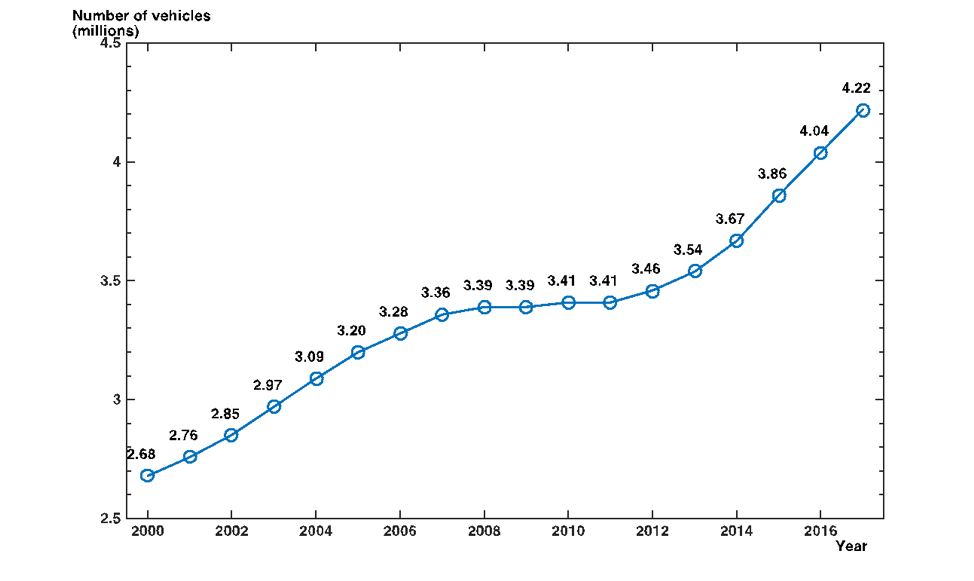
years we’ve been adding 183,000 vehicles (almost all of them cars and small
commercials) to the fleet per year. Aucklanders can guess where most of them
have ended up.
Number of vehicles in New Zealand, 2000-2017. Source: NZTA. Credit: Environmental Health Indicators New Zealand. This represents one of the highest ownership rates in the world (compare our 4.22m vehicles to our 3.7m adults).
CO2 is invisible; the damage in
extracting, processing, and burning oil is often far away and invisible. But
cars are not invisible. They are very much in your face, every day for most of
us, especially in our cities that are now completely choked with cars. You
can’t turn on the TV for five minutes without seeing an ad for an SUV or sports
car. For most of us the car is our single greatest source of personal
greenhouse gas emissions.
Many
believe that electric vehicle technology (EV, including both full electrics and
plug-in hybrids) is superior to the internal combustion engine vehicle (ICEV).
It cuts local emissions significantly — by 90 percent today, and by more
tomorrow as we move to 100 percent renewable electricity.
Techno-optimists can point to Tesla,
to the trickle of EV models becoming a flood, to massive investments by old and
new car manufacturers. They see EVs becoming cheaper, with longer range and
complete charging networks. At this point EVs will be winning on all points and
the revolution assured. There may be a rapid ‘S-curve’ adoption like that of
the smartphone.
I
am not so sure.
First,
progress around the world has been extremely variable to date.
Here
are the market shares of EV sales, as a
percentage of total sales, in three leading markets, Norway, Iceland, and
Sweden, all three doubling every two years or less:
2013 2014 2015 2016 2017
Norway 6% 14% 23% 27% 34%
Iceland 0.9% 2.7% 2.9% 5.7% 13%
Sweden 0.7% 1.7% 2.6% 3.2% 4.7%
Market share of electric vehicle sales, as a percentage of total sales.
Now
for three very large markets that have been trying hard, the UK and Germany
(doubling every two years) and the US
(doubling every 5 years).
2013 2014 2015 2016 2017
UK 0.2% 0.6% 1.1% 1.5% 1.9%
Germany 0.2% 0.4% 0.8% 0.8% 1.6%
US 0.6% 0.7% 0.7% 0.9% 1.2%
Optimists
foresee a worldwide doubling of market share every two years, reaching 60
percent by 2030; after that, bans on the sale of ICEVs are more prevalent, and
the transition could largely be complete by 2040. Heavy transport follows close
behind and 60 percent of oil consumption could be gone by 2050.
But
consider one very sad story, Denmark, a country of 6m people and a renewable
energy leader in Europe, which has experienced mixed results with their EV
policies:
2013 2014 2015 2016 2017
Denmark 0.3% 0.9% 2.3% 0.6% 0.4%
Tax
on new vehicles, previously 180 percent, had been waived for EVs. From 2016 the
tax was reduced to 150 percent for ICEVs, while the EV tax was raised to 20
percent in 2016 and is being phased in to 150 percent by 2022. Despite the high
tax, Denmark still has some the highest per-capita car sales in Europe.
Another
perplexing example is the Netherlands, which also has sizeable (but fluctuating) incentives,
as well as the most extensive charging network in the world, but no clear
signal of accelerating adoption:
2013 2014 2015 2016 2017
Netherlands 5.6% 3.9% 9.6% 6.0% 2.2%
Second, the EV transition may need
more help to become a reality.
The
first six countries above all have complex and widespread incentive systems in place. Norway
provides an effective discount of about 1/3 of the up-front cost, with other
extensive ongoing incentives. The US provides a discount of up to US$10,000 and
a gas guzzler tax (in place since 1978) of up to US$7700. The UK has a petrol
excise tax of 58p/l (compare New Zealand’s 60c/l, the same in real terms as 50
years ago), an EV rebate of up to £8000, and no road tax for EVs—but up to
£1120 + £515/year for gas guzzlers. Controversially, the UK road tax system was
changed in April 2017, so far without
ill effect on EV sales.
Third, getting the transition
underway may require a change in attitudes.
Robert
Llewellyn, host of the popular web series ‘Fully Charged’, remarked in his testimony to a parliamentary committee
on EVs that he does not see the famous ‘S-curve’ transition as being in the bag
by any means. People have a complex emotional relationship to their cars. They
may stick to their favourite kind of car (or an emerging new one, like the huge
SUV) beyond any obvious reason. I find it striking that in the EV world, most
people want to talk up the amazing advantages of EVs; yet few want to dwell on
the evil of ICEVs.
I like to imagine public health information posted at petrol stations such as
these:[1]
This
vehicle emits gases known to be damaging to the long term stability of the
climate and estimated to cause trillions of dollars in damages.
The
exhaust gases of this fuel remain in the air and oceans for thousands of years,
raising sea levels and acidifying the oceans.
The
product you are dispensing is directly responsi[2]ble for major wars and terrorist
attacks.
It
may seem far fetched, but the public seems to
accept analogous warnings on
cigarettes. Why not on fossil fuel burning cars?
Some
activists, such as Naomi
Klein, would say that driving a petrol car is wrong.
Arnold Schwarzenegger, who is suing oil companies for first-degree
murder, would say that the manufacturers, importers, and sellers of cars, the
producers and refiners and sellers and burners of oil, are in fact a public
nuisance. And clearly, the Volkswagen emissions scandal ‘Dieselgate’, the ExxonMobil climate change
denial controversy ‘ExxonKnew’,[3]
and some mining operations are wrong. But most of us are both actors and
victims, caught in a difficult situation. Some car companies are clearly stalling, others are deliberating
restricting the supply of ‘compliance vehicles’, but all of them
need the income from selling ICEVs to fund the development of EVs, and they’re
the ones with money and expertise. Just to pick one local example from many,
Toyota NZ—a leader in the Sustainable Business Council and in greening their
own operations—feels compelled to fill their ‘Sustainability’ page with subtle digs
at all-electric vehicles, because Toyota doesn’t have one.
It’s
a tautology that ceasing investment in ICEVs means not actually buying them
anymore. Incentives, charges, advertising campaigns, are just mechanisms. Are
people really ready for that to happen? In general terms, New Zealanders say
they want the government to act on climate change but have we made the
connection to our own behaviour and the
current freedom to pollute? We’re talking about changes coming that will make
the extra 10c/l in the pipeline for Auckland look like spare change.
Fourth, time is running out, both
for the planet and for our goals.
A
Zero Carbon 2050 Act is coming this year. That’s 32 years. Planting trees will
buy us some time, but let’s regard them as offsetting agricultural emissions.
CO2
should see steeper reductions than methane, and many industries will need
ongoing protection while acceptable
reduction plans are set in place globally. (There’s no point closing one
of the world’s cleanest smelters, Tiwai Point, when China is building coal-fired
smelters flat out.) Some sectors, such as aviation, have no low-emission
options yet. What’s left? Private cars! The alternative exists already; the
emissions savings are large; there is no local car industry to protect or
cajole; while cars have some productive value, they are by and large consumer
items; the NZ$8.4b a year we spend importing
vehicles is a valuable existing source of finance that can fund the low-emission
transition; the NZ$5b a year we spend importing fuel
is a pointless ongoing drain on the current account. As the transition gets underway,
the fuel savings will grow rapidly.
The
actions required for the scale and speed of the transition could be large. One proposal currently gaining
attention is a feebate, developed in depth by Barry Barton and Peter Schūtte in
a November 2015 report. A feebate is charged on every
newly imported vehicle that is directly related to its emissions. In the simplest
model, the feebate varies in direct proportion to emissions and adjusted so
that the entire scheme is revenue neutral. Let’s consider an example. (The
actual dollar amounts can be scaled up or down depending on what is needed.)
Buyers of a gas guzzler like the biggest 240g/km Toyota Hilux or Mercedes might
pay an extra NZ$4000 up front. Buyers of smaller cars like the 140g/km Honda
Civic or the 110g/km Toyota Yaris might
get rebates of NZ$2000-3500, while 17g/km EVs get a rebate of NZ$9,000. The
amounts would change over time as the fleet gets cleaner. The difficult
question, not answered here, is the overall scale of the scheme. With these
numbers — broadly similar to what other countries are already doing — NZ$300m
is changing hands per year. Not a small sum, but not as big as the NZ$13b spent
last year on vehicles and fuel. At some point, the scale of the scheme has to
be pegged to the market response.
The
Barton-Schūtte proposal achieves emissions reductions in one area — cars. That
goes against decades of official thinking in New Zealand, which is that a
single price for carbon may decarbonize the economy at least cost. This kind of
thinking has to go. Not only is it not necessarily true, it flies in the face
of the reality that (a) our emissions are rising, not falling, and (b) we don’t
have a fixed price for carbon anyway; there are all sorts of exemptions and
allowances in place. Andy Reisinger, of the NZ Agricultural Greenhouse Gas
Research Centre, wrote in submission to the Productivity
Commission that:
“I
disagree … that direct regulation doesn’t achieve emission reductions at
overall least cost to the economy. That statement would only be true if there
were no market failures, no information limitations or asymmetries, and no
preferences in specific interest groups that go beyond economics… It is also
important to consider whether least-cost is the dominant criterion for policy
choices, or whether risk, equity, social inclusion etc. are not equally or more
important”.
Even
the Australian government, so far no EV hero, is now considering direct regulations that would cut
emissions of new cars 45 percent by 2025.
So 2018 really is shaping up to be
a big year. As the groundwork takes place for the Zero Carbon Act and the
Climate Commission, there will be plenty of opportunities to talk about cars.
This article first appeared on 9 April 2018 at pureadvantage.org. Postscript: We now know that New Zealand did not get a Zero Carbon Act in 2018. Maybe in 2019?