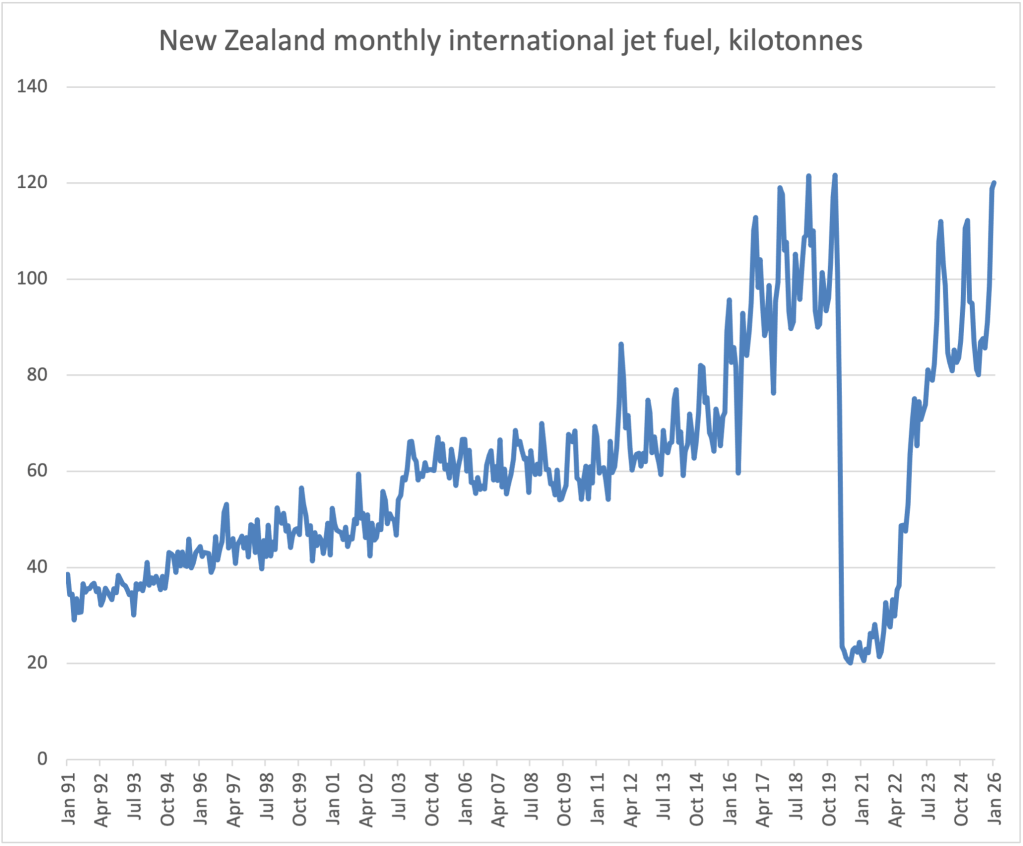
Just a few weeks ago New Zealand’s aviation and tourism sectors were riding high. Summer flights were up 7% on the previous year, and returned to their pre-Covid levels for the first time.
Dec/Jan jet fuel up 7% in a year, up 57% since 2013/14. Source: MBIE Energy Quarterly
All last year there were stories like “Christchurch Airport is entering a period of strong growth, with new and expanded air routes set to deliver a significant boost to Canterbury’s tourism, freight and export sectors” (The Press, June 2025). As late as 3 February this year, the CEO of Tourism Industry Aotearoa was saying “International arrivals are edging upwards, confidence has lifted across the sector, and operators are reporting strong bookings.”
On 3 March, three days after the war began, Tourism Minister Louise Upston said, “The Government welcomes data out today showing New Zealand’s tourism sector continues to go from strength to strength, driving billions into the economy.”
New Zealand wasn’t alone. Willie Walsh, director of the global airline body IATA, said in January, “2025 saw demand for air travel grow by 5.3% with international demand growing by 7.1% and domestic by 2.4%. This returns industry growth to align with historical growth patterns after the robust post-COVID rebound.”
The only dark clouds were the need for decarbonisation (“Governments whose economies grow because of aviation and whose citizens thirst for connectivity need to provide the supportive fiscal policy framework to rapidly accelerate progress”) and supply chain issues (“People clearly wanted to travel more, but airlines were continually disappointed with unreliable delivery schedules for new aircraft and engines, maintenance capacity constraints, and resultant cost increases.”)
IATA forecast essentially permanent growth of 4.2% per year. This far exceeds any ability of the industry to reduce emissions and is a recipe for continually increasing damage.
Source: MBIE Energy Quarterly, Stats NZ
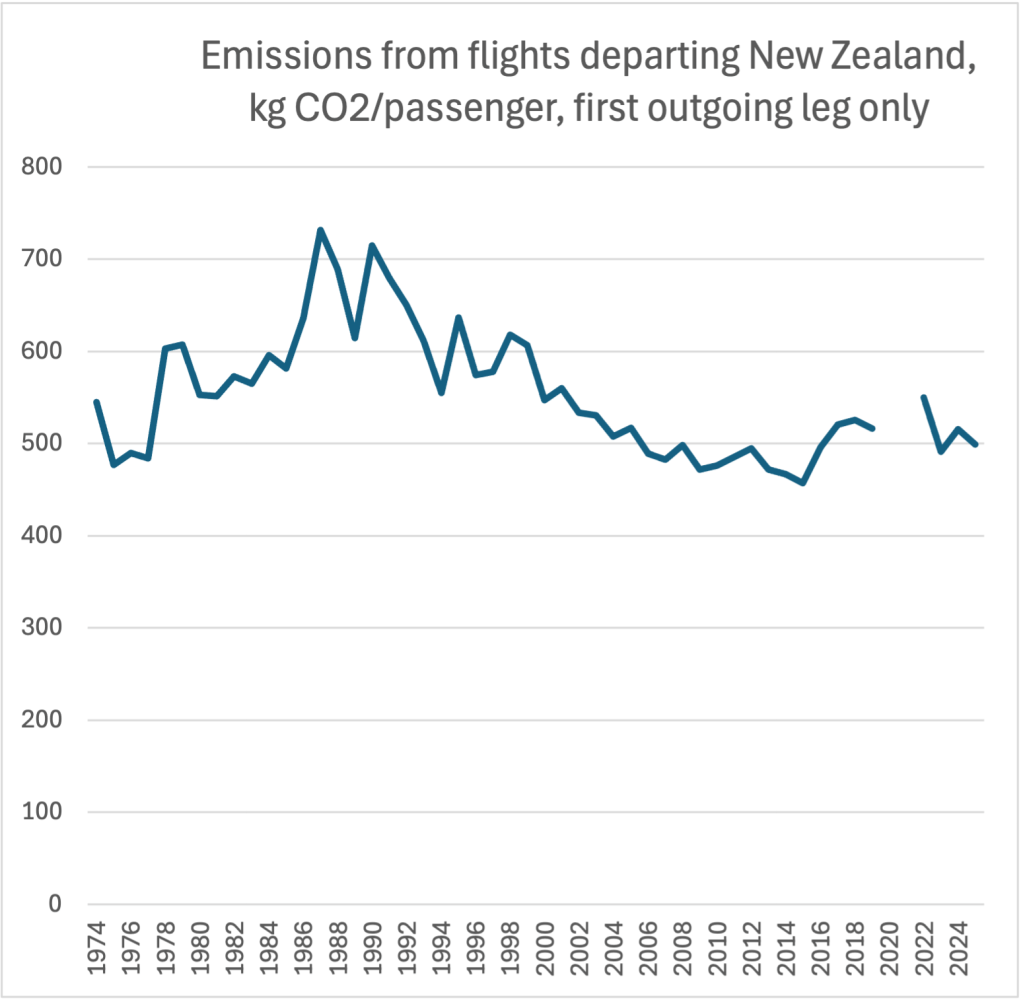
Setting aside decarbonisation – each flight departing New Zealand uses 200 litres of jet fuel per passenger, emitting 500 kg of CO2, a number that has not budged in 20 years – how is that desire to travel more holding up?
Pretty well, it seems. Just yesterday (1 April – but apparently they weren’t joking), RNZ reported:
Despite the conflict and dire news about air travel price surges due to fuel costs, New Zealand consumers are still booking long-haul flights to places like Europe, says Julie White, chief executive of the Travel Agents’ Association of New Zealand.
Swapping the warmth of the northern hemisphere in July for a Queenstown skiing holiday is of little interest to some travel consumers at the moment, White says.
New Zealanders, in general, might have a bit of domestic travel fatigue due to the restrictions during Covid. Many since the Covid years have made travel an essential item in their budget rather than a discretionary one, says White.
“We’re still experiencing strong demand. Kiwis are really wanting to travel, and they are really hoping this is going to be over soon, so they are still booking travel.”
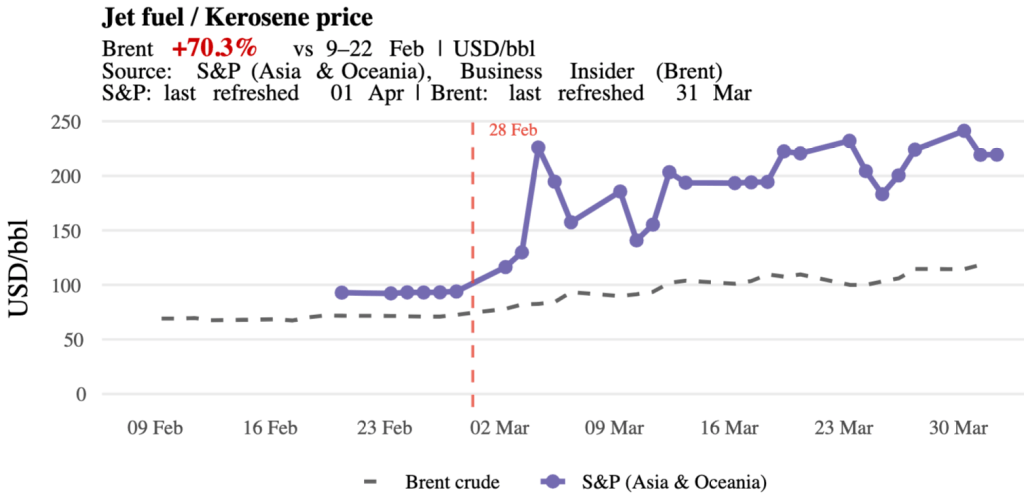
This is delusional and irresponsible. The Ministry of Transport’s own dashboard shows that the price of jet fuel has already more than doubled, which would add at least 30% to future ticket prices even before flight cancellations kick in.
Travelers could very easily find themselves stranded overseas with cancelled flights and no insurance. The BBC and Financial Times are reporting that the UK’s final shipment of jet fuel from the Middle East is arriving this week, with no more booked or on the water. Tourism professor Susanne Becken from Griffiths University wrote
Tourism’s dependence on (affordable and available) jet fuel has long been a known issue; yet the sector choses to ignore this massive challenge. All the discussions around decarbonisation aviation are much more than climate action, they are an insurance for the very future of this industry.
During the Covid pandemic I made the suggestion that countries should look into ‘minimum viable networks’ to find out what level of aviation is considered essential as opposed to discretionary. This would be very sensible risk management, and would – by default – include crises such as global pandemics (i.e. how much lack of connectivity can a country afford), climate change (managing the long-term risk of climate collapse), or fuel constraints.
Although all countries will be affected, New Zealand is more exposed than many, given our remote location, habituated frequent flying, and large tourist industry. (Pacific Islands are even more at risk.) International travel shut down once before, only six years ago. It looks like we are in for a re-run.
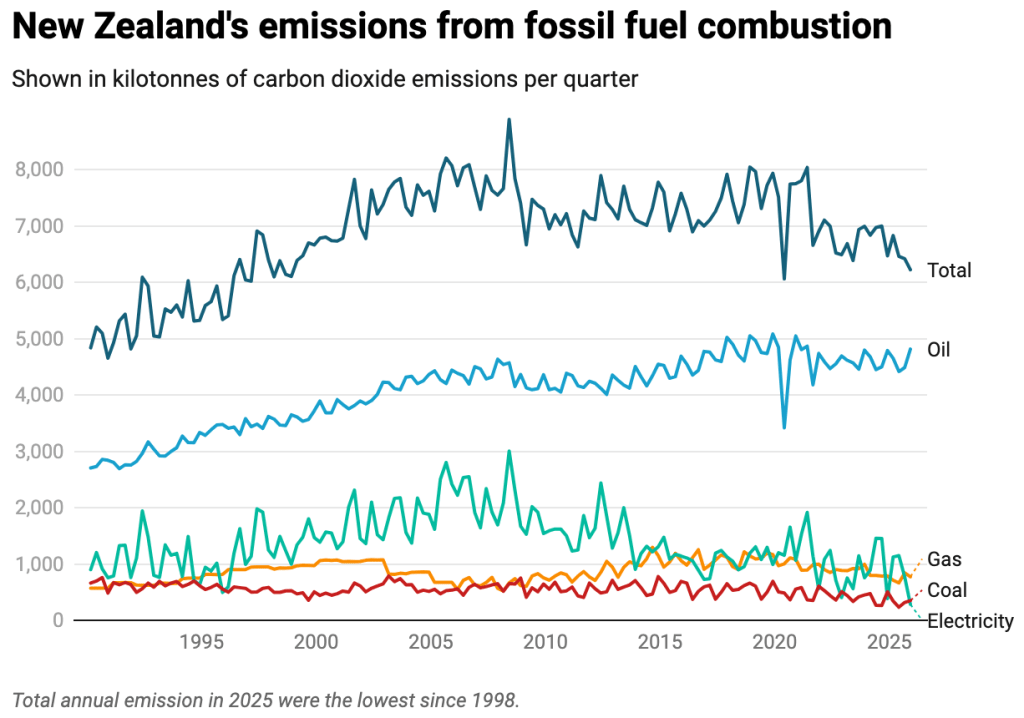
New Zealand’s latest quarterly energy report shows electricity production was above 90% renewable and emissions from generation fell to the lowest level on record.
But it also shows New Zealand’s oil consumption, which had fallen markedly after the COVID pandemic, has crept back up to reach its highest quarterly level in five years.
Oil now comprises its highest quarterly share of New Zealand’s overall energy emissions on record.
Of the total carbon emissions from the burning of fossil fuels, 77% were from oil (mostly used for transport), 12% from industrial and domestic gas usage, 6% from coal, and just 5% from electricity generation.
Source: MBIE Energy Quarterly
Developing a coordinatedenergy strategy to reduce oil dependence would not only provide an effective climate response, but also protect New Zealand from recurring oil price and supply shocks.
The previous government had committed to a comprehensive strategy to transition to a renewable energy system in New Zealand’s first emissions reduction plan in 2022.
During two previous periods of high oil prices, New Zealand missed the chance to weaken the country’s dependence on oil.
The 1978 oil shock was a severe hit to the economy; New Zealand’s oil consumption did not recover to its previous level until 1990.
The soaring oil prices hit New Zealand at a time of extensive government control of the economy under the National government of Robert Muldoon, whose “Think Big” strategy included building an experimental plant to produce petrol from natural gas.
This was intended to build energy independence, but unfortunately it proved to be costly and ineffective.
The 2008 financial crisis also involved extreme oil price spikes and a prolonged recession. Oil consumption did not recover until 2015. One planned response was to introduce fuel economy standards for new cars – a form of regulation already in place in most OECD countries.
Had these standards been put in place and gradually strengthened over time, New Zealand would now be in a much better place, with less pollution and less economic dependence on oil.
However, a change in government in late 2008 led to the cancellation of the planned standards. New Zealand now uses nearly twice as much transport oil per capita as the UK, where such standards have been in place since 2001.
New law changed NZ’s trajectory
The Climate Change Response (Zero Carbon) Amendment Act of 2019 was a turning point. Before that, total fossil fuel emissions were flat or trending up. Afterwards, a wave of investments in renewable electricity, in the decarbonisation of industry and in low-emission transport turned the trend around.
This was perhaps not just due to the specifics of the act, which includes five-yearly carbon budgets, but to strong pro-climate signalling from the government of the day.
Under the current government, both messaging and policy have changed. As Climate Change Minister Simon Watts has repeatedly stressed, New Zealand’s main climate tool is now the emissions trading scheme (ETS). However, this now covers only 35% of net emissions and is not an effective way to reduce oil use.
At the current price of NZ$40 per tonne of carbon dioxide emissions, the ETS adds only nine cents per litre to the price of petrol. Given New Zealand’s high car dependency, this has virtually no effect on existing drivers or on car buyers.
How to cut oil use in transport
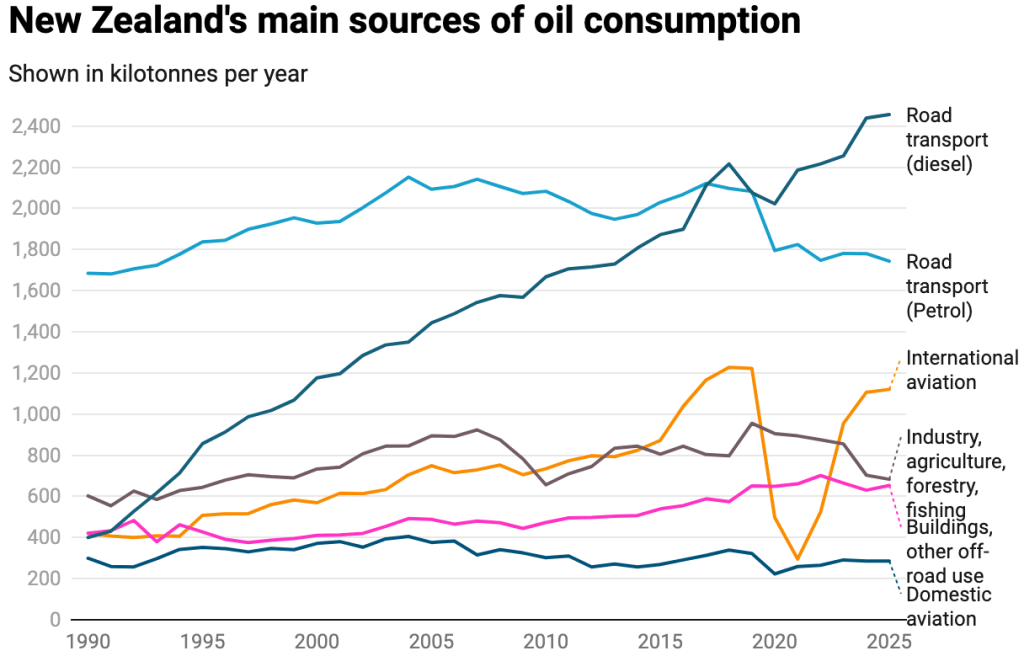
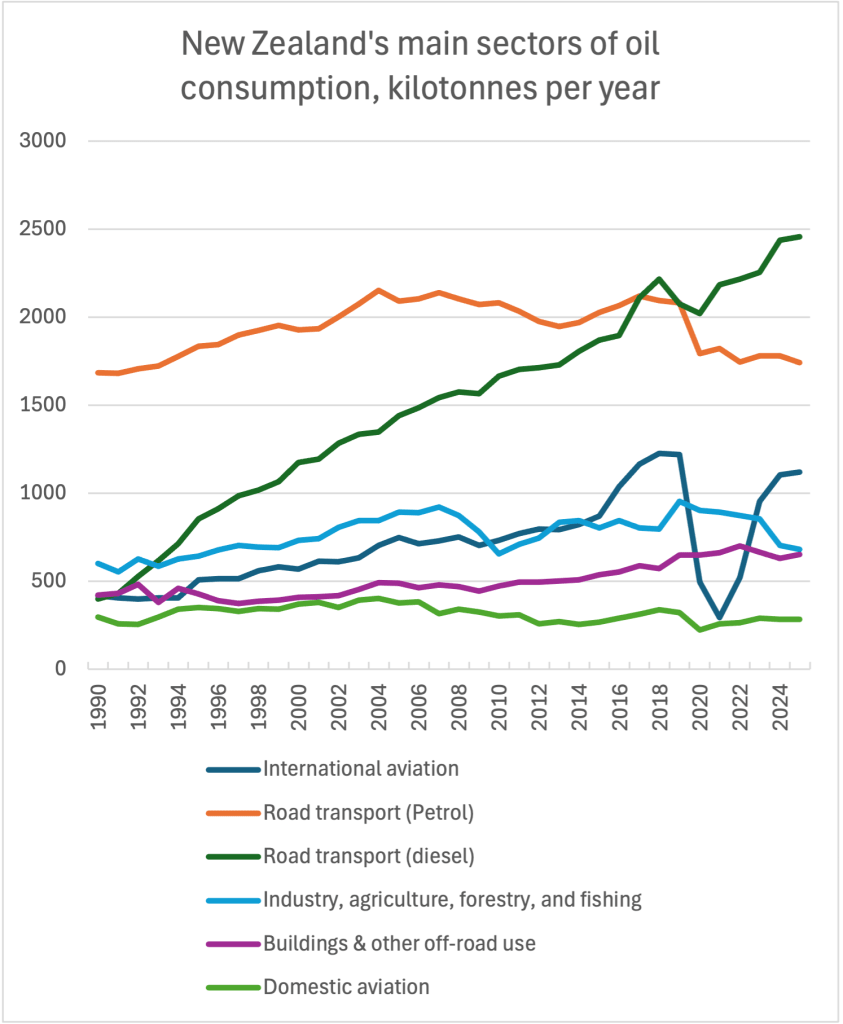
In New Zealand, 80% of oil goes into air and land transport. An oil transition plan really means a transport plan.
Source: MBIE Energy Quarterly
There is a known way to turn off the tap on oil. The “avoid, shift, improve” framework is supported by three decades of experience.
Changing work patterns such as shorter work weeks and working-from-home arrangements can help avoid unnecessary travel. Better infrastructure for walking and cycling and public transport helps to shift transport and dramatically reduce oil use.
The remaining private vehicle travel can be improved through electrification. This requires a combination of incentives and stronger emissions standards, as the International Energy Agency reinforced this week.
At present, New Zealand is still moving in the wrong direction. Over the past decade, the total distance driven by light vehicles increased by 20%, while the distance driven by utility vehicles is up 55%.
Each utility vehicle has 50% higher carbon emissions than a (fossil-fueled) passenger car. These trends have outweighed the improvements from the rise of hybrid and electric vehicles.
There is a limit to how quickly New Zealand’s fleet can realistically be electrified. For a country with the world’s highest rate of car ownership, mass purchasing of new cars is not a good transport solution by itself.
But in any event, phasing out fossil fuels is required for a safe future and should happen in ways that build energy resilience and independence.
Yes, we should have weaned off oil long ago. The oil shocks of the 1970s would have been a good time to start. Failing that, the 2007 oil price spike that was one of the triggers of the Global Financial Crisis. Never mind. The third best time to start is now.
New Zealand’s oil consumption for road transport has nearly doubled since 1990. Preliminary data from MBIE suggests another 4% rise between 2023 and 2025.
Industry is doing it tough.
What are the drivers of this increase? More cars, obviously, but also more people, with each person driving further.
Here’s the breakdown over the past decade:
Impact on road transport CO2 emissions from change in…
Change between 2013 & 2023
Population:
+16.1%
Fuel economy of fossil-fueled car fleet:
–15.6%
Distance driven in light vehicles, per person:
+4.5%
Fleet shift from cars to utes:
+4.5%
Proportion of electric driving
–1.7%
Total change in CO2 emissions
+4.2%
Utility vehicles emit 50% more than (non-hybrid) cars – 259 gCO2/km vs 175 gCO2/km – and the shift is at least partly cultural, with the twin-cab ute becoming a social norm. Utes now comprise 18% of the light vehicle fleet, do 23% of the kilometres, form 26% of sales, and emit 31% of light vehicle CO2. If that shift continues, as it appears to be doing, it forms a significant headwind to emissions reduction.
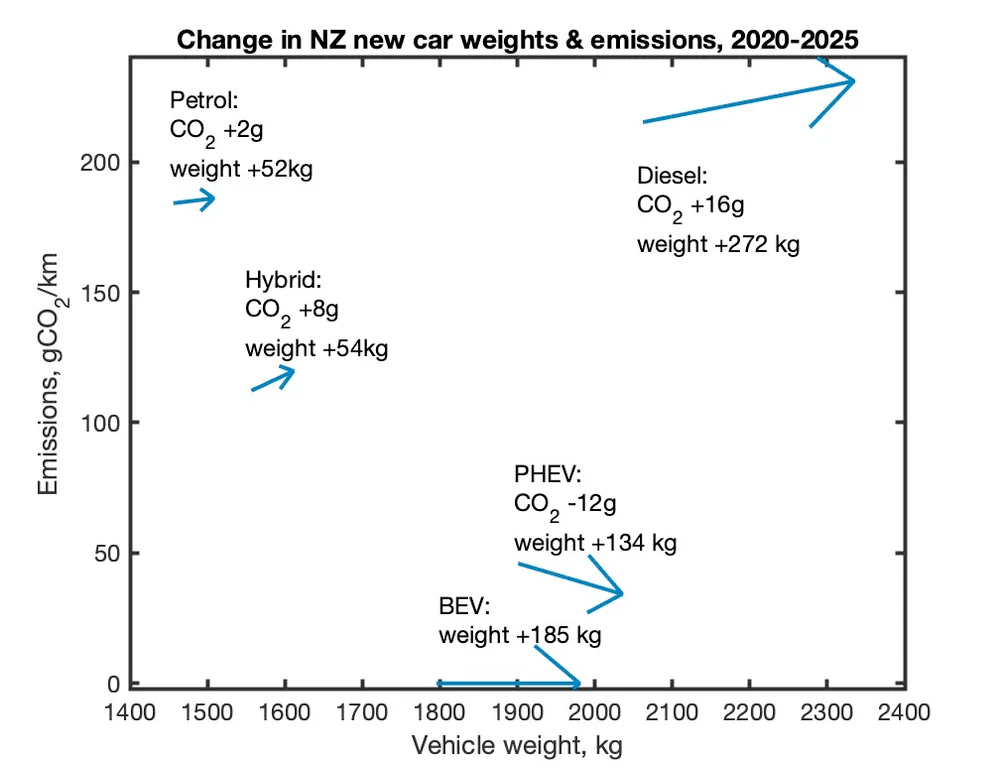
Lately, although the shift to hybrids is reducing emissions, fossil-fueled cars themselves are getting heavier and higher-emission.
What’s up with those diesel cars at 231 gCO2/km?! The average petrol hybrid at 121 gCO2/km does not even meet the 2026 fuel economy standard of 108 gCO2/km. Averaged over all sales, the target is being exceeded by 27 gCO2/km.
Overall, the picture is grim. On balance the country is no better prepared for an oil price or supply shock than we were in the 1970s – oil imports were 2.5% of GDP last year, compared to 1.8% in 1974. But in one respect, we do have an advantage. We know how we failed to seize the opportunity previously, and we know what will work this time.
New Zealand still has a choice, however. It already powers lights, hospitals and factories with renewable electricity. It could have powered a diverse transport system the same way, and it still can.
Every bus electrified, every cycleway built, every train funded is a direct reduction in exposure to the next crisis. The question now is whether New Zealanders begin to treat their car dependence not as a lifestyle choice but as a strategic liability.
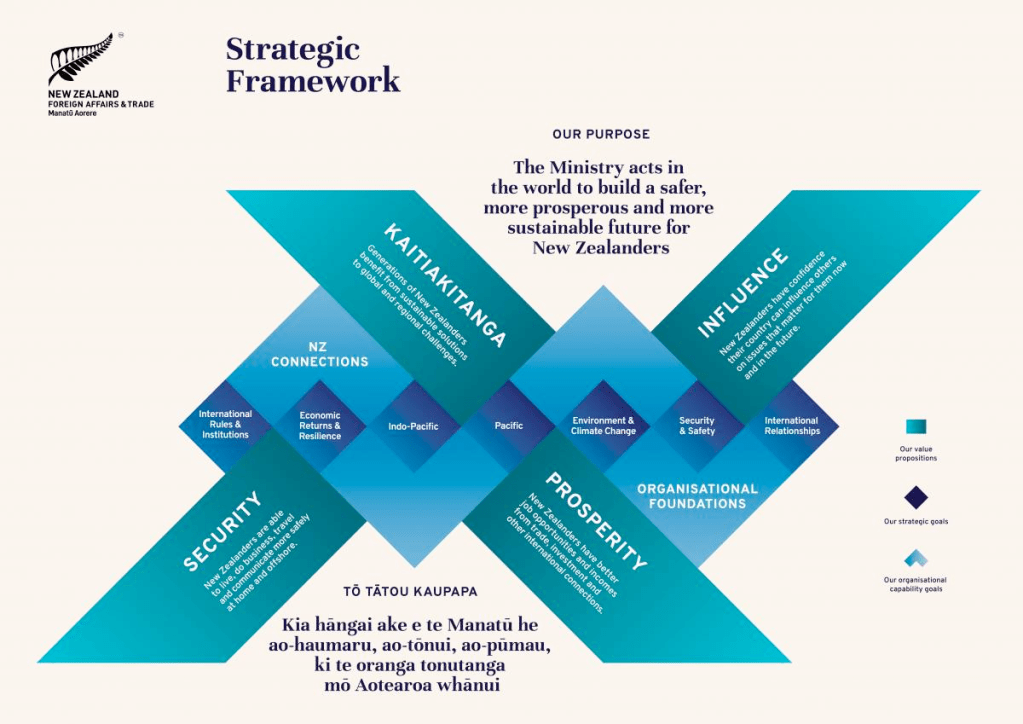
A graphic from the previous Assessment, conducted in 2023 under the previous government.
[The Ministry of Foreign Affairs and Trade is undertaking its triennial Strategic Foreign Policy Assessment. The Ministry writes: “The Assessment will examine the international context New Zealand will navigate in the decade to 2036, and what this means for us. The Assessment will consider the most important changes and drivers we see happening in the world, what they mean for New Zealand, what those changes mean for our relationships, and what they mean for our region — the Pacific and the Indo-Pacific.” Heidi O’Callahan’s submission is below. She would love to read other people’s submissions that tackle other (climate-exacerbated) topics, like overfishing, war, peacekeeping, humane treatment of refugees, terrorism, the scam economies and cyber security.
What are the big international issues you think New Zealand will have to navigate over the next 10 years, and what are the opportunities you think New Zealand can pursue?
The big international problems we must navigate are biodiversity loss and climate change, as well as the poverty, inequity, migration, societal breakdown and geopolitical instability exacerbated by these problems. To navigate these issues successfully requires accepting the root cause: an unsustainable economic paradigm of exploitation centred on the pursuit of economic growth.
Above all, our economy needs to operate within planetary limits; it must become more circular, socially-positive, and ecologically regenerative. Our best opportunities for international trade lie in low-carbon, high-value intellectual innovation. The current industries of bulk commodities (timber, milk products, meat, etc) and international tourism must be scaled back significantly. The scale of these industries cannot be justified on a climate basis, and their pollution and transport impacts are directly damaging to New Zealanders’ health, accessibility and freedoms.
What do you consider New Zealand’s foreign policy needs to do to protect and advance our interests in the world over the next 10 years?
Our government needs to act domestically to protect and advance our interests, if our foreign policy is to have a chance of helping us on the international front. We are currently witnessing the opposite; the government is introducing policy and legislation that is directly undermining our safety and wellbeing. This is happening across all spheres: Te Tiriti, transport, agriculture, education, health, climate, housing and social wellbeing are examples. In climate alone, the government has 1) unethically scrapped policies designed to reduce emissions, 2) reduced the climate targets on the basis of no evidence, 3) decided against bringing agriculture into the ETS and 4) indicated they will baulk at paying the bill for international credits to cover emissions that such a climate-ignorant set of actions creates (despite buying credits being the centrepiece of the National Party’s otherwise non-existent climate policy.)
MFAT cannot operate with any integrity on the international stage alongside such appalling government backsliding. So, while New Zealand’s foreign policy needs to support international climate regulations and rules that force wealthier countries like us to reduce emissions rapidly and pay for our past damage, it is hard for MFAT staff to be taken seriously when representing a hypocritical government.
Nor will MFAT succeed at advancing our economic interests or pursuing opportunities; the government’s climate denial will exclude us from markets and keep us out of key international decision-making.
It’s not just in climate we are becoming a laughing stock. The GPS on Transport attracted derision and ridicule from international experts. The UN Committee for the Elimination of Racial Discrimination highlighted how quickly New Zealand is going backwards under this racist government.
New Zealand’s foreign policy should advance real climate justice, climate action, the commitment to international agreements on improving transport safety, reducing racial, gender and age discrimination, the pursuit of improving the wellbeing of people in all countries (especially indigenous people, and the educational and health opportunities for girls and women), the promotion of sustainable practices and ecological regeneration, and above all, the dismantling of the economic paradigm that has led to the destruction of water, soil, air, natural and human resources.
But to pursue advancing these issues, diplomats should be able to draw on robust examples of domestic New Zealand practices, with truth and integrity. Currently, they cannot.
For you, your community, organisation or business: What matters most in the world beyond New Zealand? What places and international relationships matter most? What do you think are New Zealand’s greatest strengths and weaknesses in our international engagement?
We should pursue strong and respectful relationships with our Pacific neighbours. One important matter “in the world beyond New Zealand” is reducing hypermobility. The majority of people in the world have never set foot in an aeroplane. Yet a small minority continue to fly, with enormous climate impact, and we are all subsidising them to do so. Flying is one of the most inequitable and destructive activities humans can indulge in. Our foreign policy should seek international mechanisms and agreements to achieve substantial reductions in aviation. As a country with apparently much to lose (but also much to gain in other ways) from reducing international aviation, New Zealand is actually in a strong position to lead this international work, through demonstration of substantial systemic change. New Zealand needs to shrink our international tourism industry, and take steps to prevent our wealthy people from travelling so much. Our government must stop promoting New Zealand as a destination, stop allowing airport expansions, introduce taxes to prevent recreational and other avoidable flights, and support the transition to sustainable industries, including sustainable bike-, rail-, and coach-based domestic tourism.
The international relationships that matter most are in implementing and honouring the various UN conventions and agreements – on traffic safety, on climate, on wellbeing and health, etc. It seems, currently, that this government is rejecting the authority of the UN, willingly forgetting what atrocities led to the creation of the UN in the first place!
Currently, the most important international relationships my community has is with experts from other countries to help us try to make gains in evidence-based transport, agricultural, energy and climate policies for New Zealand. Currently, much community effort is being spent trying to undo or mitigate aggressive and regressive government actions that have no basis in evidence or accepted practices. It is very sad to see this waste of human toil and effort, which could be being used to build a better New Zealand.
Also important are the relationships with international experts on democracy. New Zealand’s poor democratic practices are stifling our progress. Deliberation and informed decision-making are the basis of good democracy. New Zealand will not thrive and we will not make the most of opportunities while most decisions are being made on the basis of misinformed opinions, corporate lobbying, misguided pursuits of economic growth, and populism.
New Zealand’s foreign policy should promote the international development of a body of knowledge about modern democracy. Such an international resource would be useful for all kinds of decision-making, and could help dispel the damaging myth that “one person one vote” is a sufficient basis for democracy.
New Zealand’s greatest strength in our international engagement is the goodwill built up over many decades by good diplomacy and leadership. While there has been a low bar for what a “good” country should do to improve the welfare of poorer countries and to pursue development goals, at least New Zealand often tried to be one of the more enlightened OECD countries. Internationally, the standard must improve. Unfortunately, New Zealand is not stepping up. The goodwill is evaporating rapidly.
Our biggest weakness in international relationships is the lack of integrity in our domestic policies.
Do you have any other thoughts on the international context you would like the team to consider?
How the climate changes depends on emissions right now and over the next few years. Net zero by 2050 is necessary but by then it will be largely irrelevant; the important point is the emissions trajectory to get there. Bureaucrats and leaders believe they face difficult decisions currently and rarely prioritise emissions reductions. Yet the different climate pathways will determine the options in front of future decision-makers, who will have fewer resources to be able to draw upon, will be functioning in more urgent circumstances, and are likely to be working within weaker institutions.
When this is fully understood, it is clear that decision-making is unlikely to get any easier! We must stick to ethical action that will help decision-makers in the future. We must invest to pursue rapid and significant emissions reductions, and rapidly transform our systems so they are low carbon. We must acknowledge that the true social cost of carbon is orders of magnitude higher than what our ETS scheme uses; much larger than what Europe is using. We must be responsible international neighbours, and ensure poor countries don’t have to make decisions between climate action and social or economic health.
None of this can be delayed while climate deniers have their turn at power plays in politics. Quality foreign policy, in the absence of quality domestic policy, is akin to “polishing a turd”.
The Nelson and Tasman communities have invested $32 million in a new airport terminal. It’s very smart, and made of wood, but it’s designed to increase fossil fuel emissions.
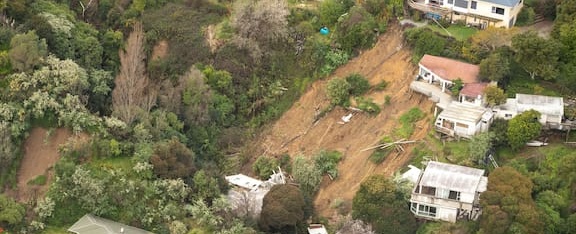
At the same time, Nelson has suffered repeated devastation from extreme storms, at a time when the city is looking to reduce emissions. The community’s critical asset – the airport – can be a helpful part of the city’s climate action plans.
Aviation is booming, especially in the Asia–Pacific region. Air travel has reached record numbers both domestically and internationally, with further strong growth forecast over coming decades.
Despite the financial headwinds faced by New Zealand’s regional airlines, operators say that “passenger numbers on regional airlines have never been better”. “Passenger numbers are through the roof”, says Sounds Air boss Andrew Crawford in a Newsroom article. Once again flights in and out of New Zealand are increasing, helped by the New Zealand government promoting international tourism as a key driver of economic growth.
To support the growth, international airlines are expanding capacity.
Airports across New Zealand have also set in place expansion plans. An example is Nelson. The airport wants to see passenger numbers double from 900,000 to 1.8 million a year by 2050.
Despite unambiguous evidence of the devastating impacts of human-induced climate change, commitments to decarbonise aviation are stalling both here and overseas. The result is that aviation emissions continue to increase at a time when other sectors are working hard to reduce theirs. In just-published research, Daniel Scott and Stefan Gössling examine the UN World Tourism Organization’s climate declarations and conclude that there has been limited to no progress on 25 climate action pledges. They also evaluate commitments by the World Travel and Tourism Council, IATA, International Civil Aviation Organization, and individual airlines, finding that none of their self-set targets has been met.
So how can aviation contribute to tackling climate change when no practicable technology-based solutions are on the horizon?
This problem of aviation emissions is playing out in Nelson, one of New Zealand’s premier tourist destinations. While it is known for its sunny days, in recent years it has also suffered from damaging storms that are predicted to become more frequent and intense with climate change. The August 2022 storm event caused more than $80m of damage in the region, and a downpour in recent weeks led to flooding in downtown Nelson. Recognising the need to reduce emissions, Nelson City Council will soon meet to approve its climate change strategy, aiming to reduce gross emissions by at least 6.8% each and every year, in line with the government’s target.
That will require significant new investment. Who should pay for it? Should it be the community as a whole, or should those who are causing the problem contribute more? If Nelson airport proposes to double passenger numbers without any realistic plan to reduce emissions, is there a way of adopting the “polluter pays” principle and using revenue from flying to help decarbonise other parts of the local economy?
There is a way. The airport is jointly owned by Nelson City Council and neighbouring Tasman District Council. It recently invested $32m in a new terminal (catering for future growth, which means growth in pollution), with further expansion on the drawing board. A “polluter pays” levy of $20 per departing passenger – about 10% of the average ticket price – would raise $9m per year towards climate action by the two councils. Potential uses of such a levy include funding active and public transport, helping businesses to reduce emissions via electrification, supporting community solar power, and funding adaptation infrastructure. Much greater price increases by Air New Zealand in recent years, of between 30% and 300% depending on the route, have had no impact on passenger numbers, indicating an ability and a willingness to pay. While most New Zealanders need to fly sometimes, most flying is done by a small number of frequent flyers. Globally, 1% of the world’s population, the wealthiest frequent flyers, are responsible for 50% of aviation emissions. Therefore, a “polluter pays” levy acts as a progressive, pro-climate tax.
It is true that New Zealand also has the Emissions Trading Scheme. Passengers contribute about $3 per domestic flight via the ETS. Unfortunately, this does little to nothing towards reducing emissions. At present the money either goes to the government (which has cancelled most direct climate spending) or towards the mass planting of pine trees, which is commonly criticised as being an ineffective strategy with negative effects on biodiversity.
Airports and airlines themselves should welcome such a levy, which could be introduced nationwide. They could then point to the tangible community benefits of the levy and maintain their social licence to operate in an era when the aviation industry’s bold claims (“Net zero by 2050!”) amount to so much greenwashing.
It needs to be recognised that such a levy only buys the aviation industry a little time, and that the industry needs to either rapidly decarbonise or start reducing flights to meet climate targets. At present it is impossible to know if any of their plans for lower-emission flights will come about or have much of an impact on emissions. We hope they do. But hope alone is not enough; hope needs action, and the time for action is now.
Since 1978, diesel vehicles in New Zealand have paid road user charges (RUC) via a formula that depends on vehicle size and weight. Petrol vehicles currently pay a fuel tax instead of RUC. Electric vehicles (EVs) were granted an exemption from RUC in 2009 which expired on 1 April 2024. From that date, EV owners were required to pay RUC at the same rate as light diesel vehicles such as utes.
The government plans to shift all light vehicles onto RUC, possibly by 2027.
The current rate of fuel tax is 92 c/l. As one litre of petrol emits 2.31 kg of CO2 when burned, this is equivalent to a carbon charge of $398 per tonne of CO2. Petrol also incurs a carbon charge via the Emissions Trading Scheme (around $50/tCO2). Thus, removing fuel tax would reduce the carbon charge from $448 to $50 per tonne.
The effect would be that fuel costs of a small petrol hybrid would increase from 10c to 14c per kilometre, while that of a large car would fall from 25c to 23c. An EV would cost 11c per kilometre if charged at home on off-peak rates, or 23c per kilometre using public rapid chargers.
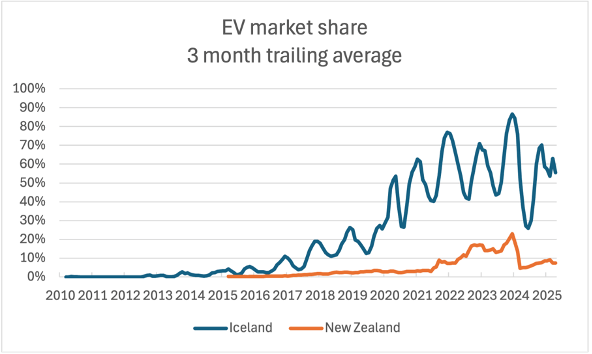
No country has tried this approach yet, although Iceland is planning to do so next year. Wisely, they will also double the carbon charge on petrol (from $100 to $200/tCO2) at the same time. They also retain other strong transport/climate policies. The purchase tax on a high-emitting car can be up to 65% of its value, and the government intends to ban the sale of fossil-fueled vehicles after 2030. In Iceland, 18% of the light vehicle fleet is already electric, compared to 3% in New Zealand.
Trucks are, of course, another large source of fossil fuel emissions that needs to be phased out. At present just 0.37% of the light commercial fleet is electric (mostly vans, not utes), while the figure for heavy vehicles is 0.46% (mostly buses, not trucks – although there are 194 electric heavy trucks in the country). Diesel trucks, utes, and vans are already exempt from fuel tax and pay RUC instead. Thus, they face a much lower effective carbon tax than cars, which could be a factor in their relatively slower improvement over time. (Diesel cars have actually been getting worse in recent years.)
However, they do get one big incentive – unlike cars, they are still exempt from RUC. The exemption ends on 1 January 2026. Perhaps this is a small change in the grand scheme of things. But it is one more change in the wrong direction, with an uncertain outcome – as far as I know, no analysis or investigation of any kind has been done on this. It is possible to design a scheme under which everyone contributes fairly according to their impact, and which still incentivizes change. At the start of this year, Denmark introduced RUC for trucks, under a formula which takes into account vehicle weight and CO2 emissions. (EV trucks get an 80% discount.) The effect has been phenomenal, with EV market share for trucks jumping straight up to 25%.
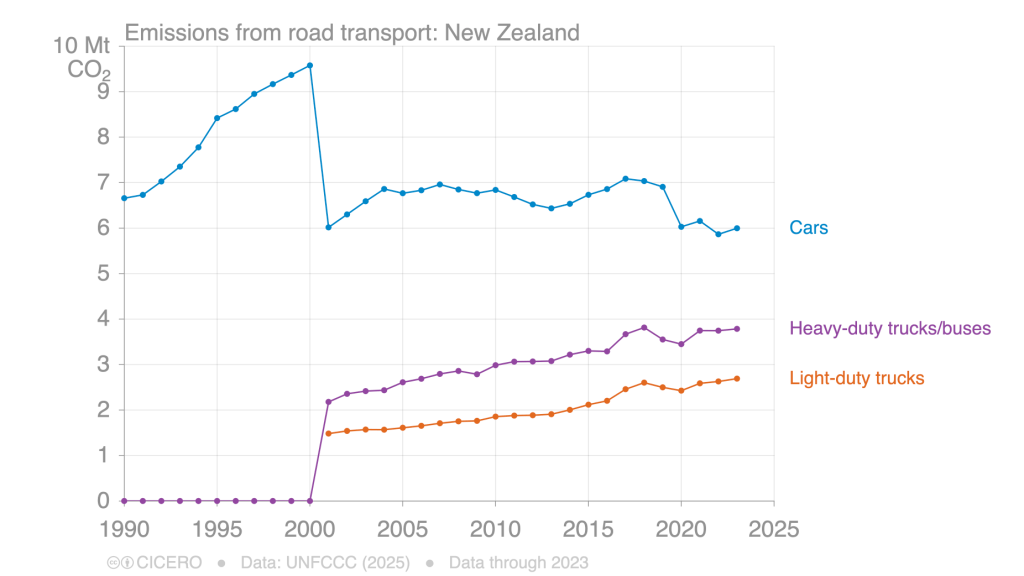
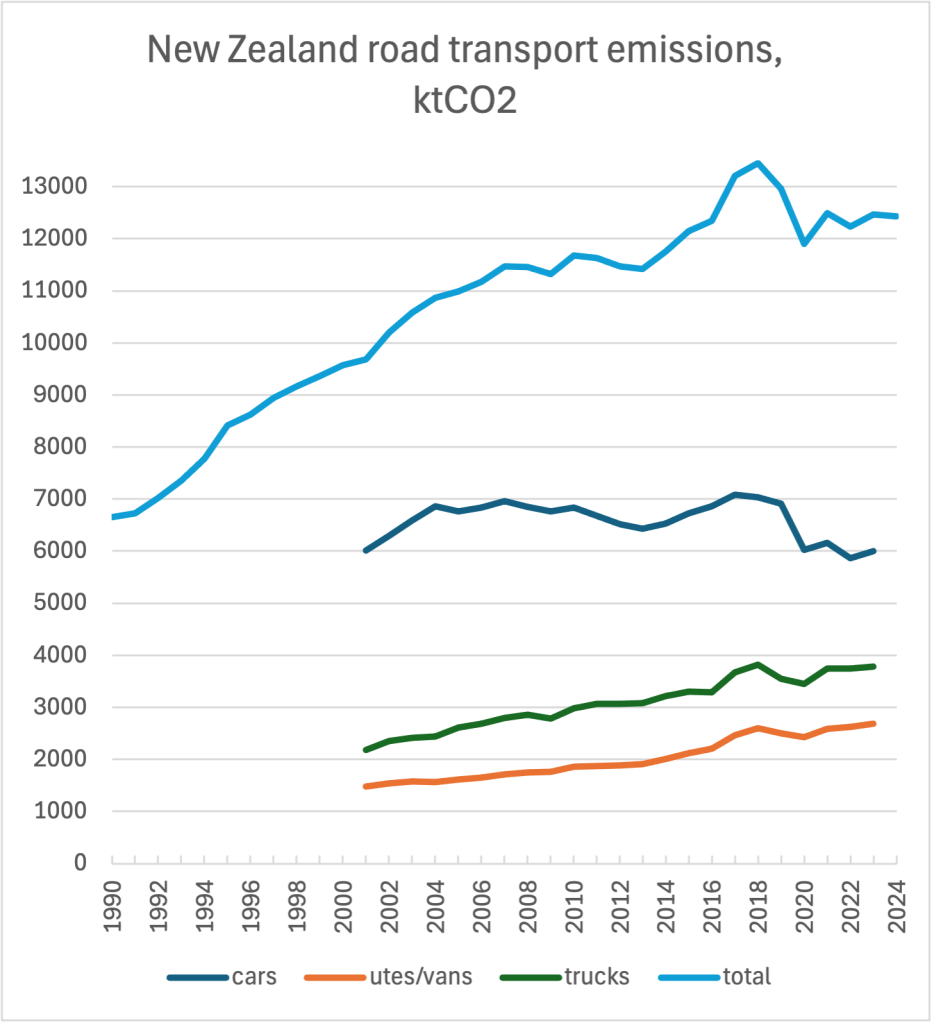
Emissions from cars are now back to 2001 levels, while trucks and utes are up 80% and still increasing. Prior to 2001 road transport emissions were not split by vehicle class. The decline in emissions from cars since 2018 is due more to behaviour change than cleaner vehicles – working from home, and less driving due to the recession.
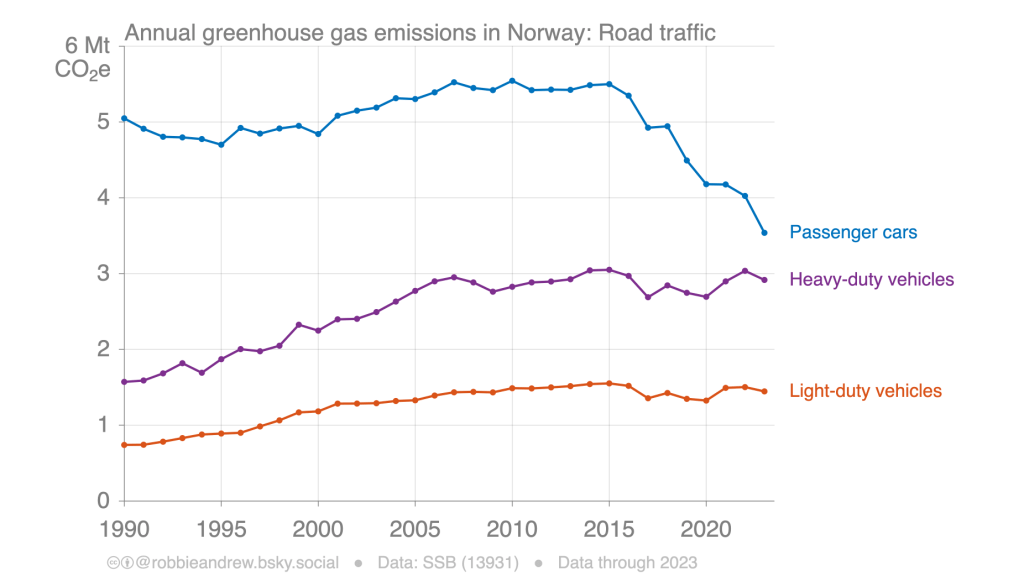
Norway is seeing sustained reductions in emissions from cars, now that virtually all new cars sold are electric. Norway’s emissions from trucks are 1/3 less than New Zealand’s, but have yet to see significant reductions.
Every three months the Ministry of Business, Innovation and Employment puts out a useful document called the Energy Quarterly. It provides up-to-the-minute data on fossil fuel emissions, well in advance of the more detailed submissions for the UN which currently only run up to 2022. It’s where I get the data for graphs like this one:
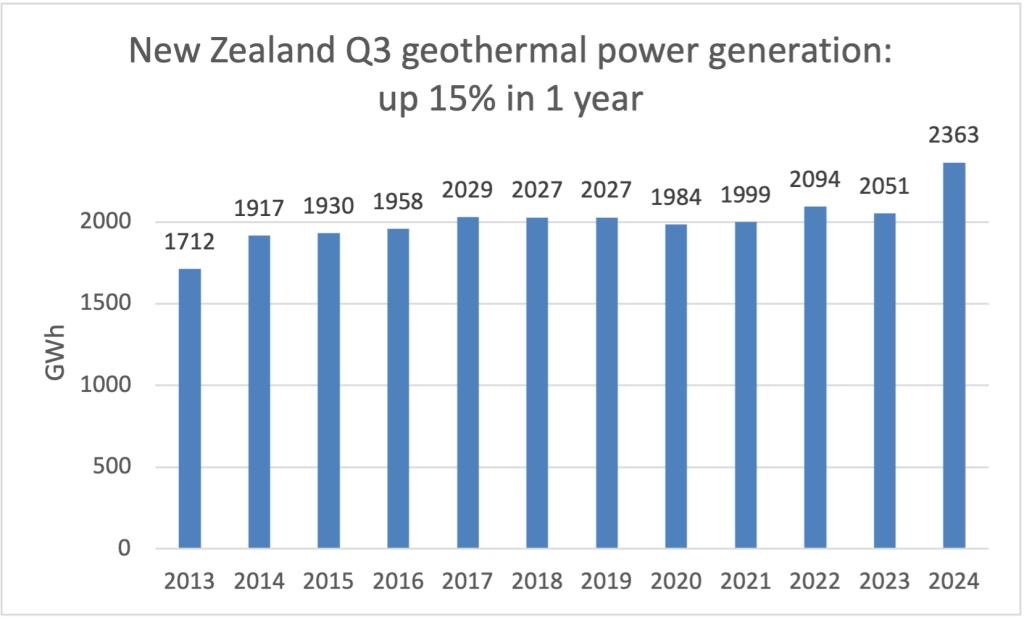
My point is to make regular reminders that addressing climate change means phasing out fossil fuels and that we are only just starting on that task. But the details are important and interesting, too, such as the recent upswing in electricity emissions due to the record-low lake inflows. This serves as a reminder that the ‘dry year’ problem isn’t yet solved, and that without the significant new wind and geothermal plants that were completed in 2023 and 2024 we really would have had an energy crisis.
The electricity generation data in the Quarterly also shows that a long static period in New Zealand’s power generation is coming to an end. The biggest trigger for investment was the passage of the Climate Change Response (Zero Carbon) Amendment Act in 2019; projects that started construction in the following years are now operating.
However, future growth depends on anticipated future demand from climate action – phasing out fossil fuels and ‘electrifying everything’. The energy and transport sections of the final Second Emissions Reduction Plan do nothing to promote electrification, placing this recent growth at risk.
But what about the big picture on energy?
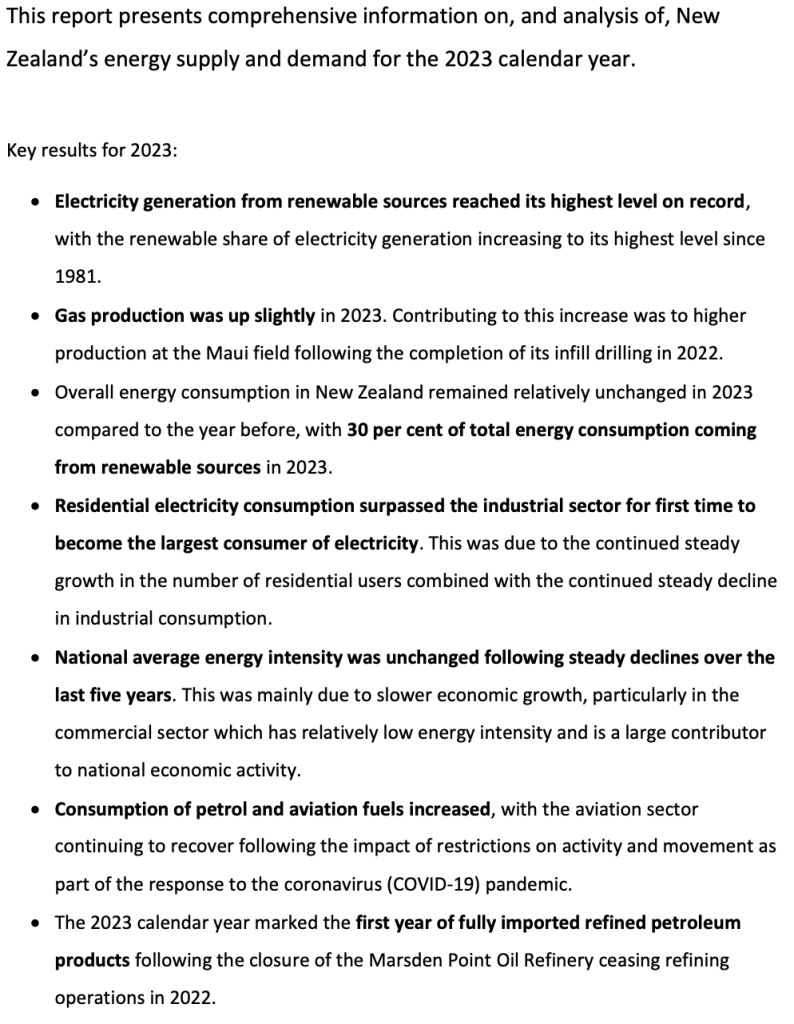
In addition to the Quarterly, MBIE produces an annual report, the latest being New Zealand Energy 2024. Here’s their summary:
The report includes many graphs, but not one showing what to me is the most striking development: total energy use has been falling for six years, and is now down nearly 10% from its peak in 2017.
Here ‘renewable’ energy is made up of hydropower (46%), geothermal (25%), biofuel (mostly wood – 23%), wind (6%), and solar (1%). Modern renewable electricity generation (wind, geothermal, and solar) was 41 PJ in 2023 or 6% of final energy demand. Here energy is what MBIE calls ‘final energy demand’, which includes the full energy content of fossil fuels and electricity but not the waste heat component of geothermal. The ‘substitution method’ used by Our World in Data (which upscales renewable energy to compensate for the thermal inefficiency of burning fossil fuels) is not used.
Coal, gas, oil, and even renewables are all down from their peaks. Looked at per capita, the effect is even more striking:
Energy use per person has been declining fairly steadily since 2001, and is now down 28% from peak. Is twenty-two years long enough to call it a trend?
There are probably many factors at play here that would be hard to untangle. At first sight the data doesn’t fit either of the convenient narratives on energy, ‘transition’, in which modern renewable energy gradually replaces fossil, or ‘more and more‘, in which new energy sources simply add to humanity’s rapacious demands.
Most likely a combination of factors – energy efficiency, deindustrialisation, and behaviour change – are at work. Initial indications are that all three of those effects were still in play in 2024, as energy-intensive industries shut down or scaled back. When we do get started on mass electrification and serious behaviour change, the energy decline will accelerate.
Between 1892 and 2012, Statistics New Zealand published an annual yearbook. As noticed by Matt Lowrie, the 1992 Yearbook included this sidebar which departed from the usual dry style of the previous hundred years:
Plus ça change. Thirty-two years later, New Zealand still has one of the highest rates of car ownership in the world, Paris is eliminating most of its on-street parking, and Sydney has just opened another light rail line. I wonder what caused this outburst from the normally staid statistics agency. Did the new Chief Statistician, Len Cook, want to shake things up a bit?
What particularly caught my eye was this bit:
In New Zealand the average car currently manages a mileage of 100 kilometres per 10 litres. To reach the Government’s target of a 20 percent reduction in greenhouse gas emissions by the year 2000, this would have to be cut to 100 kilometres per 3.5 litres.
Even under the generous interpretation that the target here refers to new cars only, we’re still nowhere near 3.5 l/100km; the last few years hover around 6-7 l/100km. Pretty startling when you consider that the popular Honda Civic (a kind of large hatchback or small station wagon) was already delivering 5.3 l/100km in 1985, and that twenty years after the introduction of the hybrid Toyota Prius in 2001, only 2% of the light vehicle fleet was hybrid.
But enough about cars. What about that Government target of a 20% reduction in greenhouse gas emissions by the year 2000? Where did that come from? Needless to say, we’re not there yet either. Gross emissions of long-lived gases, and net emissions of all gases, are both up 40% on 1990 levels. This year, despite the downturn, 210,000 fossil-fueled cars will be imported, which if parked up would fill the entire length of State Highway 1. (Sorry, I mentioned cars again.)
To answer this I want to go back to a fascinating document from 1990, “Responding to Climate Change: A Discussion of Options for New Zealand”.
This was the year of the first IPCC report as well as of New Zealand’s first reports on climate science, climate impacts, and policy options. It was the year that both Labour and National (who defeated the incumbent Labour party in the October 1990 general election) adopted emissions targets. The May 1990 Climate Options report led to Labour adopting a target of –20% on 1990 levels by 2005. The election was to be held on 27 October; with a major international climate meeting falling on 29 October, National announced their own, more ambitious target (–20% on 1990 levels by 2000) just two days before the election.
The 1990 Climate Options Report
The report is comprehensive and offers 93 different options for consideration. They are grouped under social and behavioural measures, planning measures, market measures, legislative and regulatory measures, energy, transport, commercial buildings and households, industry, energy efficiency, agriculture, and forestry. Pretty comprehensive, and all of the options are given a balanced hearing. Any or all of them would have been a good idea.
Transport, as such a large source of emissions, is given a particularly thorough going-over. Suggestions include mandatory tune-ups, fuel efficiency standards, rebates for scrapping old vehicles, lower speed limits, fuel efficiency standards, fuel efficiency labelling, business tax incentives and levies, CO2-linked registration fees, integrated transport planning (hah!), mode shift such as rail freight, responsible town planning, staff transport, optimisation of freight routing and loading, and alternative fuels – CNG, biogas, bioethanol, electricity, and hydrogen.
One of the transport options in the 1990 report. 45 mpg is equivalent to 6.3 l/100km, a level that has still not been reached in 2024.
What’s notable is that all of these ideas were either already in use or under active consideration in many countries. The US introduced fuel efficiency standards in 1975. Norway introduced EV incentives in 1990, after the pop group A-ha had toured the country in an EV (refusing to pay tolls) the previous year. (Thirty-six years later, a quarter of the cars in Norway are electric, which gives some idea of the time and determination required for a technology transition. Per-capita transport emissions in Norway did not begin falling until 2010, and have only now returned to 1990 levels. On its present course, Norway will have decarbonised road transport by 2050, a sixty year journey.)
Morten Harket (left) and Magne Furuholmen from A-ha with Prof Rostvik (second left) and Frederic Hauge with their converted electric Fiat. (source)
So what happened? Unfortunately, from a promising start, the front fell off New Zealand’s climate response almost immediately. As Kirsty Hamilton writes,
This was particularly disappointing because most of the ingredients for a world class national response were present in New Zealand at the end of the 1980s. However, by 1997 New Zealand had gone from being in a prime position to serve as a positive catalyst in the debate, to at best sitting on the fence on key issues, and at worst becoming an impediment to the formulation of an effective international response to climate change.
Consideration of transport emissions virtually fell off the radar for years or decades. Consider the fate of just two of the policy options, fuel efficiency standards and labelling. (I lied when I said “enough about cars”.) They did not progress during the 1990s, but when Labour returned to power in 1999, standards and labelling did eventually make it into a policy document, the New Zealand Transport Strategy 2002. Labelling came into effect in April 2008, but standards fell victim to the election later that year that brought National back to power. Without standards, labelling did next to nothing. Another attempt by Labour to introduce standards in 2018 was blocked by New Zealand First; it took a further electoral cycle before standards were finally came into effect in 2023, 33 years after they were first suggested. That same year National returned and immediately weakened the standards.
Emissions of newly registered light vehicles, 2014-2024, showing a reduction from 208 gCO2/km in 2014 (8.9 l/100km) to 156 gCO2/km in 2024 (6.7 l/100km). The Clean Car Discount (feebate) was in effect from July 2021 to December 2023. (Source)
New Zealand’s road transport emissions increased 82% from 1990 to 2022. The increase per capita is 18% (source).
It’s been a similar story of vacillation in almost every other sector. Some of the causes run wide and deep and span the entire problem of climate change itself. Rather than go through the whole history, I want to stick to the 1990 report and ask – did they miss anything? I mean, clearly the authors did not anticipate the strong, organised and persistent opposition that would be raised to virtually any suggestion on how to cut emissions. Perhaps they can hardly be blamed for that. Did they miss anything that could plausibly have been included, and if so, would it have made any difference?
I think they did. They did miss the significant impacts of population growth (57% from 1990 to 2023, faster than the world average) and economic growth (also 57% in real per capita terms, faster than the US). Efficiency gains would have to be really heroic to overcome both of those. Questioning them would have killed the report in any event. Also, the authors weren’t thinking in terms of phasing out fossil fuels entirely, but that need wasn’t widely recognised until fairly recently, and remains a stumbling block even today.
No, the big thing they missed was renewable energy. I could hardly believe it. I had to read the report twice to be sure. In a 100,000-word report (the length of a decent novel), this is all we get:
Surely the central importance of replacing fossil with renewable energy was well established by 1990? It’s even more surprising in view of New Zealand’s long-standing pride in its renewable resources (despite an unfortunate detour into gas in the 1970s). 1990 may have been a bit early for solar, but it was not too early for wind. Denmark was already generating 610 GWh a year from wind power in 1990 (similar to the Manapouri hydropower station), as was California, both having started in the 1970s. A New Zealand energy research group had published a report in 1987 outlining the feasibility of twelve 250 MW wind farms, triple what we have now in 2024. We built the first substantial geothermal power station in the world in 1958 and have never lost our world-leading expertise. Moreover, our second geothermal power station at Ohaaki (producing a sizeable 300 MWh a year) had only just opened the previous year.
I’m at a bit of a loss to explain this. Our experience in renewable energy since then has been one of repeated stops and starts, whereas the evidence from other countries is that large-scale transitions, whether in energy, transport, or otherwise, can take many decades and require sustained consistency of focus. Denmark has only largely decarbonised its electricity supply now, fifty years after their journey started.
Source: New Zealand Energy Quarterly, MBIE
I started out by calling this essay “What have we learned?”. Perhaps that was a bit ambitious. Is the lesson that comprehensive policy development and engagement is not enough? That we should have picked a smaller, more focused target and gone after it hard and fast, to bed in momentum and support? Or should we have been bolder to begin with? In the UK, the Royal Commission on Environmental Pollution (an independent agency in existence from 1970 to 2011) went really hard out in their 1994 report Transport and the Environment. They recommended doubling the price of petrol over the coming ten years, reducing total driving, and greatly curtailing road building. Even though none of that happened, their report is right on the facts, and perhaps it did set the scene for other measures which did eventually come about, and which have survived several changes of government.
Thirty-four years after our first climate report, we have at last turned the corner on emissions. In that sense we are on the way. But the harder step, of achieving a society-wide consensus on where we want to be and how to get there, still lies ahead.
Gillespie, A. (2001). New Zealand and the climate change debate: 1995–1998. In Climate Change in the South Pacific: Impacts and responses in Australia, New Zealand, and small island states (pp. 165-187). Dordrecht: Springer Netherlands.
Cherry, N. (1987). Wind energy resource survey of New Zealand: National resource assessment: summary and final report. New Zealand Energy Research and Development Committee, University of Auckland.
On 25 June, the Government amended the Clean Vehicles Act. This was completed in a single day under urgency, so there was no opportunity for public input. On 9 July, there was a press release saying that New Zealand would now be following Australian emission standards from 2025. On 11 July, the Ministry’s advice was released, giving us a few more details.
Vehicle emissions are reported in grams of CO2 per kilometre (gCO2/km). (For petrol vehicles, 200 gCO2/km is the same as 8.6 l/100km.) Here are the new targets:
Cars
Light commercials (vans & utes)
Previous target
New target
Previous NZ
New target
2023
145
218.3
2024
133.9
201.9
2025
112.6
112.6
155
223
2026
84.5
108
116.3
207
2027
63.3
103
87.2
175
2028
76
144
2029
65
131
The Minister talked to the Motor Industry Association (MIA), the Imported Motor Vehicle Industry Association (VIA), the Motor Trade Association (MTA) and the New Zealand Automobile Association (AA). We don’t have their reports, but, judging by what has been released, the Minister has accepted their reasoning at face value and rubber stamped their request. Neither Tesla nor Drive Electric (not members of the MIA) were consulted.
The Ministry report that their modelling of the emissions impact of this change has not been completed yet, but they do provide a rough estimate of an increase of emissions by 0.3–0.5 MtCO2 over 2024-2050. Another department, the Climate Impact of Policy Assessment, puts the increase at 1.2–1.9 MtCO2, but regards this as unreliable on the grounds that the previous targets were unlikely to be met – which is the car industry’s argument.
The car industry appears to take the position that they will do nothing whatsoever to respond to the targets, and just let the market take its course. Car importers would pay fines rather than try to meet the target. One key figure (which was also provided to Cabinet) is their estimate that this would add $5,500 to the price of every new light vehicle in 2027.
The fines are set at $45/gCO2, so the MIA are saying they’ll miss the targets by 122 gCO2 on average. The target for all light vehicles is 71 gCO2/km, so they’re saying they expect to sell vehicles averaging 193 gCO2/km in 2027, or nearly triple the target. That level (193 gCO2/km) is what we had already reached in 2021, before the introduction of the feebate and fuel efficiency standards. In 2022 the average was 167g; in 2023, 145g.
These industry and ministry figures look like nonsense, so let’s do a back-of-the-envelope calculation. Assuming no change in overall levels of sales, and that the targets are met, the annual extra emissions from vehicles sold in 2025 will be 46,000 tCO2; in 2026, 132,000 tCO2; in 2027, 120,000 tCO2. Over the 20 year life of the vehicles, the extra emissions from sales in these three years alone are 7.14 MtCO2.
That’s all assuming the targets are met. The industry says they won’t be. But one thing we did learn from the feebate experience is that both the industry and the car buying public are incredibly responsive to signals. Under the previous government, the signal was that it’s time to get serious about cutting emissions. The price signal (the rebate) was only part of that. EV sales vastly exceeded expectations, and the industry delivered. After the election, the signaling changed; the only electric ute on the market was withdrawn less than a week later.
Source: Ministry of Transport. The Clean Car Discount (feebate) was introduced progressively in July 2021 and April 2022, and cancelled in January 2024. Chart includes both new and newly imported used vehicles.
Second, missing the targets still achieves something. Fines are a deterrent and a signal to the industry. If they’re added to the price of higher-emitting vehicles, those sales will slow. Even for utes, that’s not the end of the world, it just means a slower replacement cycle until better vehicles are available. This will still prevent new, high-emission models entering the country and sticking around for decades.
There is one issue, though, which is that the fines, at $45/g, are low by international standards. They were set low because at that time, the intention was that the feebate would be doing most of the work and the Standards were mostly a backstop. In Australia, whose standards we are now adopting, the fines are $111/g, and in Europe, $170/g. (In Europe, where emissions in 2021 were already 40% below ours, not a single car company has had to pay fines for missing the targets.) Australia and Europe have extensive systems of incentives in place, which helps. New Zealand importers also have heaps of cheap credits available from overachieving in 2023 that (in another change) can now be used up until 2027.
When the Minister of Climate Change was asked about the impact on emissions, he said that “Clean car standards … have quite an insignificant impact in regards to overall emissions targets”. The relevant number to compare to here is not total emissions, but the required annual emissions cuts as we move into the late 2020s. Those are about 2 MtCO2 per year. In that context, the change due the weakening of fuel efficiency standards – 6% of so of the total effort required – is significant.
However, the Ministry has an answer there too:
In our view the proposed targets will not impact the ability for the first emissions budget (or subsequent ones) to be met. This is because transport emissions are covered by the ETS, therefore changing the Standard’s targets might change how or where emissions reductions occur from a gross perspective, but not from a net perspective.
This comes pretty close to the common argument that nothing the government or anyone else does has any impact on emissions; if I emit more, others will emit less so that the carbon budgets are met. But, they throw in an extra twist by bringing in the gross/net distinction: basically the argument is that more trees will be planted to cover the extra emissions. None of these arguments hold water, but even if we accept them at face value, actions that lead to higher emissions in one sector will definitely have an effect on those other sectors that will now have to make up the difference. For example, through a higher carbon price. However, it appears that this effect was not considered.
The new targets do get tighter over time, particularly in 2028 and 2029. If those are met, we could still be on track to end fossil-fueled vehicle sales by 2035, as in Europe. (The new UK government is reinstating a 2030 end date.) But there are two caveats. First, Australia has an election next year. The opposition could easily make emissions standards an issue, as they tried unsuccessfully to do in the last election (“Ute tax!”). A change of government could see the Australian standards weakened, as has happened here. Second, our own new standards will be reviewed again in 2026. On present performance, the MIA would only need a quiet word in the Minister’s ear to wind back the standards.
The purpose of a fuel efficiency standard is to radically change the make-up of the fleet as quickly as possible. There do have to be changes. But the whole tenor of the Ministry’s advice is that no one should have to change or pay any more, the overriding goal is that “vehicle affordability is maintained and the mix of vehicles imported meets the needs of New Zealanders.”
Reducing transport emissions is difficult, and it is something that many countries struggle with. But some countries are trying and are starting to see results.
Source: Our World in Data. Sweden has a target reaching of 0.6 tCO2/p in 2030.
Weakening fuel efficiency standards is the third of four parts of the Government’s “War on EVs“. Part 1 was ending the feebate; part 2 was the introduction of Road User Charges (RUC) for EVs, at a punishing rate. Iceland is the only other country in the world to try this, and there too sales have collapsed. Basically we are in uncharted waters. Part 3 is now done. Part 4 is still to happen: it’s the Government’s signaled intention to replace petrol tax with RUC for all vehicles. As petrol tax is currently equivalent to a carbon charge of $360/tCO2, this would amount to a hefty carbon tax cut and hence would also act to increase transport emissions. The extra cost of driving a hybrid (where sales are still holding up well) could be significant.
Fuel consumption l/100km
Current fuel/RUC cost cents/km
Fuel/RUC cost under an RUC-only system
0 (Battery electric)
12
12
4 (small hybrid)
10
14.5
6 (normal hybrid)
15
18
8 (normal car)
20
21.5
10 (large car)
25
25
12 (large ute)
30
28.5
Assumptions: Petrol $2.50/l, electricity 29c/kWh, RUC 7.6c/km
RenewEconomy is a well-established Australian website focusing on green energy. Last week, they published an article by Andrew Blakers based around the claim that “New solar capacity is being installed faster than anything else in history.”
This received some push-back online (“disinformation!”), on the grounds that
(i) this is only electricity, not total energy; and
(ii) nature doesn’t care how fast something is installed, only about emissions.
We were directed to look at this graph from Our World in Data:
It’s true that solar forms a minute part (2%) of the energy supply as yet, and that emissions of no single fossil fuel has peaked, not even coal.
But the topic at hand is change, and for that we have to look a bit closer.
The low-emission transition is based on two main things:
(i) decarbonising electricity; and
(ii) switching all other energy uses to electricity (“electrify everything”).
You could add more items, such as using less energy in the first place, but that wouldn’t prevent the need for (i) and (ii).
Andrew Blakers is Emeritus Professor of Renewable Energy at the Australian National University, well-known for his work on 100% renewable energy futures and his contribution to the development of solar PV technology. I would be surprised if he had messed anything up.
On the surface the claim passes easily: 360 GW (gigawatts) of solar PV was installed in 2023 (the IEA says even more, 510 GW), and the fastest period of coal installation that I can find is 75 GW per year, in the mid 2000s.
But it’s more instructive to look at electricity generation, rather than just installed capacity. Solar has a particularly low capacity factor – it generates less when it’s cloudy, and not at all at night time. It’s also at risk of going unused when too much is generated at the same time.
To look at this I have carried out the following steps:
I downloaded data on world electricity generation from ember.org.
As generation fluctuates a lot from year to year, I smoothed the data to reveal the underlying trend.
I computed the change in generation from each year to the next.
Steps 1 and 2 give the following results for the 6 main sources of electricity:
Solar is the smallest of the six, and the fossil sources are still growing.
Step 3 gives the following results for the growth rate of each source of electricity:
Coal’s rate of growth peaked at 300 TWh (terawatt-hours) per year in 2005 (the rise of China); it then declined until 2019 before accelerating again. Some of that is offset by a slowdown in gas. But still, the combined slowdown of coal and gas stopped in 2020, which is alarming.
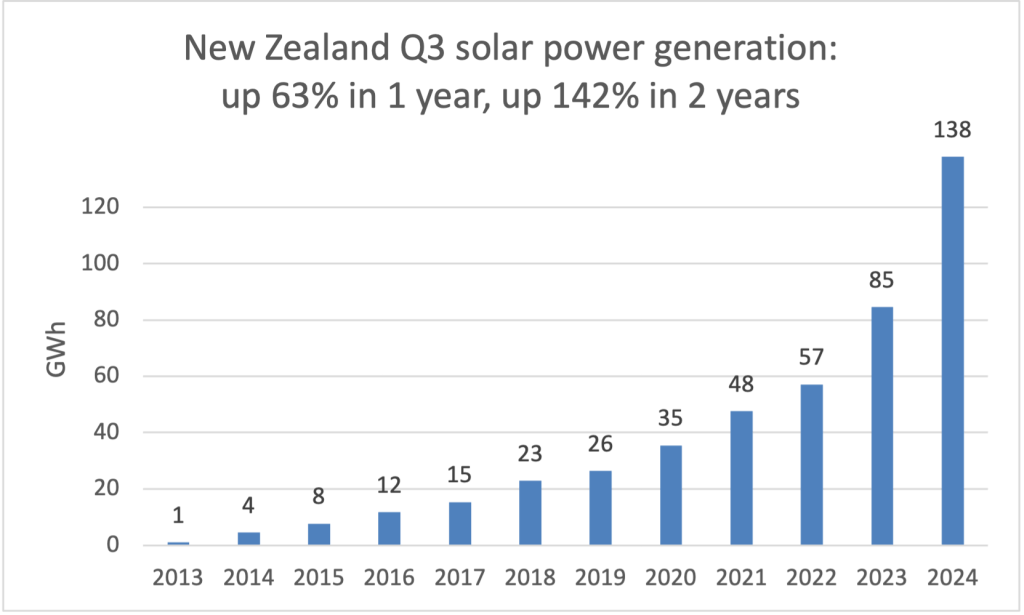
Solar added nearly 300 TWh in 2023, more than any other source, and pretty much matching coal’s old record. Actually, the 2023 data from Ember is provisional – if the IEA’s estimate is correct, the increase could be 400 TWh.
My conclusion is that the original headline (“solar is being installed faster than any technology history”) may be a bit breathless and lacking context, but the underlying trend is clear, and the record is significant. 2023 really was off the charts, and more is yet to come. Solar power generation is increasing as fast as any kind of electricity has ever done. This has been done despite many regions placing no restrictions on fossil fuels at all, and the global average carbon price being just US$5/tonne.