How much is climate misinformation shaping NZ Govt policy?

By Matt Halliday

While an inquiry into climate misinformation is sounding alarm bells about fossil fuel propaganda and its threat to the very foundations of society across the Tasman, we’re even more vulnerable to misinformation and unseen influence here in Aotearoa.

The Select Committee on Information Integrity on Climate Change and Energy submitted its report to the Australian senate last month. Unsurprisingly, they found that, in a post-truth world, bombarded by AI, social media and billionaire-owned broadcasters, misinformation is rife and could be considered a threat to Australia’s democracy.

We’re not talking about placard-waving activists or fringe political parties here. A former chief of the Australian Defence Force is talking about how climate misinformation is speeding our descent into catastrophic global heating that will “crash society as we know it”.

Meanwhile, back in Aotearoa, Resources Minister Shane Jones talks about the “moral hysteria of climate change.”

It’s not a coincidence that that quote comes from a speech he delivered in Taranaki, New Zealand’s oil fields, where he focussed on economic and energy security for the region, as he pledged to help his audience keep extracting our natural resources. These tactics are straight from the disinformation playbook started by big tobacco in the 1950s and ’60s and perpetuated by polluting companies ever since. Being “merchants of doubt” means that big oil has no need to overturn the scientific consensus. They only need to seed queries in the minds of the public (their customers) to keep the false controversy alive and maintain the status quo – oil as a daily concern. It’s also no coincidence that the main narrative of big oil’s advertising and PR campaigns has moved from energy security to fossil fuel dependence over the last 5 years.

Unfortunately, in some ways, they’re right. Our society does overwhelmingly rely on the supply of cheap oil to run the way it does. However, we now know what the consequences of continuing to live the way we do will mean. We’re seeing it in the extreme weather events that are increasing in frequency and intensity on both sides of the Tasman. What the Australian Select Committee has highlighted, is that these vested interests are doing everything they can to keep the fuel lines pumping rather than help the transition, despite what the sustainability pages on their corporate websites say.

What does this mean for New Zealand?

In some ways, we’re even more vulnerable to misinformation and unseen influence here in Aotearoa. Australia has lobbying laws. Anyone acting on behalf of third-party clients, trying to get into the ear of politicians, must be registered. We don’t have any such laws. In 2023, the Ministry of Justice was tasked with helping third-party lobbyists develop a voluntary code of conduct and review “different policy options for regulating lobbying activities.” However, the MoJ website says they’re currently “assessing the scale and scope of any review” and there have been no updates for almost two years. This leaves our politicians open to be influenced by big industry with deep pockets.

Just hours after announcing a new LNG terminal as the supposed solution to New Zealand’s energy worries, Climate Change and then-Energy Minister Simon Watts and Resources Minister Shane Jones were both at a breakfast event co-hosted by fossil fuel lobby group Energy Resources Aotearoa.

While the LNG plan has been slammed by multiple energy experts as locking in further dependence on foreign fossil fuels, Energy Resources Aotearoa head John Carnegie was in a small minority of commentators to welcome the LNG plan. He is also on record criticising the previous Labour Government for helping companies get off coal and gas and shrinking demand for fossil fuels in the process.

On the same day as the fossil fuel breakfast, it was revealed that New Zealand has sunk further in Transparency International’s Corruption Perception Index, while the Government’s Anti-Corruption Taskforce released its first pilot report, flagging potentially billions of dollars in public-sector fraud.

New Zealand remains the only Five Eyes country without a whole-of-government national anti-corruption strategy. With no lobbying register – the OECD ranks us 34th out of 38 countries for regulating influence on policymaking. We have no cooling-off period for ministers entering lobbying. We have no beneficial ownership register and no independent anti-corruption commission.

Industry influence

Recent changes to tobacco laws offer a glaring example of industry influence. Tobacco regulation has been one of the most successful examples of public health regulation globally, with the WHO Framework Convention on Tobacco Control now ratified by parties that represent over 90% of the world’s population.

Which brings us back to Shane Jones and his buddies.

The current coalition government repealed Aotearoa’s world-leading tobacco regulation. This was not something any of the coalition parties had campaigned on, yet it was one of the first actions taken in their first months in office. The Public Health Communication Centre outlined how closely politicians across all three coalition parties modeled their talking points on propaganda seeded by the tobacco industry. The difference between tobacco and climate change is that people noticed this break from the social norm. Smoking has lost its social license; decades of dedicated work by non-profits, health professionals and regulators meant that within my parent’s lifetime smoking went from being a signifier of cool to one of shame.

We’re not yet at that point with fossil fuels, which means that when our politicians repeat fossil fuel industry rhetoric (as Shane Jones does) it doesn’t jar us the way the tobacco rhetoric does. Fossil fuels are still a part of everyday life. Current conflicts have illustrated how over reliant our global society is on them. What the Australian Select Committee Report highlights is how much lobbying, sponsorship and disinformation are a part of keeping us reliant on them. It recognizes coordinated campaigns of disinformation amplified through various platforms. These campaigns work on us because they’re all closely tied to how embedded fuel companies are into everyday communities, often through their sponsorship of sport and cultural activities. Activists in WA have pointed out that with sponsorship of Nippers surf lifesaving, the Woodside logo appears about 42,000 times every Sunday in summer. Their logo appears in five different places on the uniform each kid wears.

Over here, BP have been sponsoring Surf Lifesaving NZ for almost 60 years. True, climate change wasn’t in the public consciousness when this partnership started. But it is now. These logos tell us stories of oil corporations saving lives, instead of the truth; use of these products is already taking more lives than smoking each and every year. Along with seeded disinformation (which turns into misinformation) this type of sponsorship and promotion helps us justify doing what we’ve always done, instead of being able to imagine a different future for Aotearoa’s next generation.

The Australian government is taking steps in the right direction. They’re now aware of the threat of coordinated disinformation campaigns and how they affect public consciousness. Hopefully they take the next step and turn these recommendations into policy that helps protect their people and our climate.

Aotearoa needs to catch up. Even though we’re a country known for our sheep, kiwis don’t like having the wool pulled over our eyes.

These corporate communication tactics have been used for decades to encourage mistrust in science. The rise of social media’s controversy-driven algorithm, and now AI’s self-reinforcing tendencies, have given these companies more tools to accelerate the doubt in science they’re peddling.

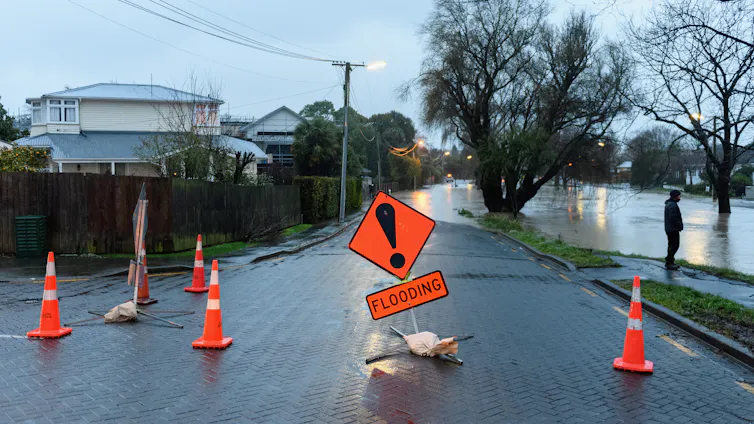
The question is: are we going to believe them, or do we believe the evidence we see in the extreme weather that’s becoming more frequent and changing the shape of New Zealand?


Matt Halliday is a lecturer and PhD student in Te Kura Whakapāho, the School of Communication Studies at AUT, where he is researching the role of advertising in the climate crisis. He is also a part of Comms Declare, and helped launched the Fossil Ad Ban campaign in Aotearoa earlier this year. Republished with permission from Carbon News.

Which climate scenario should we plan for?

By Robert McLachlan

In the Manawatū region of New Zealand where I live, the Horizons Regional Council plans for climate change impacts under the high-emission “RCP8.5” scenario. This is a scenario in which no attempts are made to reduce emissions – the track we were on for decades. In this scenario, emissions triple by 2100 and coal burning expands by a factor of six.

This is now considered highly unlikely. So why is it still used for planning?

The Ministry for the Environment recommends

using the middle-of-the-road scenario (RCP4.5) and the fossil-fuel intensive development scenario (RCP8.5), and screening hazard and risk assessments for longer-term coastal impacts up to 2130 (RCP8.5).

RCP4.5 reflects moderate emissions and implementation of current global emissions reduction policy settings. It represents limiting the rise in global air temperature to 2.7°C by 2100.

RCP8.5 broadly aligns with emissions-reduction practice over the past few decades. It reflects high emissions, limited mitigation measures and no global emissions reduction policy settings. This scenario represents a rise in global air temperature to 4.4°C by 2100. RCP8.5 enables local government to understand the full extent of possible climate risk. It is particularly important for developments with a long timeframe (more than 100 years), especially for climate-sensitive projects and coastal planning activities, due to the very long time-lag (from decades to centuries) between sea level rising and seeing the effects on developments.

Ministry for the Environment. 2022. National adaptation plan and emissions reduction plan. https://environment.govt.nz/assets/publications/national-adaptation-plan-and-emissions-reduction-plan-guidance-note.pdf

RCP8.5 is relevant not just as a worst-case scenario of emissions. The key point is that it gives an idea of a bad-case outcome for the climate response even under moderate emissions. For that reason, only RCP8.5 should be used for planning; RCP4.5 still allows a completely unacceptable level of risk.

Climate change predictions are highly uncertain. One measure is the “Equilibrium Climate Sensitivity”, the increase in temperature in response to a doubling of CO2, after short- and medium-term feedbacks have entered equilibrium. (“Medium-term” means decades to a few centuries). This has long been estimated at 2–4.5 ºC, with an average of 3 ºC. We are currently at just over half a doubling, resulting in 1.3 ºC of warming, although not all those feedbacks have yet run to equilibrium.

2–4.5 ºC is a wide range, and that’s only the “most likely” values – a 66% probability. If the sensitivity is actually on the high side, then even moderate emissions will lead to much greater impacts.

There are two fundamental reasons why the uncertainty is so large and has proven difficult to reduce.

First, there are many climate feedbacks. Some lead to more warming and some to cooling. Each is hard to predict accurately because of the long time scales and complicated interactions of the atmosphere and ocean.

Combining effects of the same sign needn’t increase uncertainty:

A = 10 ± 1 (10% uncertainty)

B = 10 ± 1 (10% uncertainty)

A + B = 20 ± 2 (10% uncertainty)

But combining effects of opposite sign always increases uncertainty:

A = 10 ± 1 (10% uncertainty)

B = –5 ± 0.5 (10% uncertainty)

A + B = 5 ± 1.5 (30% uncertainty)

Secondly, the uncertainty is worse on the high side:

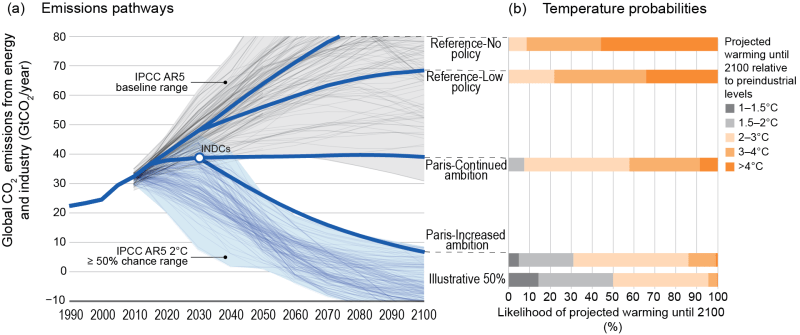
Here the most likely response is 3 ºC, but very large values (6 ºC or even higher) are possible. In the most recent IPCC report (AR6) the most likely range was reduced somewhat, to 2.5 ºC–4 ºC. However, this was due in part to discarding a number of “hot models” that showed higher sensitivity. (In those models, forecasts of less clouds meant less sunlight reflected directly back to space, and hence more warming.) And that was done for a good reason, namely that the mid-range models fit the observed warming extremely well:

The takeaway message is that even under moderate emissions, there is still a pretty decent chance of catastrophe.

Allen Fawcett et al., Can Paris pledges avert severe climate change? Science, 2015.

Here the “no policy” scenario (RCP8.5) gives a 90% chance of more than 3 ºC of warming by 2100. But even “Paris–continued ambition” (which assumes that all countries in the world achieve their 2030 targets and continue decarbonising at the same rate) has a 42% chance of exceeding 3 ºC. Only “Increased ambition”, in which decarbonisation accelerates greatly after 2030, gives a decent 14% chance of avoiding 3 ºC. That’s an “extreme climate change” scenario, with up to 60% of the global population at risk of starvation.

Risk is a funny thing. For aircraft, we think a 1-in-10 million chance of a crash is an acceptable level of risk. If a crash is linked to a design flaw, the entire global fleet of that model is grounded indefinitely. For flooding, we’ve settled on a 1-in-500 annual risk of catastrophic urban flooding in any given location. (In Palmerston North, stop banks were upgraded to that level just in time to survive the 2004 floods.) For climate change, a 50-50 risk of complete annihilation is met with “that’s the best we can do”.