Since 1978, diesel vehicles in New Zealand have paid road user charges (RUC) via a formula that depends on vehicle size and weight. Petrol vehicles currently pay a fuel tax instead of RUC. Electric vehicles (EVs) were granted an exemption from RUC in 2009 which expired on 1 April 2024. From that date, EV owners were required to pay RUC at the same rate as light diesel vehicles such as utes.
The government plans to shift all light vehicles onto RUC, possibly by 2027.
The current rate of fuel tax is 92 c/l. As one litre of petrol emits 2.31 kg of CO2 when burned, this is equivalent to a carbon charge of $398 per tonne of CO2. Petrol also incurs a carbon charge via the Emissions Trading Scheme (around $50/tCO2). Thus, removing fuel tax would reduce the carbon charge from $448 to $50 per tonne.
The effect would be that fuel costs of a small petrol hybrid would increase from 10c to 14c per kilometre, while that of a large car would fall from 25c to 23c. An EV would cost 11c per kilometre if charged at home on off-peak rates, or 23c per kilometre using public rapid chargers.
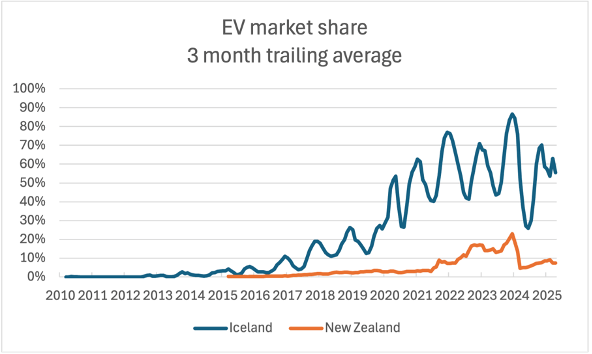
No country has tried this approach yet, although Iceland is planning to do so next year. Wisely, they will also double the carbon charge on petrol (from $100 to $200/tCO2) at the same time. They also retain other strong transport/climate policies. The purchase tax on a high-emitting car can be up to 65% of its value, and the government intends to ban the sale of fossil-fueled vehicles after 2030. In Iceland, 18% of the light vehicle fleet is already electric, compared to 3% in New Zealand.
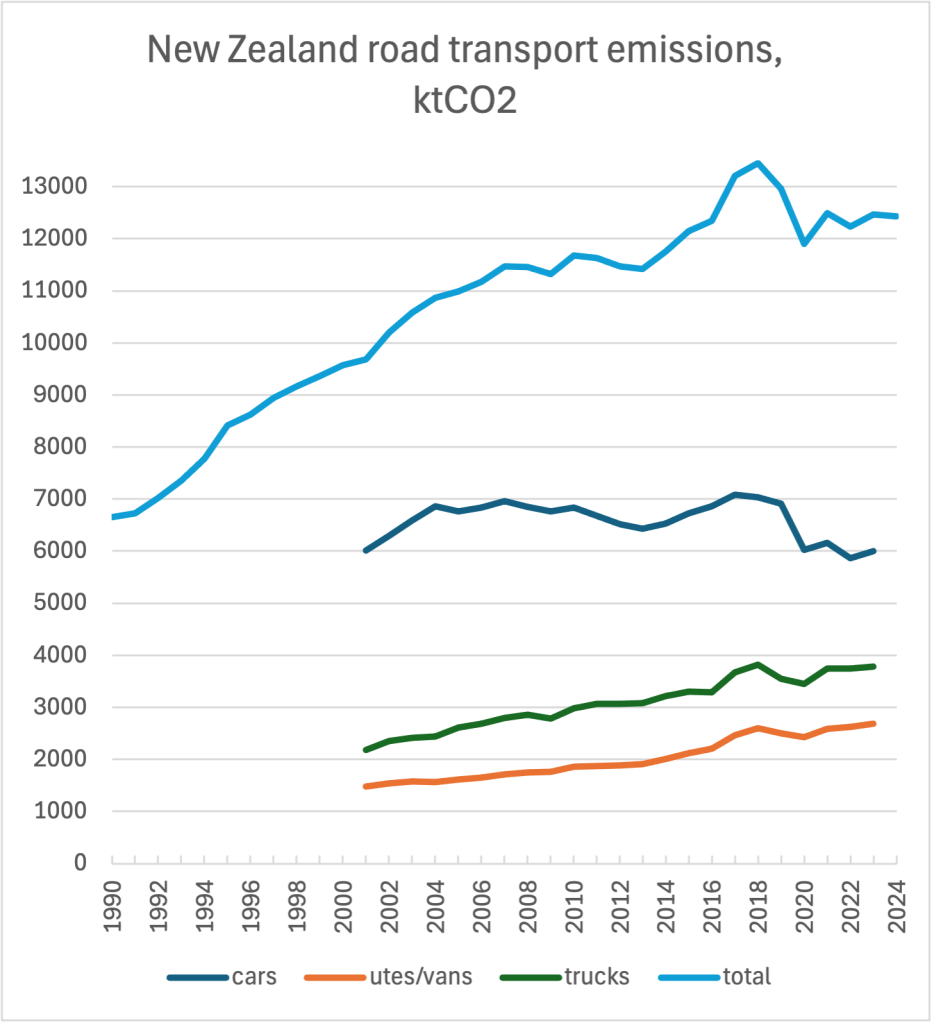
Trucks are, of course, another large source of fossil fuel emissions that needs to be phased out. At present just 0.37% of the light commercial fleet is electric (mostly vans, not utes), while the figure for heavy vehicles is 0.46% (mostly buses, not trucks – although there are 194 electric heavy trucks in the country). Diesel trucks, utes, and vans are already exempt from fuel tax and pay RUC instead. Thus, they face a much lower effective carbon tax than cars, which could be a factor in their relatively slower improvement over time. (Diesel cars have actually been getting worse in recent years.)
However, they do get one big incentive – unlike cars, they are still exempt from RUC. The exemption ends on 1 January 2026. Perhaps this is a small change in the grand scheme of things. But it is one more change in the wrong direction, with an uncertain outcome – as far as I know, no analysis or investigation of any kind has been done on this. It is possible to design a scheme under which everyone contributes fairly according to their impact, and which still incentivizes change. At the start of this year, Denmark introduced RUC for trucks, under a formula which takes into account vehicle weight and CO2 emissions. (EV trucks get an 80% discount.) The effect has been phenomenal, with EV market share for trucks jumping straight up to 25%.
Emissions from cars are now back to 2001 levels, while trucks and utes are up 80% and still increasing. Prior to 2001 road transport emissions were not split by vehicle class. The decline in emissions from cars since 2018 is due more to behaviour change than cleaner vehicles – working from home, and less driving due to the recession.
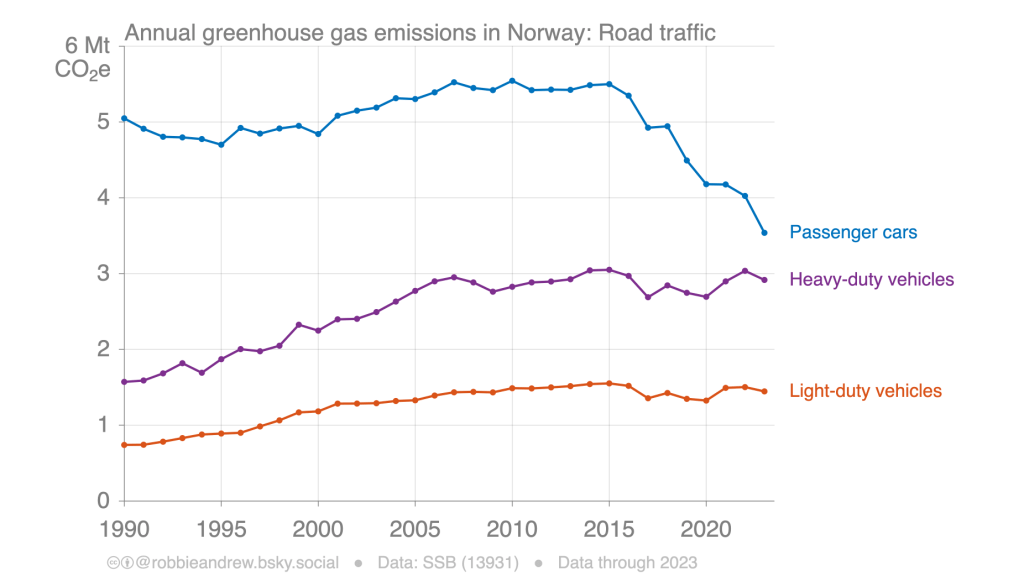
Norway is seeing sustained reductions in emissions from cars, now that virtually all new cars sold are electric. Norway’s emissions from trucks are 1/3 less than New Zealand’s, but have yet to see significant reductions.
On 25 June, the Government amended the Clean Vehicles Act. This was completed in a single day under urgency, so there was no opportunity for public input. On 9 July, there was a press release saying that New Zealand would now be following Australian emission standards from 2025. On 11 July, the Ministry’s advice was released, giving us a few more details.
Vehicle emissions are reported in grams of CO2 per kilometre (gCO2/km). (For petrol vehicles, 200 gCO2/km is the same as 8.6 l/100km.) Here are the new targets:
Cars
Light commercials (vans & utes)
Previous target
New target
Previous NZ
New target
2023
145
218.3
2024
133.9
201.9
2025
112.6
112.6
155
223
2026
84.5
108
116.3
207
2027
63.3
103
87.2
175
2028
76
144
2029
65
131
The Minister talked to the Motor Industry Association (MIA), the Imported Motor Vehicle Industry Association (VIA), the Motor Trade Association (MTA) and the New Zealand Automobile Association (AA). We don’t have their reports, but, judging by what has been released, the Minister has accepted their reasoning at face value and rubber stamped their request. Neither Tesla nor Drive Electric (not members of the MIA) were consulted.
The Ministry report that their modelling of the emissions impact of this change has not been completed yet, but they do provide a rough estimate of an increase of emissions by 0.3–0.5 MtCO2 over 2024-2050. Another department, the Climate Impact of Policy Assessment, puts the increase at 1.2–1.9 MtCO2, but regards this as unreliable on the grounds that the previous targets were unlikely to be met – which is the car industry’s argument.
The car industry appears to take the position that they will do nothing whatsoever to respond to the targets, and just let the market take its course. Car importers would pay fines rather than try to meet the target. One key figure (which was also provided to Cabinet) is their estimate that this would add $5,500 to the price of every new light vehicle in 2027.
The fines are set at $45/gCO2, so the MIA are saying they’ll miss the targets by 122 gCO2 on average. The target for all light vehicles is 71 gCO2/km, so they’re saying they expect to sell vehicles averaging 193 gCO2/km in 2027, or nearly triple the target. That level (193 gCO2/km) is what we had already reached in 2021, before the introduction of the feebate and fuel efficiency standards. In 2022 the average was 167g; in 2023, 145g.
These industry and ministry figures look like nonsense, so let’s do a back-of-the-envelope calculation. Assuming no change in overall levels of sales, and that the targets are met, the annual extra emissions from vehicles sold in 2025 will be 46,000 tCO2; in 2026, 132,000 tCO2; in 2027, 120,000 tCO2. Over the 20 year life of the vehicles, the extra emissions from sales in these three years alone are 7.14 MtCO2.
That’s all assuming the targets are met. The industry says they won’t be. But one thing we did learn from the feebate experience is that both the industry and the car buying public are incredibly responsive to signals. Under the previous government, the signal was that it’s time to get serious about cutting emissions. The price signal (the rebate) was only part of that. EV sales vastly exceeded expectations, and the industry delivered. After the election, the signaling changed; the only electric ute on the market was withdrawn less than a week later.
Source: Ministry of Transport. The Clean Car Discount (feebate) was introduced progressively in July 2021 and April 2022, and cancelled in January 2024. Chart includes both new and newly imported used vehicles.
Second, missing the targets still achieves something. Fines are a deterrent and a signal to the industry. If they’re added to the price of higher-emitting vehicles, those sales will slow. Even for utes, that’s not the end of the world, it just means a slower replacement cycle until better vehicles are available. This will still prevent new, high-emission models entering the country and sticking around for decades.
There is one issue, though, which is that the fines, at $45/g, are low by international standards. They were set low because at that time, the intention was that the feebate would be doing most of the work and the Standards were mostly a backstop. In Australia, whose standards we are now adopting, the fines are $111/g, and in Europe, $170/g. (In Europe, where emissions in 2021 were already 40% below ours, not a single car company has had to pay fines for missing the targets.) Australia and Europe have extensive systems of incentives in place, which helps. New Zealand importers also have heaps of cheap credits available from overachieving in 2023 that (in another change) can now be used up until 2027.
When the Minister of Climate Change was asked about the impact on emissions, he said that “Clean car standards … have quite an insignificant impact in regards to overall emissions targets”. The relevant number to compare to here is not total emissions, but the required annual emissions cuts as we move into the late 2020s. Those are about 2 MtCO2 per year. In that context, the change due the weakening of fuel efficiency standards – 6% of so of the total effort required – is significant.
However, the Ministry has an answer there too:
In our view the proposed targets will not impact the ability for the first emissions budget (or subsequent ones) to be met. This is because transport emissions are covered by the ETS, therefore changing the Standard’s targets might change how or where emissions reductions occur from a gross perspective, but not from a net perspective.
This comes pretty close to the common argument that nothing the government or anyone else does has any impact on emissions; if I emit more, others will emit less so that the carbon budgets are met. But, they throw in an extra twist by bringing in the gross/net distinction: basically the argument is that more trees will be planted to cover the extra emissions. None of these arguments hold water, but even if we accept them at face value, actions that lead to higher emissions in one sector will definitely have an effect on those other sectors that will now have to make up the difference. For example, through a higher carbon price. However, it appears that this effect was not considered.
The new targets do get tighter over time, particularly in 2028 and 2029. If those are met, we could still be on track to end fossil-fueled vehicle sales by 2035, as in Europe. (The new UK government is reinstating a 2030 end date.) But there are two caveats. First, Australia has an election next year. The opposition could easily make emissions standards an issue, as they tried unsuccessfully to do in the last election (“Ute tax!”). A change of government could see the Australian standards weakened, as has happened here. Second, our own new standards will be reviewed again in 2026. On present performance, the MIA would only need a quiet word in the Minister’s ear to wind back the standards.
The purpose of a fuel efficiency standard is to radically change the make-up of the fleet as quickly as possible. There do have to be changes. But the whole tenor of the Ministry’s advice is that no one should have to change or pay any more, the overriding goal is that “vehicle affordability is maintained and the mix of vehicles imported meets the needs of New Zealanders.”
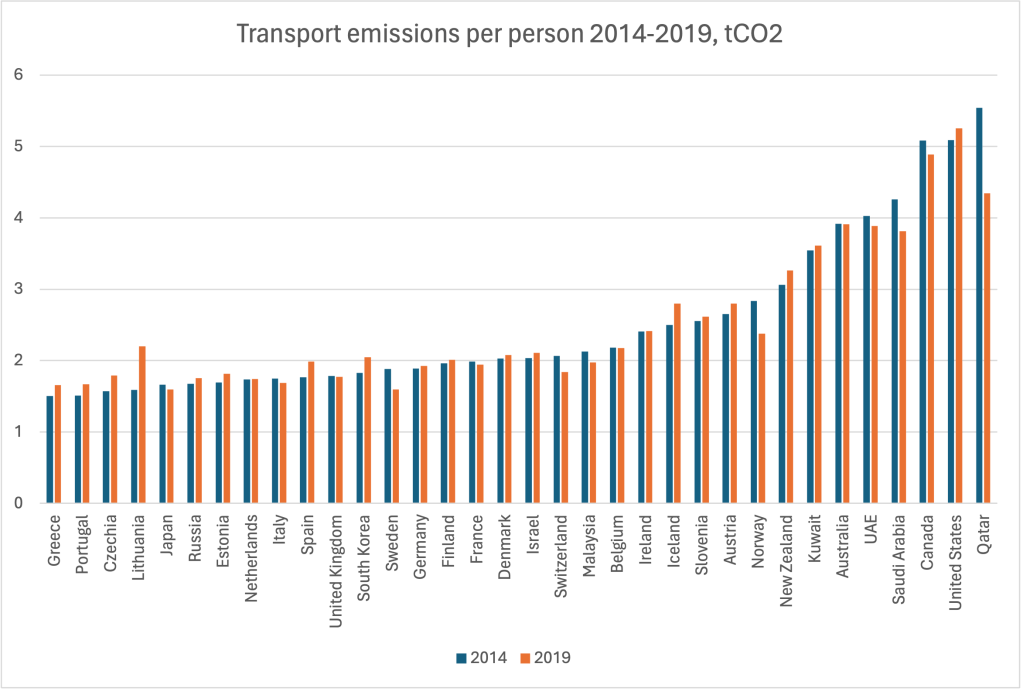
Reducing transport emissions is difficult, and it is something that many countries struggle with. But some countries are trying and are starting to see results.
Source: Our World in Data. Sweden has a target reaching of 0.6 tCO2/p in 2030.
Weakening fuel efficiency standards is the third of four parts of the Government’s “War on EVs“. Part 1 was ending the feebate; part 2 was the introduction of Road User Charges (RUC) for EVs, at a punishing rate. Iceland is the only other country in the world to try this, and there too sales have collapsed. Basically we are in uncharted waters. Part 3 is now done. Part 4 is still to happen: it’s the Government’s signaled intention to replace petrol tax with RUC for all vehicles. As petrol tax is currently equivalent to a carbon charge of $360/tCO2, this would amount to a hefty carbon tax cut and hence would also act to increase transport emissions. The extra cost of driving a hybrid (where sales are still holding up well) could be significant.
Fuel consumption l/100km
Current fuel/RUC cost cents/km
Fuel/RUC cost under an RUC-only system
0 (Battery electric)
12
12
4 (small hybrid)
10
14.5
6 (normal hybrid)
15
18
8 (normal car)
20
21.5
10 (large car)
25
25
12 (large ute)
30
28.5
Assumptions: Petrol $2.50/l, electricity 29c/kWh, RUC 7.6c/km
2018
should be a big year for climate mitigation in New Zealand as three factors
converge: the potential for a Zero Carbon Act, continuously
rising emissions and a growing sentiment for action from the public.
To
cut emissions we need to stop investing in fossil fuel infrastructure and
invest instead in renewable energy infrastructure. While all countries struggle
with this, Australia and the US, for example, are closing coal plants and
investing in solar and wind. This builds clean
energy industries and creates expertise which can be a base for further
progress in the future. In New Zealand there are no large commercial solar
farms, no large wind farms are planned (the
last moderately-sized wind farm to be constructed was Meridian’s 60MW Mill
Creek, in Wellington in 2014), while Contact and Nova are renovating and building gas
power stations. Indeed, in the present policy environment, unless demand grows,
why would an existing generator build a wind farm? Adding a wind farm would
lower the wholesale price of electricity and potentially leave all generators
worse off.
But
let’s talk about cars. The car importing business represents a huge, ongoing
malinvestment in fossil fuel infrastructure which we must face head on. The 325,000 petrol and diesel cars
imported to New Zealand last year will be emitting greenhouse gases for many
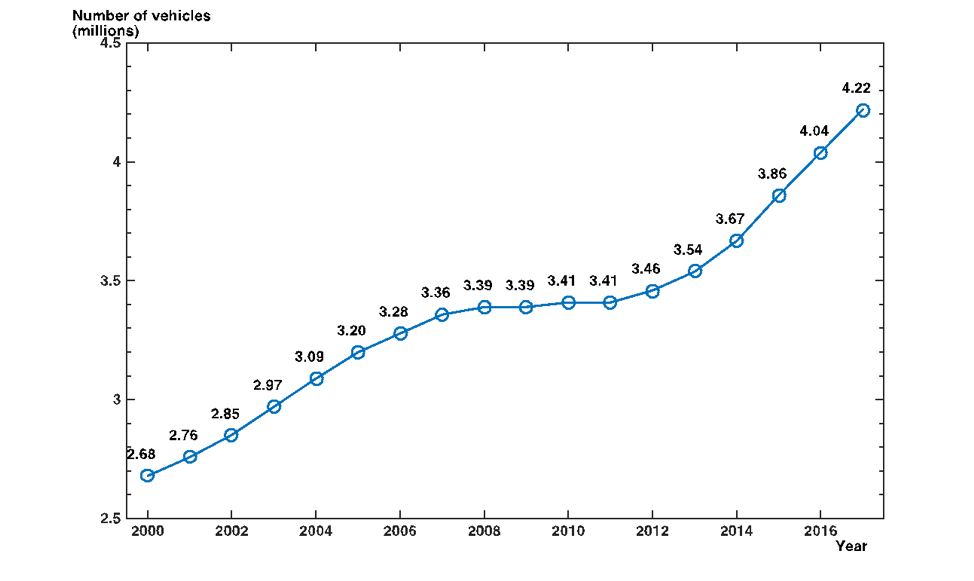
years to come. Worse, the total number of cars is increasing rapidly – a
development that took many people by surprise, after an apparent plateau during
the GFC (there were even articles at that time about how young
people preferred to buy a smartphone than a car). The climate only cares about
cumulative emissions, but at the moment it is not clear how we can compensate
for our cumulative transport emissions, since 2000, say. In the past three
years we’ve been adding 183,000 vehicles (almost all of them cars and small
commercials) to the fleet per year. Aucklanders can guess where most of them
have ended up.
Number of vehicles in New Zealand, 2000-2017. Source: NZTA. Credit: Environmental Health Indicators New Zealand. This represents one of the highest ownership rates in the world (compare our 4.22m vehicles to our 3.7m adults).
CO2 is invisible; the damage in
extracting, processing, and burning oil is often far away and invisible. But
cars are not invisible. They are very much in your face, every day for most of
us, especially in our cities that are now completely choked with cars. You
can’t turn on the TV for five minutes without seeing an ad for an SUV or sports
car. For most of us the car is our single greatest source of personal
greenhouse gas emissions.
Many
believe that electric vehicle technology (EV, including both full electrics and
plug-in hybrids) is superior to the internal combustion engine vehicle (ICEV).
It cuts local emissions significantly — by 90 percent today, and by more
tomorrow as we move to 100 percent renewable electricity.
Techno-optimists can point to Tesla,
to the trickle of EV models becoming a flood, to massive investments by old and
new car manufacturers. They see EVs becoming cheaper, with longer range and
complete charging networks. At this point EVs will be winning on all points and
the revolution assured. There may be a rapid ‘S-curve’ adoption like that of
the smartphone.
I
am not so sure.
First,
progress around the world has been extremely variable to date.
Here
are the market shares of EV sales, as a
percentage of total sales, in three leading markets, Norway, Iceland, and
Sweden, all three doubling every two years or less:
2013 2014 2015 2016 2017
Norway 6% 14% 23% 27% 34%
Iceland 0.9% 2.7% 2.9% 5.7% 13%
Sweden 0.7% 1.7% 2.6% 3.2% 4.7%
Market share of electric vehicle sales, as a percentage of total sales.
Now
for three very large markets that have been trying hard, the UK and Germany
(doubling every two years) and the US
(doubling every 5 years).
2013 2014 2015 2016 2017
UK 0.2% 0.6% 1.1% 1.5% 1.9%
Germany 0.2% 0.4% 0.8% 0.8% 1.6%
US 0.6% 0.7% 0.7% 0.9% 1.2%
Optimists
foresee a worldwide doubling of market share every two years, reaching 60
percent by 2030; after that, bans on the sale of ICEVs are more prevalent, and
the transition could largely be complete by 2040. Heavy transport follows close
behind and 60 percent of oil consumption could be gone by 2050.
But
consider one very sad story, Denmark, a country of 6m people and a renewable
energy leader in Europe, which has experienced mixed results with their EV
policies:
2013 2014 2015 2016 2017
Denmark 0.3% 0.9% 2.3% 0.6% 0.4%
Tax
on new vehicles, previously 180 percent, had been waived for EVs. From 2016 the
tax was reduced to 150 percent for ICEVs, while the EV tax was raised to 20
percent in 2016 and is being phased in to 150 percent by 2022. Despite the high
tax, Denmark still has some the highest per-capita car sales in Europe.
Another
perplexing example is the Netherlands, which also has sizeable (but fluctuating) incentives,
as well as the most extensive charging network in the world, but no clear
signal of accelerating adoption:
2013 2014 2015 2016 2017
Netherlands 5.6% 3.9% 9.6% 6.0% 2.2%
Second, the EV transition may need
more help to become a reality.
The
first six countries above all have complex and widespread incentive systems in place. Norway
provides an effective discount of about 1/3 of the up-front cost, with other
extensive ongoing incentives. The US provides a discount of up to US$10,000 and
a gas guzzler tax (in place since 1978) of up to US$7700. The UK has a petrol
excise tax of 58p/l (compare New Zealand’s 60c/l, the same in real terms as 50
years ago), an EV rebate of up to £8000, and no road tax for EVs—but up to
£1120 + £515/year for gas guzzlers. Controversially, the UK road tax system was
changed in April 2017, so far without
ill effect on EV sales.
Third, getting the transition
underway may require a change in attitudes.
Robert
Llewellyn, host of the popular web series ‘Fully Charged’, remarked in his testimony to a parliamentary committee
on EVs that he does not see the famous ‘S-curve’ transition as being in the bag
by any means. People have a complex emotional relationship to their cars. They
may stick to their favourite kind of car (or an emerging new one, like the huge
SUV) beyond any obvious reason. I find it striking that in the EV world, most
people want to talk up the amazing advantages of EVs; yet few want to dwell on
the evil of ICEVs.
I like to imagine public health information posted at petrol stations such as
these:[1]
This
vehicle emits gases known to be damaging to the long term stability of the
climate and estimated to cause trillions of dollars in damages.
The
exhaust gases of this fuel remain in the air and oceans for thousands of years,
raising sea levels and acidifying the oceans.
The
product you are dispensing is directly responsi[2]ble for major wars and terrorist
attacks.
It
may seem far fetched, but the public seems to
accept analogous warnings on
cigarettes. Why not on fossil fuel burning cars?
Some
activists, such as Naomi
Klein, would say that driving a petrol car is wrong.
Arnold Schwarzenegger, who is suing oil companies for first-degree
murder, would say that the manufacturers, importers, and sellers of cars, the
producers and refiners and sellers and burners of oil, are in fact a public
nuisance. And clearly, the Volkswagen emissions scandal ‘Dieselgate’, the ExxonMobil climate change
denial controversy ‘ExxonKnew’,[3]
and some mining operations are wrong. But most of us are both actors and
victims, caught in a difficult situation. Some car companies are clearly stalling, others are deliberating
restricting the supply of ‘compliance vehicles’, but all of them
need the income from selling ICEVs to fund the development of EVs, and they’re
the ones with money and expertise. Just to pick one local example from many,
Toyota NZ—a leader in the Sustainable Business Council and in greening their
own operations—feels compelled to fill their ‘Sustainability’ page with subtle digs
at all-electric vehicles, because Toyota doesn’t have one.
It’s
a tautology that ceasing investment in ICEVs means not actually buying them
anymore. Incentives, charges, advertising campaigns, are just mechanisms. Are
people really ready for that to happen? In general terms, New Zealanders say
they want the government to act on climate change but have we made the
connection to our own behaviour and the
current freedom to pollute? We’re talking about changes coming that will make
the extra 10c/l in the pipeline for Auckland look like spare change.
Fourth, time is running out, both
for the planet and for our goals.
A
Zero Carbon 2050 Act is coming this year. That’s 32 years. Planting trees will
buy us some time, but let’s regard them as offsetting agricultural emissions.
CO2
should see steeper reductions than methane, and many industries will need
ongoing protection while acceptable
reduction plans are set in place globally. (There’s no point closing one
of the world’s cleanest smelters, Tiwai Point, when China is building coal-fired
smelters flat out.) Some sectors, such as aviation, have no low-emission
options yet. What’s left? Private cars! The alternative exists already; the
emissions savings are large; there is no local car industry to protect or
cajole; while cars have some productive value, they are by and large consumer
items; the NZ$8.4b a year we spend importing
vehicles is a valuable existing source of finance that can fund the low-emission
transition; the NZ$5b a year we spend importing fuel
is a pointless ongoing drain on the current account. As the transition gets underway,
the fuel savings will grow rapidly.
The
actions required for the scale and speed of the transition could be large. One proposal currently gaining
attention is a feebate, developed in depth by Barry Barton and Peter Schūtte in
a November 2015 report. A feebate is charged on every
newly imported vehicle that is directly related to its emissions. In the simplest
model, the feebate varies in direct proportion to emissions and adjusted so
that the entire scheme is revenue neutral. Let’s consider an example. (The
actual dollar amounts can be scaled up or down depending on what is needed.)
Buyers of a gas guzzler like the biggest 240g/km Toyota Hilux or Mercedes might
pay an extra NZ$4000 up front. Buyers of smaller cars like the 140g/km Honda
Civic or the 110g/km Toyota Yaris might
get rebates of NZ$2000-3500, while 17g/km EVs get a rebate of NZ$9,000. The
amounts would change over time as the fleet gets cleaner. The difficult
question, not answered here, is the overall scale of the scheme. With these
numbers — broadly similar to what other countries are already doing — NZ$300m
is changing hands per year. Not a small sum, but not as big as the NZ$13b spent
last year on vehicles and fuel. At some point, the scale of the scheme has to
be pegged to the market response.
The
Barton-Schūtte proposal achieves emissions reductions in one area — cars. That
goes against decades of official thinking in New Zealand, which is that a
single price for carbon may decarbonize the economy at least cost. This kind of
thinking has to go. Not only is it not necessarily true, it flies in the face
of the reality that (a) our emissions are rising, not falling, and (b) we don’t
have a fixed price for carbon anyway; there are all sorts of exemptions and
allowances in place. Andy Reisinger, of the NZ Agricultural Greenhouse Gas
Research Centre, wrote in submission to the Productivity
Commission that:
“I
disagree … that direct regulation doesn’t achieve emission reductions at
overall least cost to the economy. That statement would only be true if there
were no market failures, no information limitations or asymmetries, and no
preferences in specific interest groups that go beyond economics… It is also
important to consider whether least-cost is the dominant criterion for policy
choices, or whether risk, equity, social inclusion etc. are not equally or more
important”.
Even
the Australian government, so far no EV hero, is now considering direct regulations that would cut
emissions of new cars 45 percent by 2025.
So 2018 really is shaping up to be
a big year. As the groundwork takes place for the Zero Carbon Act and the
Climate Commission, there will be plenty of opportunities to talk about cars.
This article first appeared on 9 April 2018 at pureadvantage.org. Postscript: We now know that New Zealand did not get a Zero Carbon Act in 2018. Maybe in 2019?





 Planetary Ecology