Since 1978, diesel vehicles in New Zealand have paid road user charges (RUC) via a formula that depends on vehicle size and weight. Petrol vehicles currently pay a fuel tax instead of RUC. Electric vehicles (EVs) were granted an exemption from RUC in 2009 which expired on 1 April 2024. From that date, EV owners were required to pay RUC at the same rate as light diesel vehicles such as utes.
The government plans to shift all light vehicles onto RUC, possibly by 2027.
The current rate of fuel tax is 92 c/l. As one litre of petrol emits 2.31 kg of CO2 when burned, this is equivalent to a carbon charge of $398 per tonne of CO2. Petrol also incurs a carbon charge via the Emissions Trading Scheme (around $50/tCO2). Thus, removing fuel tax would reduce the carbon charge from $448 to $50 per tonne.
The effect would be that fuel costs of a small petrol hybrid would increase from 10c to 14c per kilometre, while that of a large car would fall from 25c to 23c. An EV would cost 11c per kilometre if charged at home on off-peak rates, or 23c per kilometre using public rapid chargers.
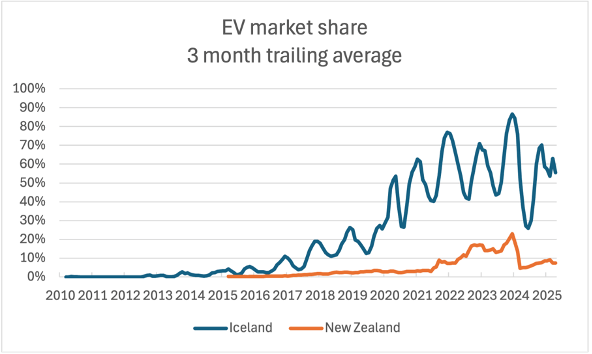
No country has tried this approach yet, although Iceland is planning to do so next year. Wisely, they will also double the carbon charge on petrol (from $100 to $200/tCO2) at the same time. They also retain other strong transport/climate policies. The purchase tax on a high-emitting car can be up to 65% of its value, and the government intends to ban the sale of fossil-fueled vehicles after 2030. In Iceland, 18% of the light vehicle fleet is already electric, compared to 3% in New Zealand.
Trucks are, of course, another large source of fossil fuel emissions that needs to be phased out. At present just 0.37% of the light commercial fleet is electric (mostly vans, not utes), while the figure for heavy vehicles is 0.46% (mostly buses, not trucks – although there are 194 electric heavy trucks in the country). Diesel trucks, utes, and vans are already exempt from fuel tax and pay RUC instead. Thus, they face a much lower effective carbon tax than cars, which could be a factor in their relatively slower improvement over time. (Diesel cars have actually been getting worse in recent years.)
However, they do get one big incentive – unlike cars, they are still exempt from RUC. The exemption ends on 1 January 2026. Perhaps this is a small change in the grand scheme of things. But it is one more change in the wrong direction, with an uncertain outcome – as far as I know, no analysis or investigation of any kind has been done on this. It is possible to design a scheme under which everyone contributes fairly according to their impact, and which still incentivizes change. At the start of this year, Denmark introduced RUC for trucks, under a formula which takes into account vehicle weight and CO2 emissions. (EV trucks get an 80% discount.) The effect has been phenomenal, with EV market share for trucks jumping straight up to 25%.
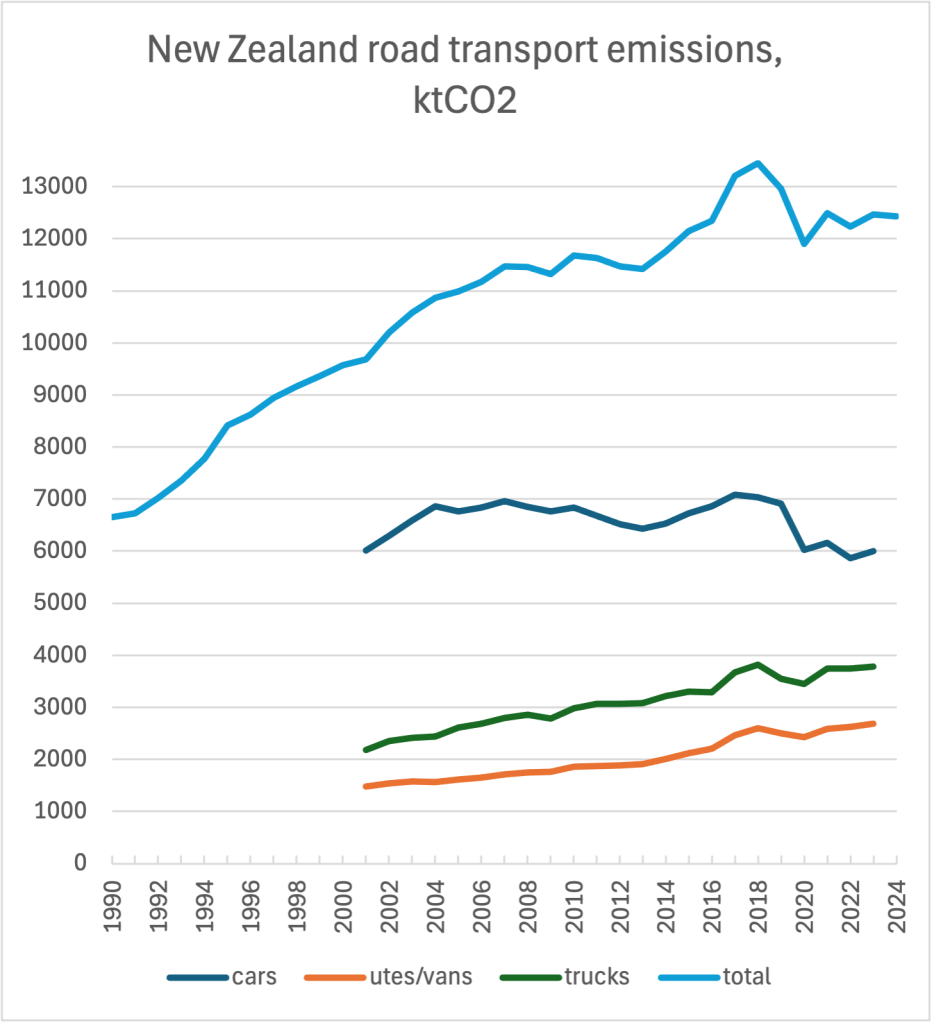
Emissions from cars are now back to 2001 levels, while trucks and utes are up 80% and still increasing. Prior to 2001 road transport emissions were not split by vehicle class. The decline in emissions from cars since 2018 is due more to behaviour change than cleaner vehicles – working from home, and less driving due to the recession.
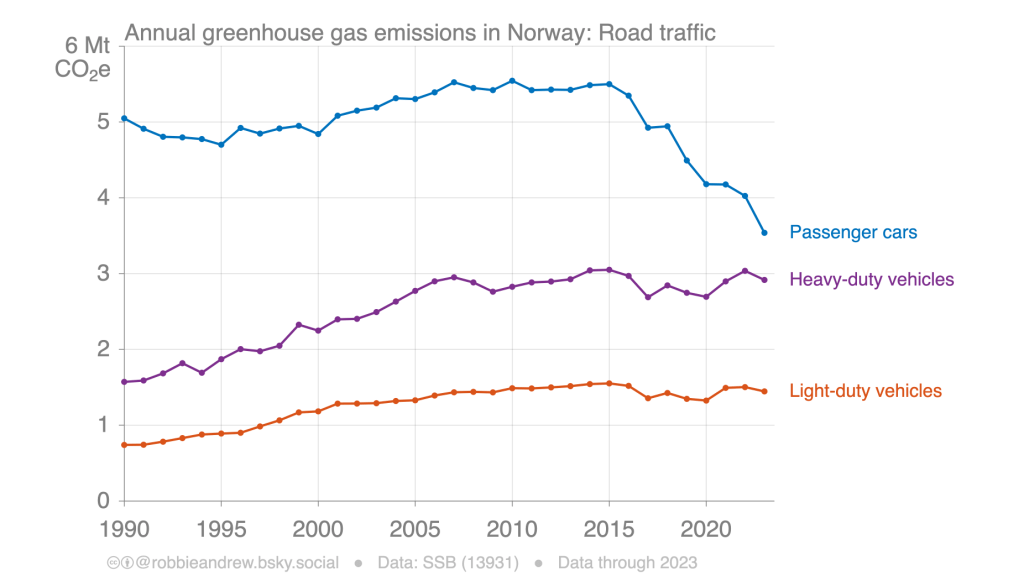
Norway is seeing sustained reductions in emissions from cars, now that virtually all new cars sold are electric. Norway’s emissions from trucks are 1/3 less than New Zealand’s, but have yet to see significant reductions.
Every three months the Ministry of Business, Innovation and Employment puts out a useful document called the Energy Quarterly. It provides up-to-the-minute data on fossil fuel emissions, well in advance of the more detailed submissions for the UN which currently only run up to 2022. It’s where I get the data for graphs like this one:
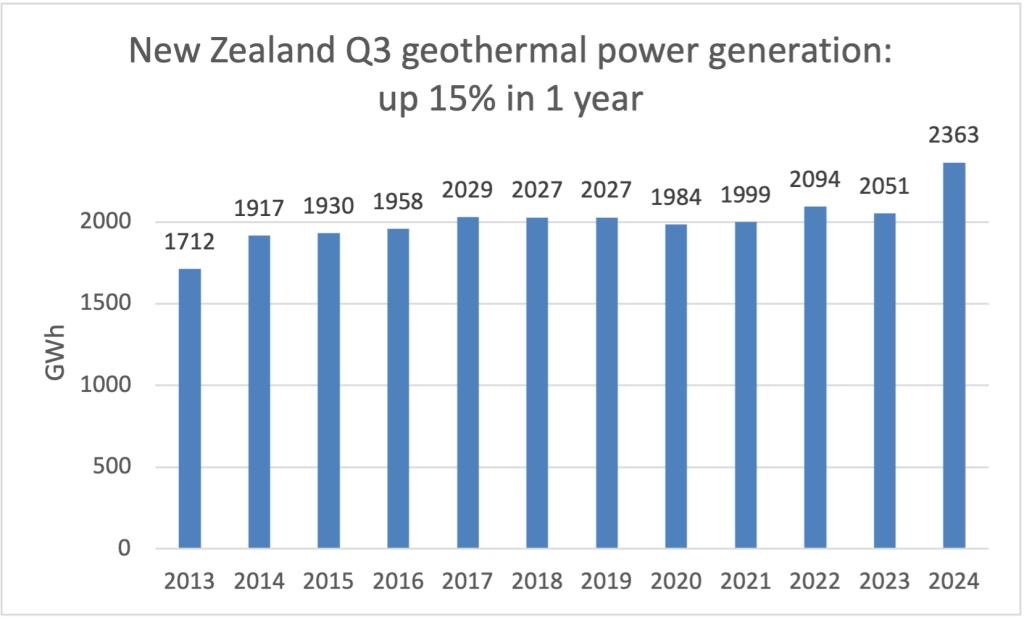
My point is to make regular reminders that addressing climate change means phasing out fossil fuels and that we are only just starting on that task. But the details are important and interesting, too, such as the recent upswing in electricity emissions due to the record-low lake inflows. This serves as a reminder that the ‘dry year’ problem isn’t yet solved, and that without the significant new wind and geothermal plants that were completed in 2023 and 2024 we really would have had an energy crisis.
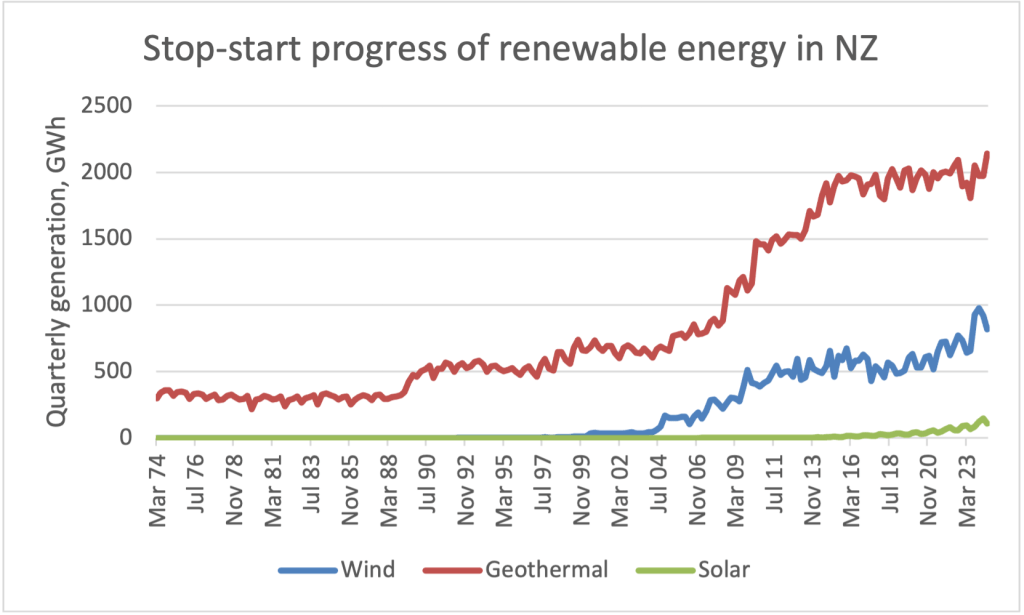
The electricity generation data in the Quarterly also shows that a long static period in New Zealand’s power generation is coming to an end. The biggest trigger for investment was the passage of the Climate Change Response (Zero Carbon) Amendment Act in 2019; projects that started construction in the following years are now operating.
However, future growth depends on anticipated future demand from climate action – phasing out fossil fuels and ‘electrifying everything’. The energy and transport sections of the final Second Emissions Reduction Plan do nothing to promote electrification, placing this recent growth at risk.
But what about the big picture on energy?
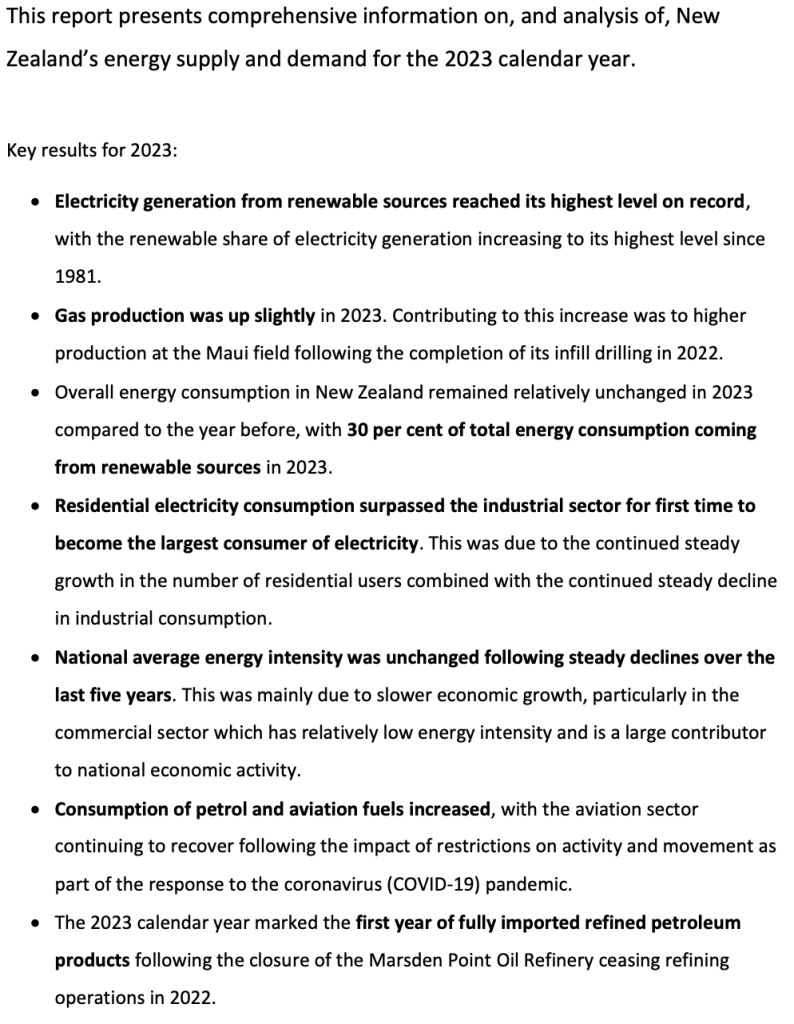
In addition to the Quarterly, MBIE produces an annual report, the latest being New Zealand Energy 2024. Here’s their summary:
The report includes many graphs, but not one showing what to me is the most striking development: total energy use has been falling for six years, and is now down nearly 10% from its peak in 2017.
Here ‘renewable’ energy is made up of hydropower (46%), geothermal (25%), biofuel (mostly wood – 23%), wind (6%), and solar (1%). Modern renewable electricity generation (wind, geothermal, and solar) was 41 PJ in 2023 or 6% of final energy demand. Here energy is what MBIE calls ‘final energy demand’, which includes the full energy content of fossil fuels and electricity but not the waste heat component of geothermal. The ‘substitution method’ used by Our World in Data (which upscales renewable energy to compensate for the thermal inefficiency of burning fossil fuels) is not used.
Coal, gas, oil, and even renewables are all down from their peaks. Looked at per capita, the effect is even more striking:
Energy use per person has been declining fairly steadily since 2001, and is now down 28% from peak. Is twenty-two years long enough to call it a trend?
There are probably many factors at play here that would be hard to untangle. At first sight the data doesn’t fit either of the convenient narratives on energy, ‘transition’, in which modern renewable energy gradually replaces fossil, or ‘more and more‘, in which new energy sources simply add to humanity’s rapacious demands.
Most likely a combination of factors – energy efficiency, deindustrialisation, and behaviour change – are at work. Initial indications are that all three of those effects were still in play in 2024, as energy-intensive industries shut down or scaled back. When we do get started on mass electrification and serious behaviour change, the energy decline will accelerate.
Between 1892 and 2012, Statistics New Zealand published an annual yearbook. As noticed by Matt Lowrie, the 1992 Yearbook included this sidebar which departed from the usual dry style of the previous hundred years:
Plus ça change. Thirty-two years later, New Zealand still has one of the highest rates of car ownership in the world, Paris is eliminating most of its on-street parking, and Sydney has just opened another light rail line. I wonder what caused this outburst from the normally staid statistics agency. Did the new Chief Statistician, Len Cook, want to shake things up a bit?
What particularly caught my eye was this bit:
In New Zealand the average car currently manages a mileage of 100 kilometres per 10 litres. To reach the Government’s target of a 20 percent reduction in greenhouse gas emissions by the year 2000, this would have to be cut to 100 kilometres per 3.5 litres.
Even under the generous interpretation that the target here refers to new cars only, we’re still nowhere near 3.5 l/100km; the last few years hover around 6-7 l/100km. Pretty startling when you consider that the popular Honda Civic (a kind of large hatchback or small station wagon) was already delivering 5.3 l/100km in 1985, and that twenty years after the introduction of the hybrid Toyota Prius in 2001, only 2% of the light vehicle fleet was hybrid.
But enough about cars. What about that Government target of a 20% reduction in greenhouse gas emissions by the year 2000? Where did that come from? Needless to say, we’re not there yet either. Gross emissions of long-lived gases, and net emissions of all gases, are both up 40% on 1990 levels. This year, despite the downturn, 210,000 fossil-fueled cars will be imported, which if parked up would fill the entire length of State Highway 1. (Sorry, I mentioned cars again.)
To answer this I want to go back to a fascinating document from 1990, “Responding to Climate Change: A Discussion of Options for New Zealand”.
This was the year of the first IPCC report as well as of New Zealand’s first reports on climate science, climate impacts, and policy options. It was the year that both Labour and National (who defeated the incumbent Labour party in the October 1990 general election) adopted emissions targets. The May 1990 Climate Options report led to Labour adopting a target of –20% on 1990 levels by 2005. The election was to be held on 27 October; with a major international climate meeting falling on 29 October, National announced their own, more ambitious target (–20% on 1990 levels by 2000) just two days before the election.
The 1990 Climate Options Report
The report is comprehensive and offers 93 different options for consideration. They are grouped under social and behavioural measures, planning measures, market measures, legislative and regulatory measures, energy, transport, commercial buildings and households, industry, energy efficiency, agriculture, and forestry. Pretty comprehensive, and all of the options are given a balanced hearing. Any or all of them would have been a good idea.
Transport, as such a large source of emissions, is given a particularly thorough going-over. Suggestions include mandatory tune-ups, fuel efficiency standards, rebates for scrapping old vehicles, lower speed limits, fuel efficiency standards, fuel efficiency labelling, business tax incentives and levies, CO2-linked registration fees, integrated transport planning (hah!), mode shift such as rail freight, responsible town planning, staff transport, optimisation of freight routing and loading, and alternative fuels – CNG, biogas, bioethanol, electricity, and hydrogen.
One of the transport options in the 1990 report. 45 mpg is equivalent to 6.3 l/100km, a level that has still not been reached in 2024.
What’s notable is that all of these ideas were either already in use or under active consideration in many countries. The US introduced fuel efficiency standards in 1975. Norway introduced EV incentives in 1990, after the pop group A-ha had toured the country in an EV (refusing to pay tolls) the previous year. (Thirty-six years later, a quarter of the cars in Norway are electric, which gives some idea of the time and determination required for a technology transition. Per-capita transport emissions in Norway did not begin falling until 2010, and have only now returned to 1990 levels. On its present course, Norway will have decarbonised road transport by 2050, a sixty year journey.)
Morten Harket (left) and Magne Furuholmen from A-ha with Prof Rostvik (second left) and Frederic Hauge with their converted electric Fiat. (source)
So what happened? Unfortunately, from a promising start, the front fell off New Zealand’s climate response almost immediately. As Kirsty Hamilton writes,
This was particularly disappointing because most of the ingredients for a world class national response were present in New Zealand at the end of the 1980s. However, by 1997 New Zealand had gone from being in a prime position to serve as a positive catalyst in the debate, to at best sitting on the fence on key issues, and at worst becoming an impediment to the formulation of an effective international response to climate change.
Consideration of transport emissions virtually fell off the radar for years or decades. Consider the fate of just two of the policy options, fuel efficiency standards and labelling. (I lied when I said “enough about cars”.) They did not progress during the 1990s, but when Labour returned to power in 1999, standards and labelling did eventually make it into a policy document, the New Zealand Transport Strategy 2002. Labelling came into effect in April 2008, but standards fell victim to the election later that year that brought National back to power. Without standards, labelling did next to nothing. Another attempt by Labour to introduce standards in 2018 was blocked by New Zealand First; it took a further electoral cycle before standards were finally came into effect in 2023, 33 years after they were first suggested. That same year National returned and immediately weakened the standards.
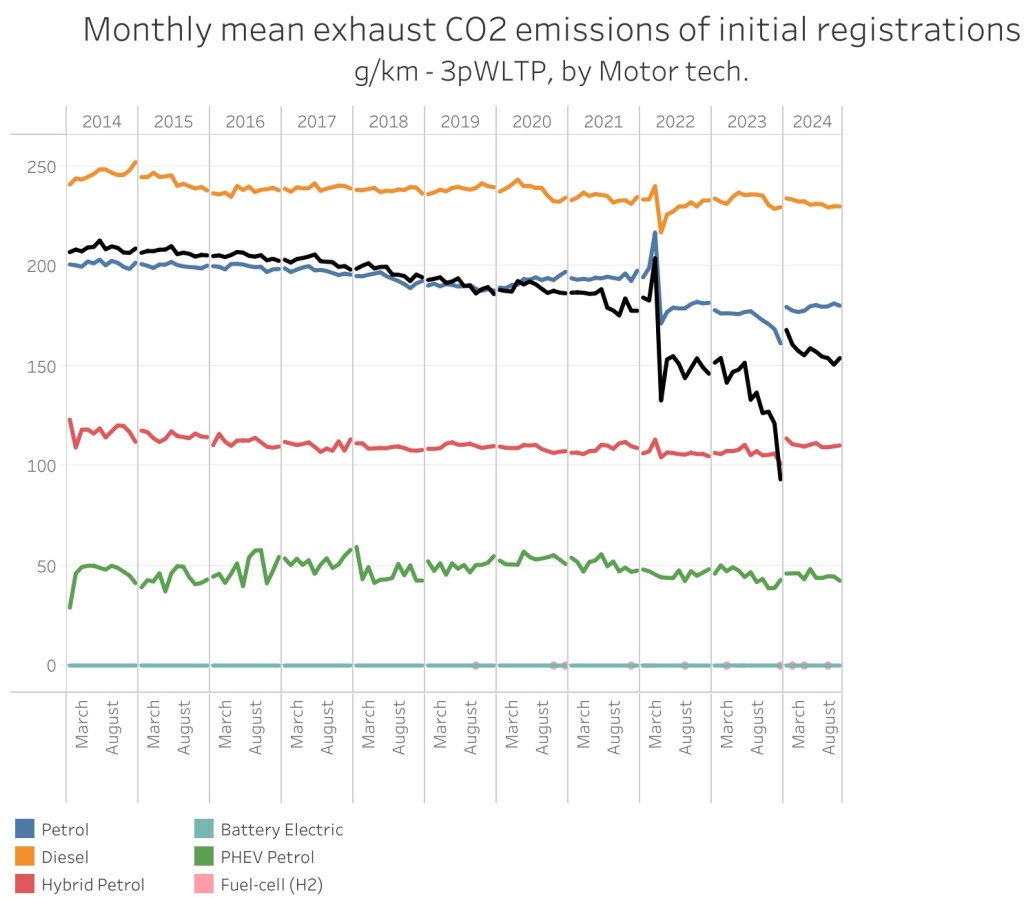
Emissions of newly registered light vehicles, 2014-2024, showing a reduction from 208 gCO2/km in 2014 (8.9 l/100km) to 156 gCO2/km in 2024 (6.7 l/100km). The Clean Car Discount (feebate) was in effect from July 2021 to December 2023. (Source)
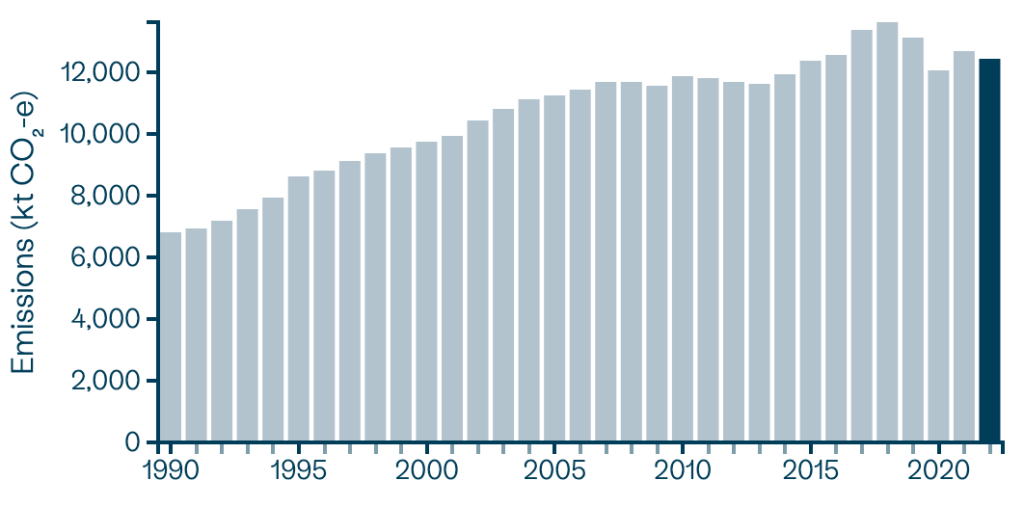
New Zealand’s road transport emissions increased 82% from 1990 to 2022. The increase per capita is 18% (source).
It’s been a similar story of vacillation in almost every other sector. Some of the causes run wide and deep and span the entire problem of climate change itself. Rather than go through the whole history, I want to stick to the 1990 report and ask – did they miss anything? I mean, clearly the authors did not anticipate the strong, organised and persistent opposition that would be raised to virtually any suggestion on how to cut emissions. Perhaps they can hardly be blamed for that. Did they miss anything that could plausibly have been included, and if so, would it have made any difference?
I think they did. They did miss the significant impacts of population growth (57% from 1990 to 2023, faster than the world average) and economic growth (also 57% in real per capita terms, faster than the US). Efficiency gains would have to be really heroic to overcome both of those. Questioning them would have killed the report in any event. Also, the authors weren’t thinking in terms of phasing out fossil fuels entirely, but that need wasn’t widely recognised until fairly recently, and remains a stumbling block even today.
No, the big thing they missed was renewable energy. I could hardly believe it. I had to read the report twice to be sure. In a 100,000-word report (the length of a decent novel), this is all we get:
Surely the central importance of replacing fossil with renewable energy was well established by 1990? It’s even more surprising in view of New Zealand’s long-standing pride in its renewable resources (despite an unfortunate detour into gas in the 1970s). 1990 may have been a bit early for solar, but it was not too early for wind. Denmark was already generating 610 GWh a year from wind power in 1990 (similar to the Manapouri hydropower station), as was California, both having started in the 1970s. A New Zealand energy research group had published a report in 1987 outlining the feasibility of twelve 250 MW wind farms, triple what we have now in 2024. We built the first substantial geothermal power station in the world in 1958 and have never lost our world-leading expertise. Moreover, our second geothermal power station at Ohaaki (producing a sizeable 300 MWh a year) had only just opened the previous year.
I’m at a bit of a loss to explain this. Our experience in renewable energy since then has been one of repeated stops and starts, whereas the evidence from other countries is that large-scale transitions, whether in energy, transport, or otherwise, can take many decades and require sustained consistency of focus. Denmark has only largely decarbonised its electricity supply now, fifty years after their journey started.
Source: New Zealand Energy Quarterly, MBIE
I started out by calling this essay “What have we learned?”. Perhaps that was a bit ambitious. Is the lesson that comprehensive policy development and engagement is not enough? That we should have picked a smaller, more focused target and gone after it hard and fast, to bed in momentum and support? Or should we have been bolder to begin with? In the UK, the Royal Commission on Environmental Pollution (an independent agency in existence from 1970 to 2011) went really hard out in their 1994 report Transport and the Environment. They recommended doubling the price of petrol over the coming ten years, reducing total driving, and greatly curtailing road building. Even though none of that happened, their report is right on the facts, and perhaps it did set the scene for other measures which did eventually come about, and which have survived several changes of government.
Thirty-four years after our first climate report, we have at last turned the corner on emissions. In that sense we are on the way. But the harder step, of achieving a society-wide consensus on where we want to be and how to get there, still lies ahead.
Gillespie, A. (2001). New Zealand and the climate change debate: 1995–1998. In Climate Change in the South Pacific: Impacts and responses in Australia, New Zealand, and small island states (pp. 165-187). Dordrecht: Springer Netherlands.
Cherry, N. (1987). Wind energy resource survey of New Zealand: National resource assessment: summary and final report. New Zealand Energy Research and Development Committee, University of Auckland.
On 25 June, the Government amended the Clean Vehicles Act. This was completed in a single day under urgency, so there was no opportunity for public input. On 9 July, there was a press release saying that New Zealand would now be following Australian emission standards from 2025. On 11 July, the Ministry’s advice was released, giving us a few more details.
Vehicle emissions are reported in grams of CO2 per kilometre (gCO2/km). (For petrol vehicles, 200 gCO2/km is the same as 8.6 l/100km.) Here are the new targets:
Cars
Light commercials (vans & utes)
Previous target
New target
Previous NZ
New target
2023
145
218.3
2024
133.9
201.9
2025
112.6
112.6
155
223
2026
84.5
108
116.3
207
2027
63.3
103
87.2
175
2028
76
144
2029
65
131
The Minister talked to the Motor Industry Association (MIA), the Imported Motor Vehicle Industry Association (VIA), the Motor Trade Association (MTA) and the New Zealand Automobile Association (AA). We don’t have their reports, but, judging by what has been released, the Minister has accepted their reasoning at face value and rubber stamped their request. Neither Tesla nor Drive Electric (not members of the MIA) were consulted.
The Ministry report that their modelling of the emissions impact of this change has not been completed yet, but they do provide a rough estimate of an increase of emissions by 0.3–0.5 MtCO2 over 2024-2050. Another department, the Climate Impact of Policy Assessment, puts the increase at 1.2–1.9 MtCO2, but regards this as unreliable on the grounds that the previous targets were unlikely to be met – which is the car industry’s argument.
The car industry appears to take the position that they will do nothing whatsoever to respond to the targets, and just let the market take its course. Car importers would pay fines rather than try to meet the target. One key figure (which was also provided to Cabinet) is their estimate that this would add $5,500 to the price of every new light vehicle in 2027.
The fines are set at $45/gCO2, so the MIA are saying they’ll miss the targets by 122 gCO2 on average. The target for all light vehicles is 71 gCO2/km, so they’re saying they expect to sell vehicles averaging 193 gCO2/km in 2027, or nearly triple the target. That level (193 gCO2/km) is what we had already reached in 2021, before the introduction of the feebate and fuel efficiency standards. In 2022 the average was 167g; in 2023, 145g.
These industry and ministry figures look like nonsense, so let’s do a back-of-the-envelope calculation. Assuming no change in overall levels of sales, and that the targets are met, the annual extra emissions from vehicles sold in 2025 will be 46,000 tCO2; in 2026, 132,000 tCO2; in 2027, 120,000 tCO2. Over the 20 year life of the vehicles, the extra emissions from sales in these three years alone are 7.14 MtCO2.
That’s all assuming the targets are met. The industry says they won’t be. But one thing we did learn from the feebate experience is that both the industry and the car buying public are incredibly responsive to signals. Under the previous government, the signal was that it’s time to get serious about cutting emissions. The price signal (the rebate) was only part of that. EV sales vastly exceeded expectations, and the industry delivered. After the election, the signaling changed; the only electric ute on the market was withdrawn less than a week later.
Source: Ministry of Transport. The Clean Car Discount (feebate) was introduced progressively in July 2021 and April 2022, and cancelled in January 2024. Chart includes both new and newly imported used vehicles.
Second, missing the targets still achieves something. Fines are a deterrent and a signal to the industry. If they’re added to the price of higher-emitting vehicles, those sales will slow. Even for utes, that’s not the end of the world, it just means a slower replacement cycle until better vehicles are available. This will still prevent new, high-emission models entering the country and sticking around for decades.
There is one issue, though, which is that the fines, at $45/g, are low by international standards. They were set low because at that time, the intention was that the feebate would be doing most of the work and the Standards were mostly a backstop. In Australia, whose standards we are now adopting, the fines are $111/g, and in Europe, $170/g. (In Europe, where emissions in 2021 were already 40% below ours, not a single car company has had to pay fines for missing the targets.) Australia and Europe have extensive systems of incentives in place, which helps. New Zealand importers also have heaps of cheap credits available from overachieving in 2023 that (in another change) can now be used up until 2027.
When the Minister of Climate Change was asked about the impact on emissions, he said that “Clean car standards … have quite an insignificant impact in regards to overall emissions targets”. The relevant number to compare to here is not total emissions, but the required annual emissions cuts as we move into the late 2020s. Those are about 2 MtCO2 per year. In that context, the change due the weakening of fuel efficiency standards – 6% of so of the total effort required – is significant.
However, the Ministry has an answer there too:
In our view the proposed targets will not impact the ability for the first emissions budget (or subsequent ones) to be met. This is because transport emissions are covered by the ETS, therefore changing the Standard’s targets might change how or where emissions reductions occur from a gross perspective, but not from a net perspective.
This comes pretty close to the common argument that nothing the government or anyone else does has any impact on emissions; if I emit more, others will emit less so that the carbon budgets are met. But, they throw in an extra twist by bringing in the gross/net distinction: basically the argument is that more trees will be planted to cover the extra emissions. None of these arguments hold water, but even if we accept them at face value, actions that lead to higher emissions in one sector will definitely have an effect on those other sectors that will now have to make up the difference. For example, through a higher carbon price. However, it appears that this effect was not considered.
The new targets do get tighter over time, particularly in 2028 and 2029. If those are met, we could still be on track to end fossil-fueled vehicle sales by 2035, as in Europe. (The new UK government is reinstating a 2030 end date.) But there are two caveats. First, Australia has an election next year. The opposition could easily make emissions standards an issue, as they tried unsuccessfully to do in the last election (“Ute tax!”). A change of government could see the Australian standards weakened, as has happened here. Second, our own new standards will be reviewed again in 2026. On present performance, the MIA would only need a quiet word in the Minister’s ear to wind back the standards.
The purpose of a fuel efficiency standard is to radically change the make-up of the fleet as quickly as possible. There do have to be changes. But the whole tenor of the Ministry’s advice is that no one should have to change or pay any more, the overriding goal is that “vehicle affordability is maintained and the mix of vehicles imported meets the needs of New Zealanders.”
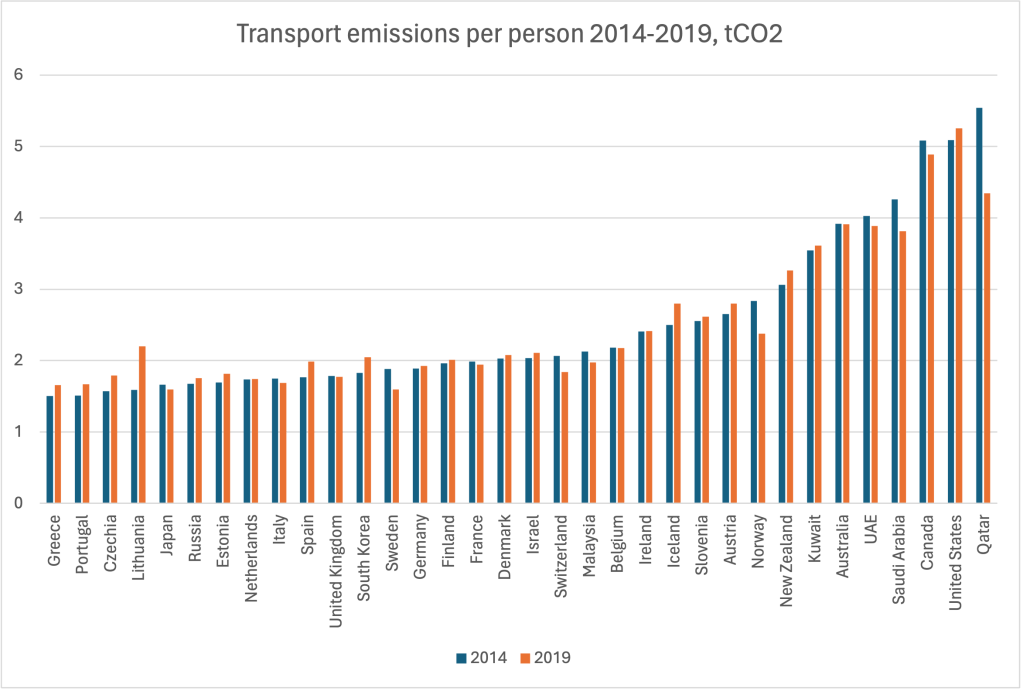
Reducing transport emissions is difficult, and it is something that many countries struggle with. But some countries are trying and are starting to see results.
Source: Our World in Data. Sweden has a target reaching of 0.6 tCO2/p in 2030.
Weakening fuel efficiency standards is the third of four parts of the Government’s “War on EVs“. Part 1 was ending the feebate; part 2 was the introduction of Road User Charges (RUC) for EVs, at a punishing rate. Iceland is the only other country in the world to try this, and there too sales have collapsed. Basically we are in uncharted waters. Part 3 is now done. Part 4 is still to happen: it’s the Government’s signaled intention to replace petrol tax with RUC for all vehicles. As petrol tax is currently equivalent to a carbon charge of $360/tCO2, this would amount to a hefty carbon tax cut and hence would also act to increase transport emissions. The extra cost of driving a hybrid (where sales are still holding up well) could be significant.
Fuel consumption l/100km
Current fuel/RUC cost cents/km
Fuel/RUC cost under an RUC-only system
0 (Battery electric)
12
12
4 (small hybrid)
10
14.5
6 (normal hybrid)
15
18
8 (normal car)
20
21.5
10 (large car)
25
25
12 (large ute)
30
28.5
Assumptions: Petrol $2.50/l, electricity 29c/kWh, RUC 7.6c/km
RenewEconomy is a well-established Australian website focusing on green energy. Last week, they published an article by Andrew Blakers based around the claim that “New solar capacity is being installed faster than anything else in history.”
This received some push-back online (“disinformation!”), on the grounds that
(i) this is only electricity, not total energy; and
(ii) nature doesn’t care how fast something is installed, only about emissions.
We were directed to look at this graph from Our World in Data:
It’s true that solar forms a minute part (2%) of the energy supply as yet, and that emissions of no single fossil fuel has peaked, not even coal.
But the topic at hand is change, and for that we have to look a bit closer.
The low-emission transition is based on two main things:
(i) decarbonising electricity; and
(ii) switching all other energy uses to electricity (“electrify everything”).
You could add more items, such as using less energy in the first place, but that wouldn’t prevent the need for (i) and (ii).
Andrew Blakers is Emeritus Professor of Renewable Energy at the Australian National University, well-known for his work on 100% renewable energy futures and his contribution to the development of solar PV technology. I would be surprised if he had messed anything up.
On the surface the claim passes easily: 360 GW (gigawatts) of solar PV was installed in 2023 (the IEA says even more, 510 GW), and the fastest period of coal installation that I can find is 75 GW per year, in the mid 2000s.
But it’s more instructive to look at electricity generation, rather than just installed capacity. Solar has a particularly low capacity factor – it generates less when it’s cloudy, and not at all at night time. It’s also at risk of going unused when too much is generated at the same time.
To look at this I have carried out the following steps:
I downloaded data on world electricity generation from ember.org.
As generation fluctuates a lot from year to year, I smoothed the data to reveal the underlying trend.
I computed the change in generation from each year to the next.
Steps 1 and 2 give the following results for the 6 main sources of electricity:
Solar is the smallest of the six, and the fossil sources are still growing.
Step 3 gives the following results for the growth rate of each source of electricity:
Coal’s rate of growth peaked at 300 TWh (terawatt-hours) per year in 2005 (the rise of China); it then declined until 2019 before accelerating again. Some of that is offset by a slowdown in gas. But still, the combined slowdown of coal and gas stopped in 2020, which is alarming.
Solar added nearly 300 TWh in 2023, more than any other source, and pretty much matching coal’s old record. Actually, the 2023 data from Ember is provisional – if the IEA’s estimate is correct, the increase could be 400 TWh.
My conclusion is that the original headline (“solar is being installed faster than any technology history”) may be a bit breathless and lacking context, but the underlying trend is clear, and the record is significant. 2023 really was off the charts, and more is yet to come. Solar power generation is increasing as fast as any kind of electricity has ever done. This has been done despite many regions placing no restrictions on fossil fuels at all, and the global average carbon price being just US$5/tonne.
[This is my personal submission to the Draft Government Policy Statement on land transport. Submissions close at noon on Tuesday 2 April, 2024.]
In the Emissions Reduction Plan (ERP1), transport emissions fall 41% by 2035. As the Ministry of Transport says, “Achieving this will reduce our dependence on fossil fuels and give us a more sustainable, inclusive, safe and accessible transport system that better supports economic activity and community life.” There is plenty of detail in the plan:
The plan is supported by four specific transport targets:
Target 1 – Reduce total kilometres travelled by the light fleet by 20 per cent by 2035 through improved urban form and providing better travel options, particularly in our largest cities.
Target 2 – Increase zero-emissions vehicles to 30 per cent of the light fleet by 2035.
Target 3 – Reduce emissions from freight transport by 35 per cent by 2035.
Target 4 – Reduce the emissions intensity of transport fuel by 10 per cent by 2035.
Targets 1 and 3 are wrecked by the Draft GPS, while Target 4 is already suspended. Target 2 is also threatened by related government actions to slow the uptake of EVs and other low-emission vehicles: cancelling the CCD, imposing high RUCs on EVs (a world first), proposing to weaken the CCS, and proposing to replace fuel tax by RUCs based on distance and weight.[1] The Ministry advise that the first two of these alone may limit EV share of the light vehicle fleet to 7% by 2030 (and 23% market share)[2], vs. 12.5% in the Climate Change Commission’s Demonstration Path (and 64% market share), putting the 2035 target at risk. However, the Ministry’s model involves 22,000 EV sales in 2024. In fact there were only about 1,700 sales in the first quarter.
The ERP1 for transport is not rocket science and should not be at all controversial. Internationally, all transport climate plans include the basic elements of fuel standards, mode shift, public transport planning. The IPCC in their summary of evidence say the same thing. The debate is over the mixture of fees, incentives, regulations, and bans, not over the direction of travel. The Draft GPS would wreck this plan. Spending on walking, cycling, and public transport would reduce and become highly constrained. Spending on rail infrastructure would reduce drastically, which could render the national rail network non-viable. That in turn wrecks the New Zealand Rail Plan, intended to increase the proportion of heavy freight carried by rail by building high-tech truck/rail freight hubs and new rail ferries.
Dropping climate from the GPS drops it from NZTA, currently the lead agency charged with delivering emissions reductions from transport. What could replace it? The government is committed to meeting the emissions budgets, but have not yet released much detail about how they plan to do that, other than that the ETS will be the main tool.
But it is well known that carbon charges are not an effective way to reduce transport emissions. At current prices the ETS adds 15 cents per litre to the price of petrol, or $15/1000 km. The RUC rate for light vehicles is $76/1000 km. The carbon price would have to increase by a factor of five just to match that, which is unthinkable – it would destroy all other exposed sectors.
This issue has been covered extremely thoroughly in the international literature. In 2022, I co-authored a review with David Hall on “Why emissions pricing can’t do it alone”[3]. The Climate Change Commission identified ten types of barriers to a low-emission transition; tellingly, transport is the only sector for which they proposed specific fixes for all ten barriers. Nearly all of them are under attack.
So it is really flying in the face of evidence think that the ETS can be our main climate tool, particularly for transport. Details are lacking – Minister of Climate Change Simon Watts will only say that work on the second Emissions Reduction Plan (2026-2030) is under way. Analyst Christina Hood has repeatedly detailed how the ETS will struggle to deliver even under present conditions[4].
Emissions reductions first entered the GPS in 2015, under John Key. It was raised to a strategic priority in 2018 and 2021, but now it is proposed to be dropped. Presumably, all work streams in NZTA related to emissions reduction will be stopped and all work teams dissolved. So, despite all the other alarming and potentially disastrous parts of the Draft GPS, this one is the worst.
Section 5ZI(3) of the Climate Change Response Act 2002 states that
The Minister may, at any time, amend the plan and supporting policies and strategies to maintain their currency, (a) using the same process as required for preparing the plan; or (b)in the case of a minor or technical change, without repeating the process used for preparing the plan.
But the Draft GPS states, in contrast, that
Following the general election and a change of government in late 2023, the intended emissions reduction policies foreshadowed by the previous Government are being reassessed. For this reason, GPS 2024 has not undertaken the alignment exercise as anticipated in ERP1. The Emissions Trading Scheme (ETS) is the Government’s key tool to reduce emissions. In addition to the ETS, matters relating to climate change/emissions reduction issues are being worked through and will be addressed during development of the second Emissions Reduction Plan (ERP2).
Thus both the Draft GPS and the decision to not perform the alignment exercise are in violation of the Climate Change Response Act 2002. Note that the relevant “plan” referred to in section 5ZI(3) in this case is ERP1, not ERP2. In addition, many of the activities needed to support the 2nd and 3rd carbon budgets need to be undertaken in the first budget period.
Slower transport emissions reductions from existing policies mean that other policies will need to be developed to replace them. I am skeptical that the two that have been announced – higher carbon prices and faster EV charger rollout – can make up the difference. But at the very least the modelling and policy advice to support this approach should be published. To put it another way, the climate plan and the transport plan should be prepared together. But they have not been prepared together in what appears to be a deliberate strategy.
Another possibility is transport emissions will be allowed to decrease more slowly that previously intended and that other sectors will make up the difference. But transport is so large a share of emissions that it is hard to know where the other savings could come from. Three other large sectors are agriculture, industry, and trees. The first two may struggle to deliver greater cuts, while trees are already performing a far greater share of net emissions reductions than in any other developed country and are also facing policy challenges and risk transferring climate obligations to future budget periods.
To sum up, the Draft GPS constitutes climate denial.
Recommendations
R1. Perform the alignment exercise required of the GPS by ERP1.
R2. As the proposed changes to ERP1 are neither minor nor technical in nature, but strike directly at its heart, revise ERP1 using the process required by the Climate Change Response Act.
R3. Publish the legal advice received regarding R1 and R2 above.
R4. Reinstate emissions reduction as a strategic priority of the GPS.
the forces for increasing fossil fuel burning were vastly more powerful than the puny forces opposing them. All the talk about climate change in 2017–2019 had little effect on the behaviour of companies or individuals.
Have we turned the corner? Possibly. The pro-fossil fuel forces are still there, but the opposing forces are gathering strength, especially through the Zero Carbon Act which for the first time includes a falling cap on emissions. In the most sensitive sector, electricity, the changes can be seen already. My takeaway from the new 2019 data is that the big four, road transport, aviation, electricity, and food processing, that are so large, that have performed so poorly, and that have so much scope for transformation, are where we need to look for change.
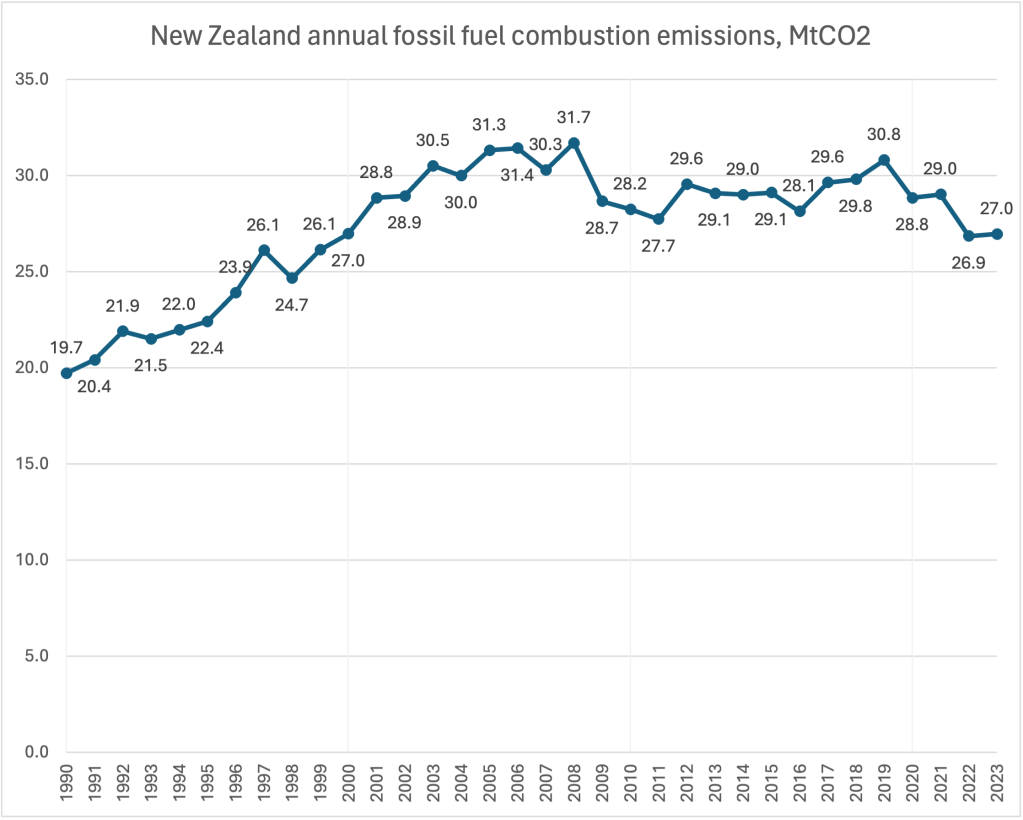
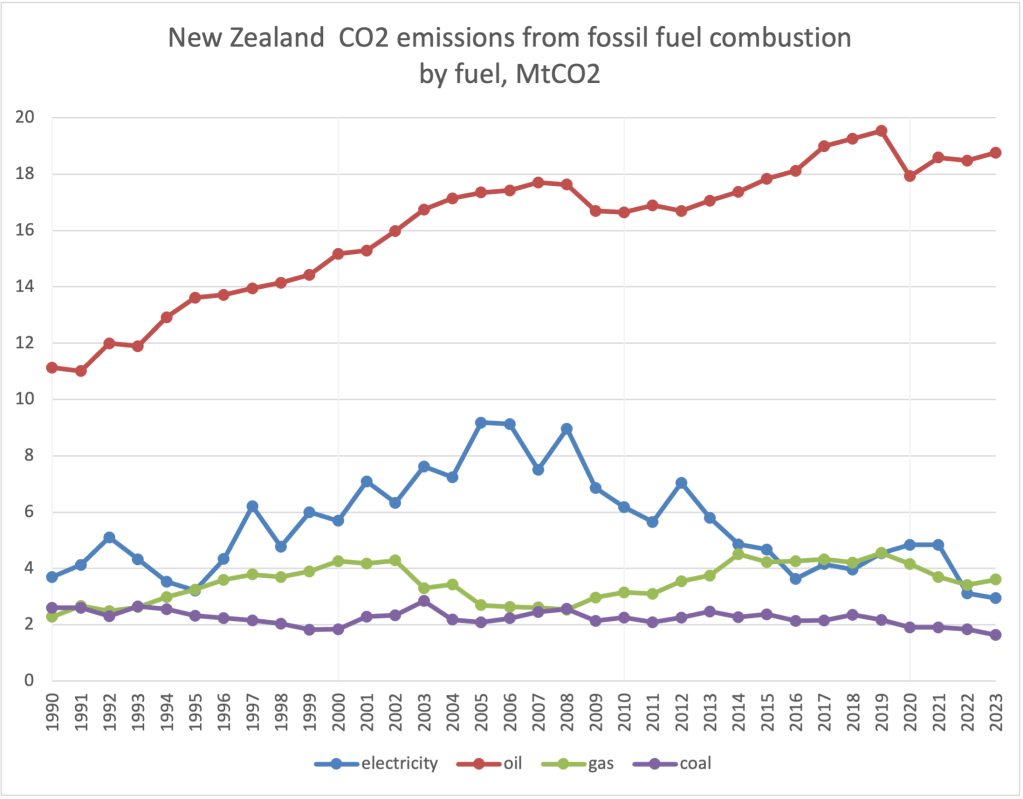
We don’t have full emissions data yet for 2023, but MBIE have just released a partial snapshot covering emissions from the burning of fossil fuels, which contribute 85% of gross CO2 emissions. 2023 was the first full post-lockdown year – travel restrictions were only eased in early and mid-2022.
Although emissions are up slightly, they are still well below the blow-out year of 2019, and stand at 23-year lows. 2022 and 2023 comprise the first half of the first 2022-2025 carbon budget, so low emissions in these two years will definitely help us meet the budget.
But digging into things in more detail, progress is not so great. Here’s the breakdown by fuel.
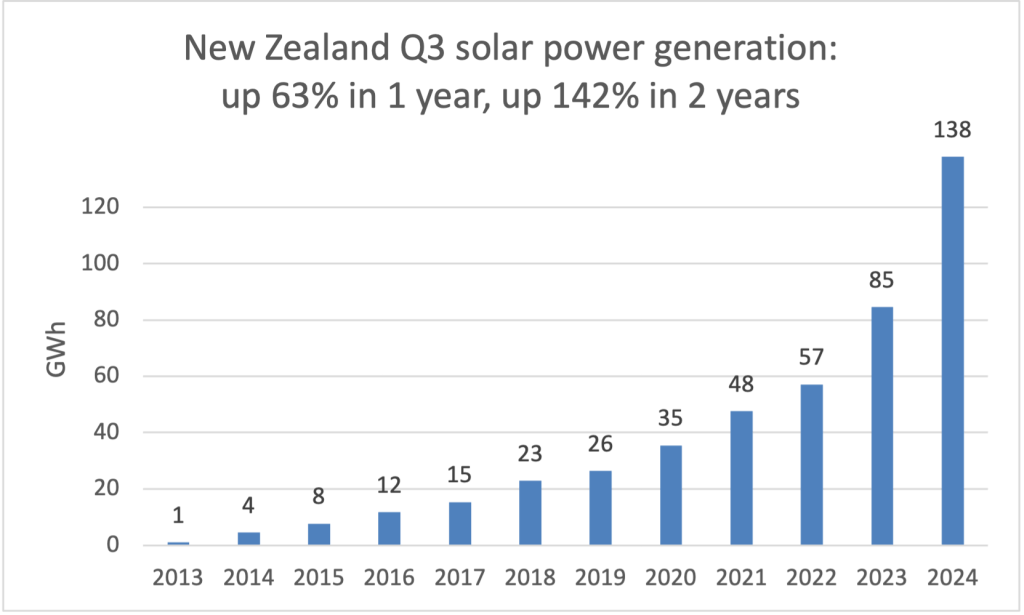
This shows that the fall in emissions in 2022-23 was due to falling electricity emissions, caused by full hydro lakes (hydro generation up 4200 GWh on the previous two years, or 5% of total generation) and new wind farms (up 1100 GWh). Solar (up 290 GWh) also started to make an appearance. That doesn’t mean that electricity emissions will bounce back, though: another 2800 GWh of new renewable generation is planned for the next three years, so even in an ‘average’ rain year we should be alright.
Clearly a major culprit is oil. It’s a big chunk of these emissions (70%) and it’s hard to move. Oil consumption is down on record highs, but not by much – closing the Marsden Point oil refinery in mid-2022 shifted 0.8 MtCO2 of emissions offshore, accounting for the whole decline.
The Clean Car Discount was introduced in mid-2021, and staying in place for 2 1/2 years, but has now ended. Road User Charges will be introduced on EVs in two weeks’ time, at a proposed rate of $76/1000 km – New Zealand will be the first country in the world to do this. (In Australia, the state of Victoria did impose RUCs on EVs, at A$25/1000 km, but this was annulled by the High Court last year.) There are also threats to weaken future fuel efficiency standards and to remove fuel excise duty entirely. Together these amount to a war on EVs which may lead to significant upward pressure on emissions. The fact that all the EVs in New Zealand are only saving 0.14 MtCO2 a year at present – too small to even see on the above graph – doesn’t mean they’re a failure, it just shows the scale of the problem and the persistence that is required.
Of course EVs are not the only or even the most important solution to transport emissions. In 2021 I wrote that “big battles over mode shift lie ahead” and these have now come to pass with the release of the Government’s draft policy statement on transport, which drastically de-emphasises cycling, passenger rail, and public transport. Climate Liberation Aotearoa have a handy mantra:
The first three are part of the first Emissions Reduction Plan, but the Government appears to think it is free to ignore the plan. As I read it, they are in violation of the Zero Carbon Act, which says that
The Minister may, at any time, amend the plan and supporting policies and strategies to maintain their currency (a) using the same process as required for preparing the plan; or (b) in the case of a minor or technical change, without repeating the process used for preparing the plan.
In the Manawatū region of New Zealand where I live, the Horizons Regional Council plans for climate change impacts under the high-emission “RCP8.5” scenario. This is a scenario in which no attempts are made to reduce emissions – the track we were on for decades. In this scenario, emissions triple by 2100 and coal burning expands by a factor of six.
This is now considered highly unlikely. So why is it still used for planning?
The Ministry for the Environment recommends
using the middle-of-the-road scenario (RCP4.5) and the fossil-fuel intensive development scenario (RCP8.5), and screening hazard and risk assessments for longer-term coastal impacts up to 2130 (RCP8.5).
RCP4.5 reflects moderate emissions and implementation of current global emissions reduction policy settings. It represents limiting the rise in global air temperature to 2.7°C by 2100.
RCP8.5 broadly aligns with emissions-reduction practice over the past few decades. It reflects high emissions, limited mitigation measures and no global emissions reduction policy settings. This scenario represents a rise in global air temperature to 4.4°C by 2100. RCP8.5 enables local government to understand the full extent of possible climate risk. It is particularly important for developments with a long timeframe (more than 100 years), especially for climate-sensitive projects and coastal planning activities, due to the very long time-lag (from decades to centuries) between sea level rising and seeing the effects on developments.
RCP8.5 is relevant not just as a worst-case scenario of emissions. The key point is that it gives an idea of a bad-case outcome for the climate response even under moderate emissions. For that reason, only RCP8.5 should be used for planning; RCP4.5 still allows a completely unacceptable level of risk.
Climate change predictions are highly uncertain. One measure is the “Equilibrium Climate Sensitivity”, the increase in temperature in response to a doubling of CO2, after short- and medium-term feedbacks have entered equilibrium. (“Medium-term” means decades to a few centuries). This has long been estimated at 2–4.5 ºC, with an average of 3 ºC. We are currently at just over half a doubling, resulting in 1.3 ºC of warming, although not all those feedbacks have yet run to equilibrium.
2–4.5 ºC is a wide range, and that’s only the “most likely” values – a 66% probability. If the sensitivity is actually on the high side, then even moderate emissions will lead to much greater impacts.
There are two fundamental reasons why the uncertainty is so large and has proven difficult to reduce.
First, there are many climate feedbacks. Some lead to more warming and some to cooling. Each is hard to predict accurately because of the long time scales and complicated interactions of the atmosphere and ocean.
Combining effects of the same sign needn’t increase uncertainty:
A = 10 ± 1 (10% uncertainty)
B = 10 ± 1 (10% uncertainty)
A + B = 20 ± 2 (10% uncertainty)
But combining effects of opposite sign always increases uncertainty:
A = 10 ± 1 (10% uncertainty)
B = –5 ± 0.5 (10% uncertainty)
A + B = 5 ± 1.5 (30% uncertainty)
Secondly, the uncertainty is worse on the high side:
Here the most likely response is 3 ºC, but very large values (6 ºC or even higher) are possible. In the most recent IPCC report (AR6) the most likely range was reduced somewhat, to 2.5 ºC–4 ºC. However, this was due in part to discarding a number of “hot models” that showed higher sensitivity. (In those models, forecasts of less clouds meant less sunlight reflected directly back to space, and hence more warming.) And that was done for a good reason, namely that the mid-range models fit the observed warming extremely well:
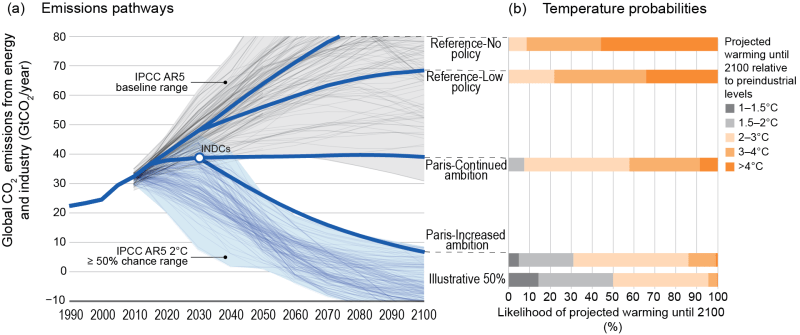
The takeaway message is that even under moderate emissions, there is still a pretty decent chance of catastrophe.
Allen Fawcett et al., Can Paris pledges avert severe climate change? Science, 2015.
Here the “no policy” scenario (RCP8.5) gives a 90% chance of more than 3 ºC of warming by 2100. But even “Paris–continued ambition” (which assumes that all countries in the world achieve their 2030 targets and continue decarbonising at the same rate) has a 42% chance of exceeding 3 ºC. Only “Increased ambition”, in which decarbonisation accelerates greatly after 2030, gives a decent 14% chance of avoiding 3 ºC. That’s an “extreme climate change” scenario, with up to 60% of the global population at risk of starvation.
Risk is a funny thing. For aircraft, we think a 1-in-10 million chance of a crash is an acceptable level of risk. If a crash is linked to a design flaw, the entire global fleet of that model is grounded indefinitely. For flooding, we’ve settled on a 1-in-500 annual risk of catastrophic urban flooding in any given location. (In Palmerston North, stop banks were upgraded to that level just in time to survive the 2004 floods.) For climate change, a 50-50 risk of complete annihilation is met with “that’s the best we can do”.
















 Planetary Ecology