Government drastically weakens emissions standards

By Robert McLachlan

On 25 June, the Government amended the Clean Vehicles Act. This was completed in a single day under urgency, so there was no opportunity for public input. On 9 July, there was a press release saying that New Zealand would now be following Australian emission standards from 2025. On 11 July, the Ministry’s advice was released, giving us a few more details.

Vehicle emissions are reported in grams of CO2 per kilometre (gCO2/km). (For petrol vehicles, 200 gCO2/km is the same as 8.6 l/100km.) Here are the new targets:

 CarsLight commercials (vans & utes)
 Previous targetNew targetPrevious NZNew target
2023145 218.3 
2024133.9 201.9 
2025112.6112.6155223
202684.5108116.3207
202763.310387.2175
2028 76 144
2029 65 131

The Minister talked to the Motor Industry Association (MIA), the Imported Motor Vehicle Industry Association (VIA), the Motor Trade Association (MTA) and the New Zealand Automobile Association (AA). We don’t have their reports, but, judging by what has been released, the Minister has accepted their reasoning at face value and rubber stamped their request. Neither Tesla nor Drive Electric (not members of the MIA) were consulted.

The Ministry report that their modelling of the emissions impact of this change has not been completed yet, but they do provide a rough estimate of an increase of emissions by 0.3–0.5 MtCO2 over 2024-2050. Another department, the Climate Impact of Policy Assessment, puts the increase at 1.2–1.9 MtCO2, but regards this as unreliable on the grounds that the previous targets were unlikely to be met – which is the car industry’s argument.

The car industry appears to take the position that they will do nothing whatsoever to respond to the targets, and just let the market take its course. Car importers would pay fines rather than try to meet the target. One key figure (which was also provided to Cabinet) is their estimate that this would add $5,500 to the price of every new light vehicle in 2027.

The fines are set at $45/gCO2, so the MIA are saying they’ll miss the targets by 122 gCO2 on average. The target for all light vehicles is 71 gCO2/km, so they’re saying they expect to sell vehicles averaging 193 gCO2/km in 2027, or nearly triple the target. That level (193 gCO2/km) is what we had already reached in 2021, before the introduction of the feebate and fuel efficiency standards. In 2022 the average was 167g; in 2023, 145g.

These industry and ministry figures look like nonsense, so let’s do a back-of-the-envelope calculation. Assuming no change in overall levels of sales, and that the targets are met, the annual extra emissions from vehicles sold in 2025 will be 46,000 tCO2; in 2026, 132,000 tCO2; in 2027, 120,000 tCO2. Over the 20 year life of the vehicles, the extra emissions from sales in these three years alone are 7.14 MtCO2.

That’s all assuming the targets are met. The industry says they won’t be. But one thing we did learn from the feebate experience is that both the industry and the car buying public are incredibly responsive to signals. Under the previous government, the signal was that it’s time to get serious about cutting emissions. The price signal (the rebate) was only part of that. EV sales vastly exceeded expectations, and the industry delivered. After the election, the signaling changed; the only electric ute on the market was withdrawn less than a week later.

Source: Ministry of Transport. The Clean Car Discount (feebate) was introduced progressively in July 2021 and April 2022, and cancelled in January 2024. Chart includes both new and newly imported used vehicles.

Second, missing the targets still achieves something. Fines are a deterrent and a signal to the industry. If they’re added to the price of higher-emitting vehicles, those sales will slow. Even for utes, that’s not the end of the world, it just means a slower replacement cycle until better vehicles are available. This will still prevent new, high-emission models entering the country and sticking around for decades.

There is one issue, though, which is that the fines, at $45/g, are low by international standards. They were set low because at that time, the intention was that the feebate would be doing most of the work and the Standards were mostly a backstop. In Australia, whose standards we are now adopting, the fines are $111/g, and in Europe, $170/g. (In Europe, where emissions in 2021 were already 40% below ours, not a single car company has had to pay fines for missing the targets.) Australia and Europe have extensive systems of incentives in place, which helps. New Zealand importers also have heaps of cheap credits available from overachieving in 2023 that (in another change) can now be used up until 2027.

When the Minister of Climate Change was asked about the impact on emissions, he said that “Clean car standards … have quite an insignificant impact in regards to overall emissions targets”. The relevant number to compare to here is not total emissions, but the required annual emissions cuts as we move into the late 2020s. Those are about 2 MtCO2 per year. In that context, the change due the weakening of fuel efficiency standards – 6% of so of the total effort required – is significant.

However, the Ministry has an answer there too:

In our view the proposed targets will not impact the ability for the first emissions budget (or subsequent ones) to be met. This is because transport emissions are covered by the ETS, therefore changing the Standard’s targets might change how or where emissions reductions occur from a gross perspective, but not from a net perspective.

This comes pretty close to the common argument that nothing the government or anyone else does has any impact on emissions; if I emit more, others will emit less so that the carbon budgets are met. But, they throw in an extra twist by bringing in the gross/net distinction: basically the argument is that more trees will be planted to cover the extra emissions. None of these arguments hold water, but even if we accept them at face value, actions that lead to higher emissions in one sector will definitely have an effect on those other sectors that will now have to make up the difference. For example, through a higher carbon price. However, it appears that this effect was not considered.

The new targets do get tighter over time, particularly in 2028 and 2029. If those are met, we could still be on track to end fossil-fueled vehicle sales by 2035, as in Europe. (The new UK government is reinstating a 2030 end date.) But there are two caveats. First, Australia has an election next year. The opposition could easily make emissions standards an issue, as they tried unsuccessfully to do in the last election (“Ute tax!”). A change of government could see the Australian standards weakened, as has happened here. Second, our own new standards will be reviewed again in 2026. On present performance, the MIA would only need a quiet word in the Minister’s ear to wind back the standards.

The purpose of a fuel efficiency standard is to radically change the make-up of the fleet as quickly as possible. There do have to be changes. But the whole tenor of the Ministry’s advice is that no one should have to change or pay any more, the overriding goal is that “vehicle affordability is maintained and the mix of vehicles imported meets the needs of New Zealanders.”

Reducing transport emissions is difficult, and it is something that many countries struggle with. But some countries are trying and are starting to see results.
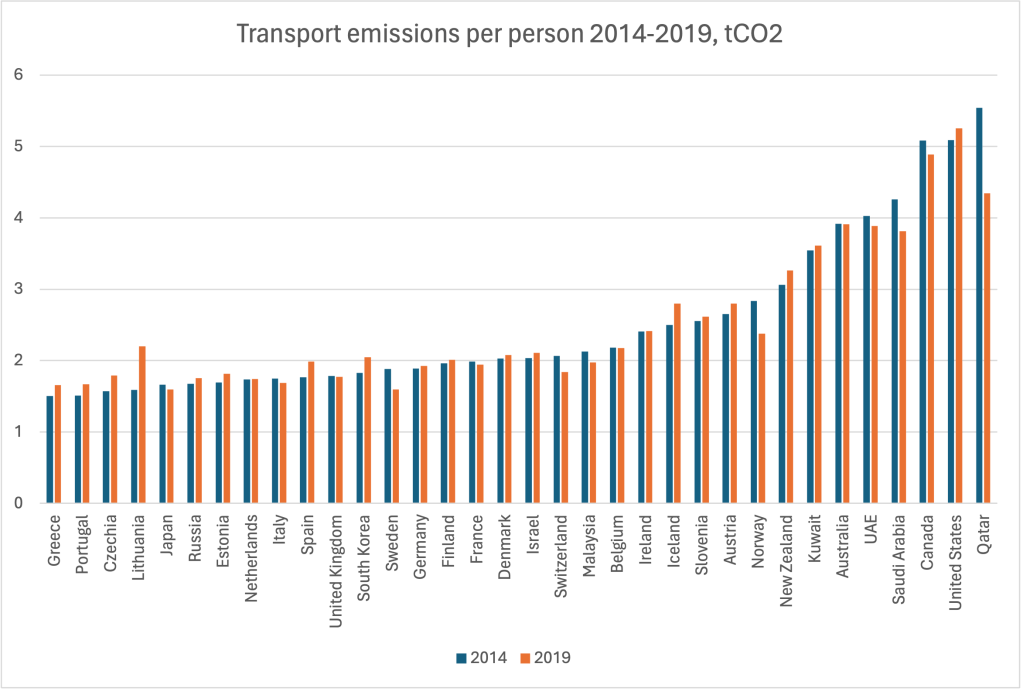
Source: Our World in Data. Sweden has a target reaching of 0.6 tCO2/p in 2030.

Weakening fuel efficiency standards is the third of four parts of the Government’s “War on EVs“. Part 1 was ending the feebate; part 2 was the introduction of Road User Charges (RUC) for EVs, at a punishing rate. Iceland is the only other country in the world to try this, and there too sales have collapsed. Basically we are in uncharted waters. Part 3 is now done. Part 4 is still to happen: it’s the Government’s signaled intention to replace petrol tax with RUC for all vehicles. As petrol tax is currently equivalent to a carbon charge of $360/tCO2, this would amount to a hefty carbon tax cut and hence would also act to increase transport emissions. The extra cost of driving a hybrid (where sales are still holding up well) could be significant.

Fuel consumption
l/100km
Current fuel/RUC cost
cents/km
Fuel/RUC cost under
an RUC-only system
0 (Battery electric)1212
4 (small hybrid)1014.5
6 (normal hybrid)1518
8 (normal car)2021.5
10 (large car)2525
12 (large ute)3028.5
Assumptions: Petrol $2.50/l, electricity 29c/kWh, RUC 7.6c/km

We (still) need to talk about cars

By Robert McLachlan

To address climate change, we need to phase out the burning of fossil fuels. The largest share of fossil fuels is burnt in cars and trucks. So it seems clear that fossil-fuelled vehicles need to stop being designed, made, imported, and driven. But anyone who has visited a road or seen a car ad recently knows that that isn’t happening, or, if it is, it’s happening so imperceptibly slowly as to hardly make a difference.

In New Zealand the situation is particularly acute, as we are now very, very far down the path towards a system dominated by urban sprawl and private cars, with little regulation of either. Road transport emissions doubled between 1990 and 2018. In the US they rose 30% in the same period, and in the UK, just 6%, which campaigners still point out is woefully insufficient.

Soon we will start to take steps to turn this ship around. It may or may not be quick, it may or not be easy. But it’s probably not going to be both quick and easy. As plans start to crystallise, there is certain to be a lot of back-and-forth between different factions.

Let’s take a look at the protagonists.

In the green corner: the climate advocates.

There are hundreds of advocacy groups, but a good example is 1.5 Project, led by Paul Winton. He points out that to fulfil our obligations under the Paris Agreement, we need to cut emissions 60% by 2030. Many sectors (such as the dairy industry, which creates huge emissions burning coal and gas to dry milk into milk powder) already have transition plans in place, and, in any event, are valuable and productive industries. So he concludes that road transport has to be virtually emission-free by 2030.

His and similar voices are being heard. For example, Auckland and Wellington councils have set made climate goals that require road transport emissions to at least halve by 2030. But targets like this are very, very difficult to achieve. They would mean essentially no new fossil-fuels vehicles entering the fleet, starting immediately. Unfortunately, hundreds of thousands are being imported every year, and people are buying them.

Passing to the red corner: the Labour government

The Government has a plan already prepared: the Clean Car Standard. It was developed and widely discussed in 2019 and taken into the 2020 election. It’s a fuel efficiency standard for new (or newly imported) vehicles, something that almost all developed countries have had for years, and that New Zealand would have had too in 2009, had not the incoming government of John Key blocked it. (You can read the official reasons in the cabinet papers; even in 2009 they must have seemed somewhat flimsy, and of course they have not stood the test of time.)

In the Standard as originally designed, the average fuel efficiency of all vehicles (of each importer) must meet a certain target that gets progressively more stringent. This was set at 161 gCO2/km in 2022, falling to 105 gCO2/km by 2025. The Standard was predicted to cut emissions  by 2 million tonnes of CO2 a year (about 13% of road transport emissions) by 2030, for a net savings of $2.4 billion.

Growth, 1990–2018Per person, 1990Per person, 2018Per vehicle4Targets
USA+30%4.8 tCO24.8 tCO2300 gCO2/km135 gCO2/km 20261
UK+6%1.94 tCO21.78 tCO2220 gCO2/km81 gCO2/km 20252
NZ+99%2.19 tCO23.06 tCO2330 gCO2/km105 gCO2/km 20253
Road transport emissions compared. 1For cars and light trucks (i.e. utes) combined; Obama target was 117g. 2EU target for cars only. Target 125g for light trucks. 3Proposed in the Clean Car Standard for cars and light trucks. Current new light vehicles average 180 gCO2/km. 4For the entire current fleet including heavy trucks.
From the Clean Car Plan proposal. I’ve tried to indicate the predicted 2 million tonnes savings by 2030 under the plan. Actually, I think the ‘BAU’ (Business As Usual, a terrible term) projection is pretty optimistic given our past and current behaviour.

OK, 13% savings, that’s a bit less than we need, but, wait a minute, there’s another player to consider….

In the blue corner: the car industry

This is a massive industry. Something like $6 billion of new cars are sold every year, in part thanks to $600 million of advertising. They are represented by the MIA (Motor Industry Association, for sellers of new vehicles), the VIA (Imported Motor Vehicle Industry Association, for sellers of used imports), and the MTA (all the above, plus resellers, petrol stations, and mechanics). Then there is the AA with 1.7 million members, half of all drivers in the country. I think it’s fair to say that they were all apoplectic about the government’s proposals.

You can read the MIA’s comments for yourself. They direct attention for emission reduction to agriculture, to the electricity sector, to the drivers of existing vehicles, and to the heavy vehicle sector – that is, to everywhere but the buyers of new cars, which is the area relevant to the MIA and to the plan itself. For the rise in land transport emissions, they blame previous governments, used vehicle importers, the lack of vehicle manufacturers in New Zealand, and buyers (for preferring utes and SUVs). They also blame external consultants and would prefer the industry to analyse itself.
Unlike the MIA, the AA does not blame car buyers (i.e., its members). However, they do blame car manufacturers for making larger vehicles, and Australia for having no fuel efficiency standard. They state, “The principal reason for the growth in transport carbon emissions is nothing to do with vehicle efficiency. It has been driven by population growth.” This does not seem to be the whole story. In the three years 2014–2017, emissions of light vehicles rose 13.7% while population rose 5.7%.

Neither the AA nor the MIA accepts any responsibility for the rise in land transport emissions, despite the fact that both organisations are heavily involved in it, the AA through its statutory role and through lobbying for more roads and favourable treatment for drivers, and the MIA through supplying vehicles and (especially) through advertising. Perhaps not surprisingly, the MIA does not favour any measure that impacts on the demand or supply of vehicles – the exact area in which its members operate. The AA says, “Lacking alternatives, much of New Zealand relies on motorised transport” – a situation due in part to the activities of the AA itself.

Both submissions say they recognise the need to reduce emissions from land transport, but neither organisation has shown much enthusiasm for the issue until now. As late as 2017 the AA were recommending ridiculously inadequate measures like educating people to drive more efficiently. The MIA’s industry-led proposal was found in 2008 to be overly complex and to have costs that exceeded its benefits. After it was dropped they don’t seem to have done anything on this issue until now. The MIA submission says they favour increased fuel taxes – how much, how often, will they tell their members and customers? More likely, they are saying this because they know it will go nowhere.

David Vinsen, chief executive of the Vehicle Importers Association, said the Government could instead “simply increase the excise tax on fuel to discourage emissions”. Simply? I don’t think so. 

Of course, these groups know now that fuel efficiency standards are actually coming. Should they cooperate in good faith, or should they try and distract and confuse the issue? Unfortunately, the MIA seems to have decided on the second strategy for the time being. A few days ago they launched their own proposal, to drop the standards entirely in favour of a feebate. The MIA’s feebate scheme exempts all vehicles between 100 and 230 gCO2/km (namely, the vast majority of all sales) entirely. They wouldn’t mind if the government chipped in to the subsidy part of the scheme as well, just to sweeten the deal.

You don’t need to run the numbers to see that the MIA’s proposal won’t have anything like the effect on emissions that is needed. In fact, it looks dangerously close to the strategy pursued by the oil and gas industry, described in Terrence Loomis’s recent book “The Predatory Delay Diaries: The petroleum industry’s survival campaign to slow New Zealand’stransition to a low carbon economy”.

But we’re not done, because, look over there… the public!

The public are perhaps the big unknown here. Any why shouldn’t we be? We hold diverse and often contradictory attitudes and behaviours. We can be fickle. 

We say that we’re getting more and more concerned about climate change, and three-quarters want the government to act more strongly on climate. 

But that’s easy to say. How would people really react if strong measures were introduced suddenly? Talk-back was running hot over Auckland’s 10c fuel surcharge, introduced in 2018, and that was enough to kill its roll-out elsewhere in the country.

I don’t think the Clean Car Standard as proposed will provoke too much unrest. It’s a gentle change, phased in gradually over a period of years. All economic and climate arguments support it. It fits the call for a “careful revolution”, in the words of David Hall. On the other hand, cars are emotional objects, and the National Party saw value in attacking the proposal last year in an ad that was later found to be misleading.

Climate change minister James Shaw said, “transport [emissions] have just gone up and up and up because we fell in love with the Ford Ranger” (a sound-bite I heard repeated on talk-back radio). The Ford Ranger, of which 10,000 are sold every year in New Zealand compared to 50,000 in the whole of Europe. “A pickup designed to last forever – just when its time is running out,” in the words of one review.

Perhaps the reason that the different parties are sounding so different here is that they have different views on the transport system as a whole. The car industry see the system as a free market, almost frozen in time, with themselves being minutely attuned to consumer preferences. The responsibility for emissions, if it lies anywhere, falls on each individual driver (or buyer).

Another view is that the entire transport system has built up over many decades as the collective result of many decisions by car manufacturers, oil companies, urban planners, central and local governments and many different factions within the public – including individuals, who can only make choices from those that are available to them. Responsibility for emissions is shared right across the spectrum. 

In climate circles there is a lot of talk of the need for a ‘just transition’. This originally meant taking into account the needs of workers in the coal, oil, and gas industries, which necessarily face major disruption; it can also mean making sure that inequality is not increased by changes such as carbon taxes. I suppose it could at a stretch refer to the makers and sellers of fossil-fuelled cars. But in New Zealand’s case we only have the sellers, not the makers, so there is less potential for an industrial hit. Second, some car companies have been dealing with emissions much more openly and positively than others. Shouldn’t they reap the rewards? Protecting the laggards just risks even more delay. Finally, I don’t think the industry as a whole really has anything to fear from the Clean Car Standard. 

Understanding climate change means knowing that road transport emissions have to come down. There’s a steady, sensible way to do start doing it. We should do it and then, once we’ve got the hang of it, work out the next step. And the car industry should embrace it as if its life depended on it.