How flying can be a climate solution

By Paul Callister and Robert McLachlan

The Nelson and Tasman communities have invested $32 million in a new airport terminal. It’s very smart, and made of wood, but it’s designed to increase fossil fuel emissions.
At the same time, Nelson has suffered repeated devastation from extreme storms, at a time when the city is looking to reduce emissions. The community’s critical asset – the airport – can be a helpful part of the city’s climate action plans.

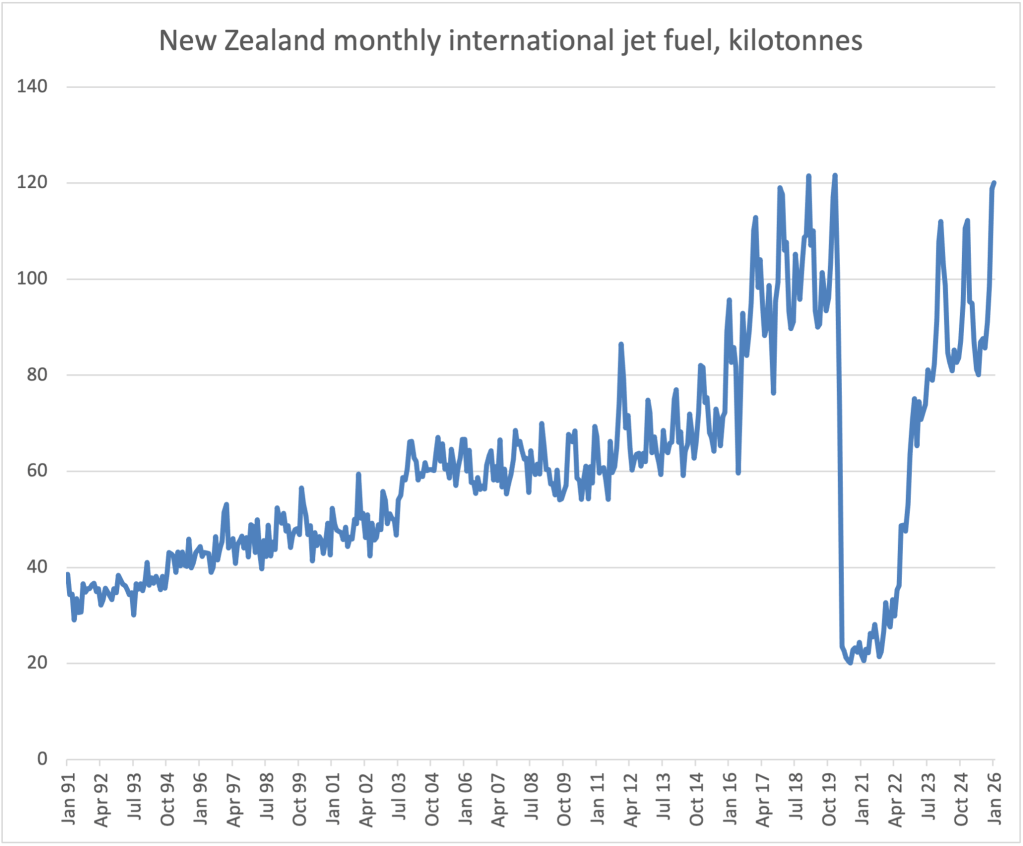
Aviation is booming, especially in the Asia–Pacific region. Air travel has reached record numbers both domestically and internationally, with further strong growth forecast over coming decades.

Despite the financial headwinds faced by New Zealand’s regional airlines, operators say that “passenger numbers on regional airlines have never been better”. “Passenger numbers are through the roof”, says Sounds Air boss Andrew Crawford in a Newsroom article. Once again flights in and out of New Zealand are increasing, helped by the New Zealand government promoting international tourism as a key driver of economic growth.

To support the growth, international airlines are expanding capacity.

Airports across New Zealand have also set in place expansion plans. An example is Nelson. The airport wants to see passenger numbers double from 900,000 to 1.8 million a year by 2050.

Despite unambiguous evidence of the devastating impacts of human-induced climate change, commitments to decarbonise aviation are stalling both here and overseas. The result is that aviation emissions continue to increase at a time when other sectors are working hard to reduce theirs. In just-published research, Daniel Scott and Stefan Gössling examine the UN World Tourism Organization’s climate declarations and conclude that there has been limited to no progress on 25 climate action pledges. They also evaluate commitments by the World Travel and Tourism Council, IATA, International Civil Aviation Organization, and individual airlines, finding that none of their self-set targets has been met.

So how can aviation contribute to tackling climate change when no practicable technology-based solutions are on the horizon?

This problem of aviation emissions is playing out in Nelson, one of New Zealand’s premier tourist destinations. While it is known for its sunny days, in recent years it has also suffered from damaging storms that are predicted to become more frequent and intense with climate change. The August 2022 storm event caused more than $80m of damage in the region, and a downpour in recent weeks led to flooding in downtown Nelson. Recognising the need to reduce emissions, Nelson City Council will soon meet to approve its climate change strategy, aiming to reduce gross emissions by at least 6.8% each and every year, in line with the government’s target.

That will require significant new investment. Who should pay for it? Should it be the community as a whole, or should those who are causing the problem contribute more? If Nelson airport proposes to double passenger numbers without any realistic plan to reduce emissions, is there a way of adopting the “polluter pays” principle and using revenue from flying to help decarbonise other parts of the local economy?

There is a way. The airport is jointly owned by Nelson City Council and neighbouring Tasman District Council. It recently invested $32m in a new terminal (catering for future growth, which means growth in pollution), with further expansion on the drawing board. A “polluter pays” levy of $20 per departing passenger – about 10% of the average ticket price – would raise $9m per year towards climate action by the two councils. Potential uses of such a levy include funding active and public transport, helping businesses to reduce emissions via electrification, supporting community solar power, and funding adaptation infrastructure. Much greater price increases by Air New Zealand in recent years, of between 30% and 300% depending on the route, have had no impact on passenger numbers, indicating an ability and a willingness to pay. While most New Zealanders need to fly sometimes, most flying is done by a small number of frequent flyers. Globally, 1% of the world’s population, the wealthiest frequent flyers, are responsible for 50% of aviation emissions. Therefore, a “polluter pays” levy acts as a progressive, pro-climate tax.

It is true that New Zealand also has the Emissions Trading Scheme. Passengers contribute about $3 per domestic flight via the ETS. Unfortunately, this does little to nothing towards reducing emissions. At present the money either goes to the government (which has cancelled most direct climate spending) or towards the mass planting of pine trees, which is commonly criticised as being an ineffective strategy with negative effects on biodiversity.

Airports and airlines themselves should welcome such a levy, which could be introduced nationwide. They could then point to the tangible community benefits of the levy and maintain their social licence to operate in an era when the aviation industry’s bold claims (“Net zero by 2050!”) amount to so much greenwashing.

It needs to be recognised that such a levy only buys the aviation industry a little time, and that the industry needs to either rapidly decarbonise or start reducing flights to meet climate targets. At present it is impossible to know if any of their plans for lower-emission flights will come about or have much of an impact on emissions. We hope they do. But hope alone is not enough; hope needs action, and the time for action is now.

Tech hopes for the aviation industry

By Robert McLachlan

The third iteration of Heart Aerospace’s proposed new aircraft, now a 30-seat parallel hybrid.

Back in 2021 electric aircraft were a hot topic. Paul Callister and I looked at three startups (Heart Aerospace’s ES-19, Eviation’s Alice, and the Lilium Jet) to see if their claims stacked up. They all faced serious difficulties with weight, range (especially the reserve range required for safety), and unproven technology.

Two of the three (Lilium and Eviation,the latter pre-ordered by Air New Zealand) went bankrupt in February 2025, leaving only Heart Aerospace. Their ES-19 (pre-ordered by Sounds Air) has undergone two radical redesigns. In May 2024, an innovative wing strut was added and the range was halved to 200 km, extended by a serial kerosene generator (ideally used only as a reserve). Later, the wing strut disappeared, and two of the four electric motors were replaced by standard kerosene turboprops – essentially a parallel hybrid. No test aircraft has yet been flown or even built, but commercial operation is still promised for 2030.

On the policy front progress has been no better. The Climate Change Commission has made a strong recommendation to bring international aviation and shipping into New Zealand’s 2050 climate target; the government has yet to respond, and the Commission has no brief to look at the issue further. The public/private partnership Sustainable Aviation Aotearoa, established in 2022 as part of the first Emissions Reduction Plan, has yet to issue reports, advice, or communications of any kind.

This was the background in my mind as I prepared to address the Royal Aeronautical Society’s New Zealand Division on “Tech hopes for the aviation industry” on 29 May.

Please watch the video of the talk below, or read the slides.

Central Otago study maps lifestyle, issues and concerns

By Robert McLachlan

Today James Renwick, James Higham and myself have released the first of three reports, making available key findings about Central Otago residents’ views on a number of topics.

The research, conducted late last year, covers five topics: Central Otago lifestyle, climate change, infrastructure and growth, tourism, and air travel and airports. Respondents chosen at random from right throughout the Queenstown Lakes and Central Otago districts were asked over 70 questions, and were also given the opportunity to comment openly on all topics.

The survey revealed a strongly unified population sharing many values, beliefs and concerns. 89% of respondents lived in or visited the region for its ‘lifestyle’; other natural factors, such as climate and landscape, also figured extremely highly. Other factors, such as ease of travel and work opportunities, were regarded as less important. There was a high level of concern about climate change and environmental sustainability in the region, and strong support for a greater focus on the value of visitors rather than the volume.

63% of respondents were opposed to the proposed Central Otago Airport (and 51%, strongly opposed) compared to 22% in favour. This level of opposition was found right across the Central Otago and Queenstown Lakes districts, in contrast to the statement from Christchurch Airport’s Michael Singleton that “the community is equally divided between supporters, opponents, and the undecided.”

The proposal to build an international airport at Tarras is not just a local issue as it is significant for New Zealand as a whole. It’s a national issue that can only be resolved by a national plan for aviation emissions that meets our international agreements.

Professor James Higham of Griffith University and the University of Otago commented that there were strong themes running through the responses. “There is no doubt that people choose to live in Central Otago for the same reasons that tourists want to visit. It is a superbly beautiful, unspoilt and tranquil place. It’s clear from our research that sustainability is now a very high priority for the people of Central Otago, and they also very clearly understand the impact of tourism that the region benefits from. This study shows that they want better tourism with less impact, rather than more tourists.”

Professor James Renwick of Victoria University of Wellington said that the impacts of climate change are clearly on Central Otago residents’ radar, which is consistent with research conducted elsewhere. “People are conscious that we have to do everything we can to get New Zealand to net-zero, and that we all have to play our part. We’re seeing people do that in numerous ways including solar energy, reducing waste to landfill and reducing unnecessary travel. Aviation can be a significant portion of people’s footprints – especially where flights are medium to long haul.”

The second report, due out next month, will present an analysis of the extensive and detailed written responses. A third report, scheduled for April 2024 will represent the results of bivariate analyses to uncover the relationships between responses to different questions.

The report can be downloaded at https://informedleaders.com/central-otago-study/.