By Robert McLachlan
I was recently introduced to climate scientist James Dyke’s excellent newsletter, Eccentric Orbits, and the first article I read there opened with this:
This is our current moment: climate change by almost every single measure is getting worse while action on phasing out fossil fuels is slowing down or even stalling.
It’s true that climate change is getting worse – it will continue to get worse until emissions fall to near zero. But is action on phasing out fossil fuels really stalling?
There are certainly terrible developments in many places. But I want to point at that in some sectors in some countries, the phase-out of fossil fuels is definitely not stalling – it’s accelerating. Therefore, faster action is at least possible.
I decided to look at two sectors, coal and transport. They are both very large (being 40% and 20%, respectively, of global CO2 emissions, or 2 resp. 1 tonne of CO2 per person on average) but are very different.
To give an idea of the scale of the task, to phase out the burning of fossil fuels by 2050 means cutting emissions by about 0.2 tCO2 per person each year for the next 25 years. That is just the average value – cuts will have to be faster in the richer and higher-emitting countries.
Here are the 26 countries that have been phasing out coal the fastest over the past decade:

For most of these countries, the phase out was twice as fast in 2018-2023 as in 2013-2018 – a dramatic acceleration. The 26 countries reduced coal emissions by an average of 0.18 tCO2/person every year for a decade.

This was achieved through concerted policy and planning maintained over a long period.
Here are the five worse performers, for comparison:

Transport is very different to coal. The coal sector is dominated by a few large factories and most coal is used to generate electricity, where there are now cost-effective alternatives. Transport is highly dispersed and is shaped by social norms and by stupendous amounts of massive infrastructure – particularly so for cars. Transport emissions in many developed countries are dominated by private cars. The standard solution – travel less; walk, bicycle, and take public transport more; and electrify the remainder – all involve changes to people’s behaviour that can be contentious. (In France, when it was proposed to lower the speed limit on two-lane highways from 90 to 80 km/h, two-thirds of the speed cameras in the country were destroyed by protesters.)
New Zealand’s transport/climate policy is really only just getting started, and has undergone wild swings right out of the gate. So I was surprised to see that emissions from cars have not rebounded since Covid:

The decline, about 15% (while population grew 7%), cannot be due solely to EVs or more efficient cars. Emissions of new cars are down by a quarter since 2019, but it takes time to turn over the fleet. The emissions of the average car on the road are only down 6%. So most of the decline must be due to something else. Driving less, due to working from home and the recession, are the two possibilities that come to mind. A surge in walking, biking, or public transport would have to be huge to make an effect of this size.
Even more surprising, the same thing appears to be happening in other countries too. New Zealander Robbie Andrew, who works at the Center for International Climate Research, Oslo, Norway, has kindly added road transport emissions data for the sixty-odd countries that he tracks. Many countries (but not all) have shown sustained falls in car emissions.
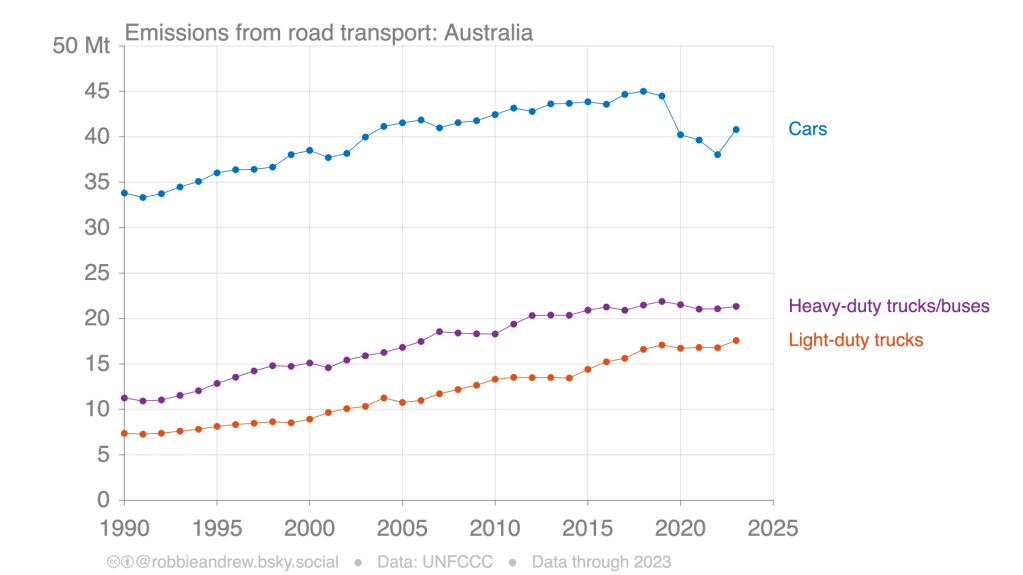

Of course, the standout example is Norway, where virtually all new cars are now electric. Norway will continue to see car emissions fall steadily to zero.
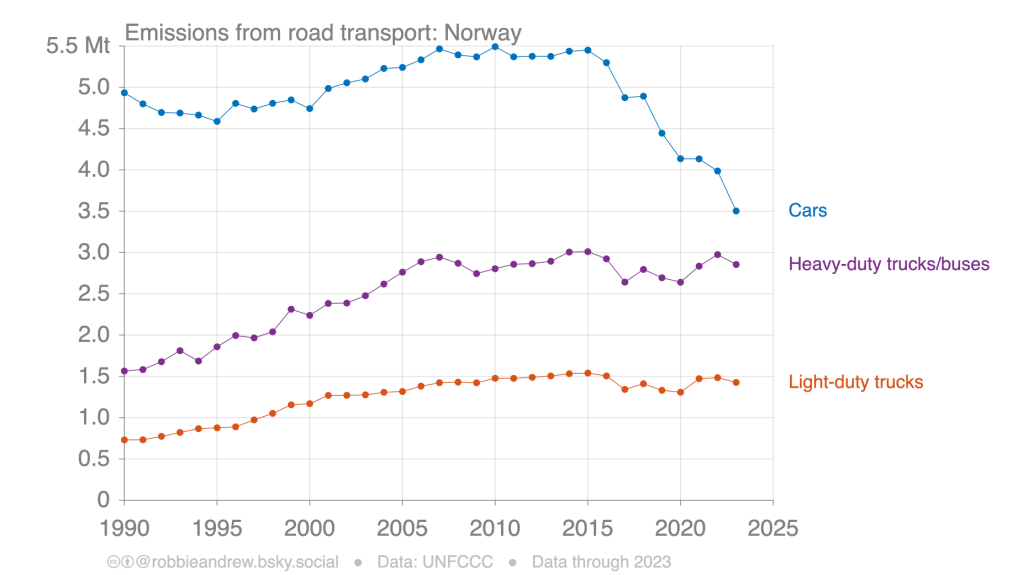
The surprise is that falls in other countries are almost as large as in Norway. New Zealand reduced from 1.44 to 1.16 tCO2 per person over 2018-2023, Norway from 0.92 to 0.63. The average reduction for the top 10 performers is 0.23 tCO2 per person (21%) over 5 years. That is outstanding for what is supposed to be a tough sector. What’s less clear is whether these reductions (if they are due to behaviour change) can persist and accelerate in the future.

The same effect is seen for all road transport emissions (including trucks, utes, and vans). Now the picture includes an impressive result from Finland (split data not available) and even the United States. (Data for the US is for 2022 as they haven’t submitted their 2023 data to the UN yet… we can guess why.) Norway now shows only the 6th biggest drop, behind Austria, Canada, Finland, New Zealand.

There’s a limit to what can be concluded from this kind of broad overview. Every country has a different emissions profile and different climate politics. But my takeaway is that fast phase-outs of fossil fuels – 5-10% per year, sustained and even accelerating over several years – have been shown to be possible, even in large and diverse sectors and in different countries.
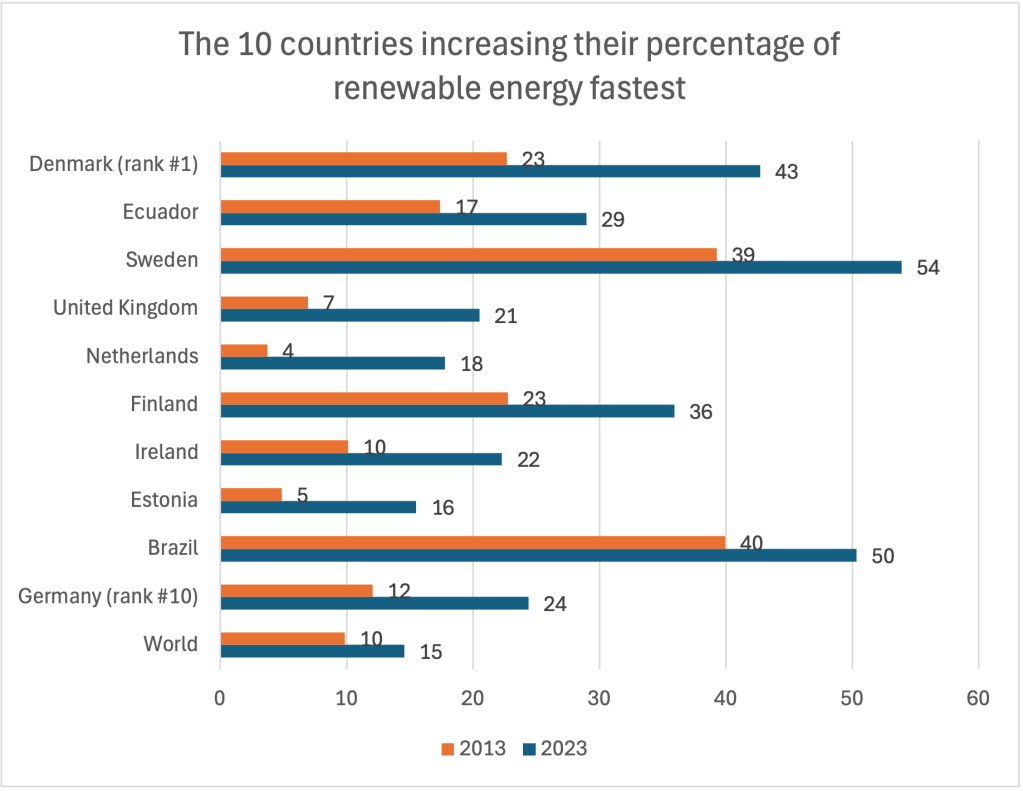
Postscript added 10 July. For another way to slice it, here are the 10 countries that have increased their percentage of renewable energy (all energy, not just electricity) the fastest, ranked by average performance over the past decade. Progress is accelerating – the average increase for 2013-2018 was 0.4 percentage points per year (top 10, 1.3%), for 2018-2023 0.6 percentage points per year (top 10, 1.8%). At that rate getting to 100% will take 150 years. The rate needs to triple (ie match the current best countries) for safety. Note that the top 10 countries are very different to each other. They are large and small, rich and poor, coming off a low or a high base. It’s easy to be discouraged looking at the scale of the task, but progress is possible.

 Planetary Ecology
you deserve an optimism prize Robert but then the reality of the non-existent energy transition
https://thehonestsorcerer.substack.com/p/the-tale-of-two-energy-transitions?utm_source=substack&publication_id=1498475&post_id=167504563&utm_medium=email&utm_content=share&utm_campaign=email-share&triggerShare=true&isFreemail=false&r=2o44x&triedRedirect=true