By Robert McLachlan
Just a few weeks ago New Zealand’s aviation and tourism sectors were riding high. Summer flights were up 7% on the previous year, and returned to their pre-Covid levels for the first time.
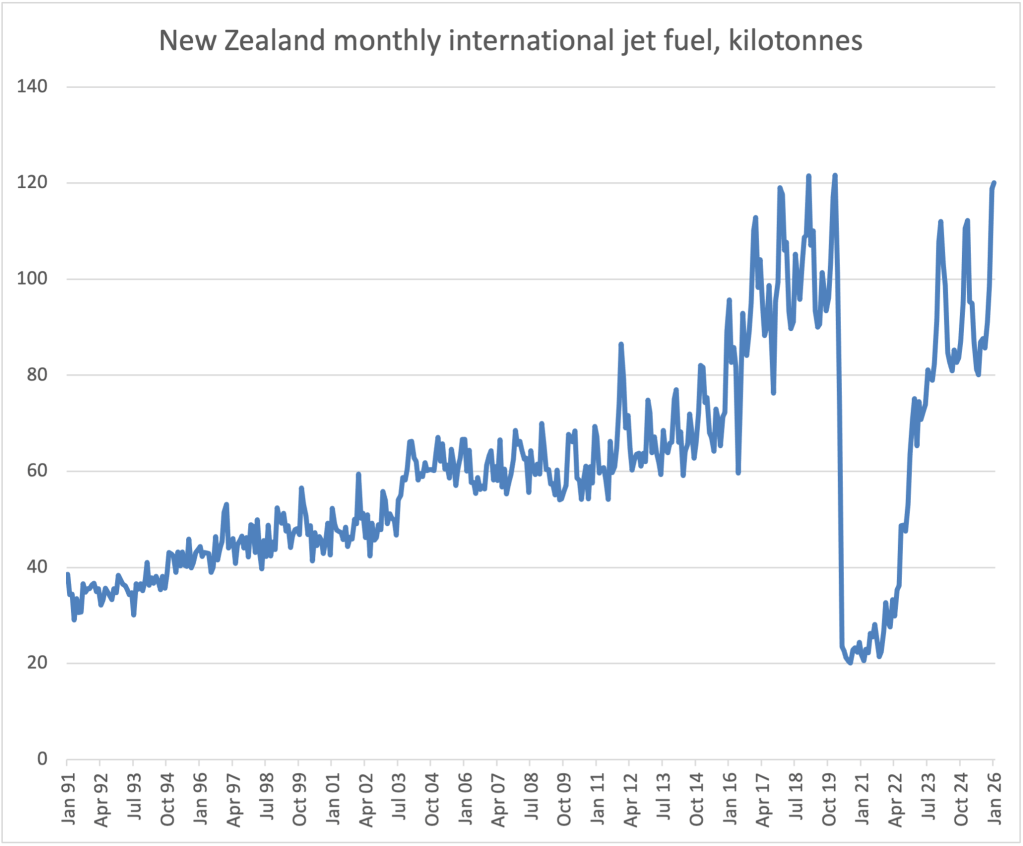
Source: MBIE Energy Quarterly
All last year there were stories like “Christchurch Airport is entering a period of strong growth, with new and expanded air routes set to deliver a significant boost to Canterbury’s tourism, freight and export sectors” (The Press, June 2025). As late as 3 February this year, the CEO of Tourism Industry Aotearoa was saying “International arrivals are edging upwards, confidence has lifted across the sector, and operators are reporting strong bookings.”
On 3 March, three days after the war began, Tourism Minister Louise Upston said, “The Government welcomes data out today showing New Zealand’s tourism sector continues to go from strength to strength, driving billions into the economy.”
New Zealand wasn’t alone. Willie Walsh, director of the global airline body IATA, said in January, “2025 saw demand for air travel grow by 5.3% with international demand growing by 7.1% and domestic by 2.4%. This returns industry growth to align with historical growth patterns after the robust post-COVID rebound.”
The only dark clouds were the need for decarbonisation (“Governments whose economies grow because of aviation and whose citizens thirst for connectivity need to provide the supportive fiscal policy framework to rapidly accelerate progress”) and supply chain issues (“People clearly wanted to travel more, but airlines were continually disappointed with unreliable delivery schedules for new aircraft and engines, maintenance capacity constraints, and resultant cost increases.”)
IATA forecast essentially permanent growth of 4.2% per year. This far exceeds any ability of the industry to reduce emissions and is a recipe for continually increasing damage.
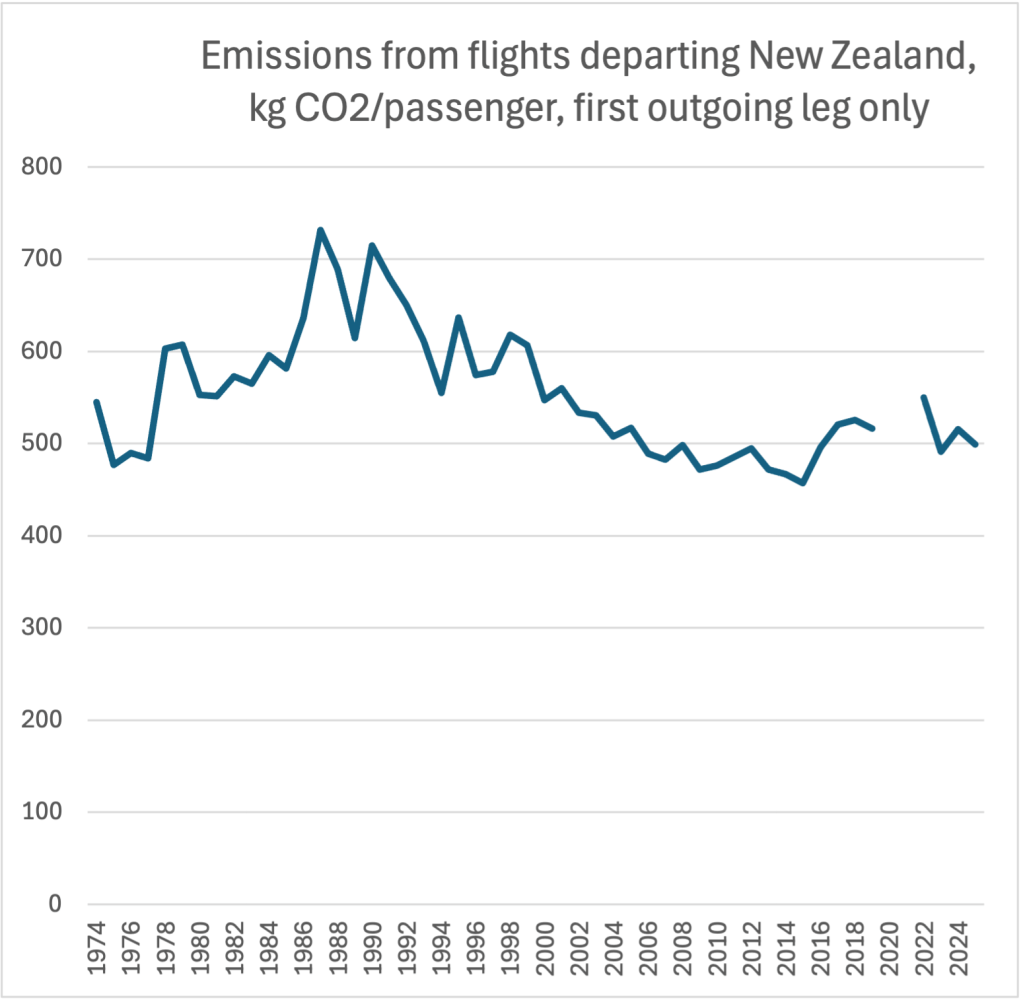
Setting aside decarbonisation – each flight departing New Zealand uses 200 litres of jet fuel per passenger, emitting 500 kg of CO2, a number that has not budged in 20 years – how is that desire to travel more holding up?
Pretty well, it seems. Just yesterday (1 April – but apparently they weren’t joking), RNZ reported:
Despite the conflict and dire news about air travel price surges due to fuel costs, New Zealand consumers are still booking long-haul flights to places like Europe, says Julie White, chief executive of the Travel Agents’ Association of New Zealand.
Swapping the warmth of the northern hemisphere in July for a Queenstown skiing holiday is of little interest to some travel consumers at the moment, White says.
New Zealanders, in general, might have a bit of domestic travel fatigue due to the restrictions during Covid. Many since the Covid years have made travel an essential item in their budget rather than a discretionary one, says White.
“We’re still experiencing strong demand. Kiwis are really wanting to travel, and they are really hoping this is going to be over soon, so they are still booking travel.”
This is delusional and irresponsible. The Ministry of Transport’s own dashboard shows that the price of jet fuel has already more than doubled, which would add at least 30% to future ticket prices even before flight cancellations kick in.
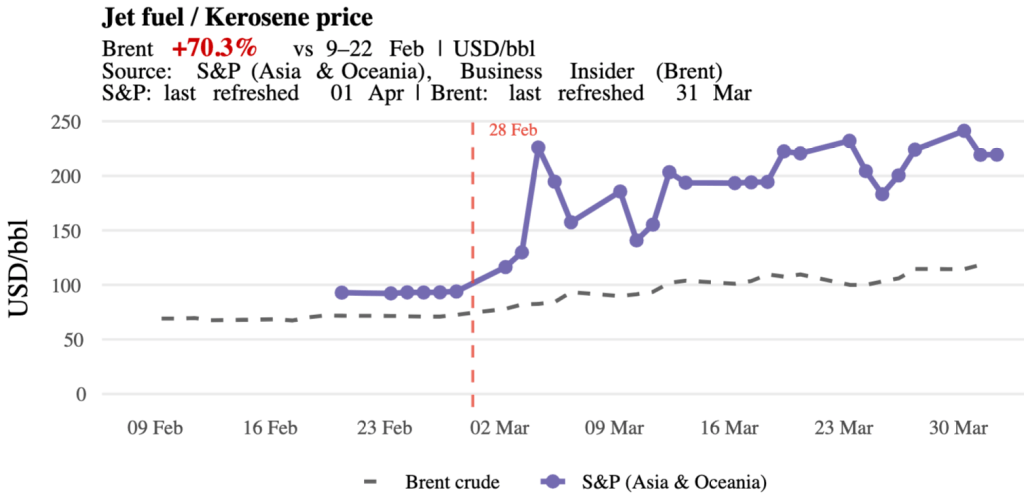
Travelers could very easily find themselves stranded overseas with cancelled flights and no insurance. The BBC and Financial Times are reporting that the UK’s final shipment of jet fuel from the Middle East is arriving this week, with no more booked or on the water. Tourism professor Susanne Becken from Griffiths University wrote
Tourism’s dependence on (affordable and available) jet fuel has long been a known issue; yet the sector choses to ignore this massive challenge. All the discussions around decarbonisation aviation are much more than climate action, they are an insurance for the very future of this industry.
During the Covid pandemic I made the suggestion that countries should look into ‘minimum viable networks’ to find out what level of aviation is considered essential as opposed to discretionary. This would be very sensible risk management, and would – by default – include crises such as global pandemics (i.e. how much lack of connectivity can a country afford), climate change (managing the long-term risk of climate collapse), or fuel constraints.
Although all countries will be affected, New Zealand is more exposed than many, given our remote location, habituated frequent flying, and large tourist industry. (Pacific Islands are even more at risk.) International travel shut down once before, only six years ago. It looks like we are in for a re-run.

 Planetary Ecology