The Rings of Saturn, a 1995 novel by W. G. Sebald, has been called the first novel of the Anthropocene, even though that era was not proposed until five years later. Ostensibly a walking tour of East Anglia with copious historical digressions and reflections, its global, far-reaching view is certainly more obvious today. Here is an extract from Chapter 7.
It had grown uncommonly sultry and dark when at midday, after resting on the beach, I climbed to Dunwich Heath, which lies forlorn above the sea. The history of how that melancholy region came to be is closely connected not only with the nature of the soil and the influence of a maritime climate but also, far more decisively, with the steady and advancing destruction, over a period of many centuries and indeed millennia, of the dense forests that extended over the entire British Isles after the last Ice Age. In Norfolk and Suffolk, it was chiefly oaks and elms that grew on the flatlands, spreading in unbroken waves across the gently undulating country right down to the coast. This phase of evolution was halted when the first settlers burnt off the forests along those drier stretches of the eastern coast where the light soil could be tilled. Just as the woods had once colonized the earth in irregular patterns, gradually growing together, so ever more extensive fields of ash and cinders now ate their way into that green-leafed world in a similarly haphazard fashion. If today one flies over the Amazon basin or over Borneo and sees the mountainous palls of smoke hanging, seemingly motionless, over the forest canopy, which from above resembles a mere patch of moss, then perhaps one can imagine what those fires, which sometimes burned on for months, would leave in their wake. Whatever was spared by the flames in prehistoric Europe was later felled for construction and ship-building, and to make the charcoal which the smelting of iron required in vast quantities. By the seventeenth century, only a few insignificant remnants of the erstwhile forests survived in the islands, most of them untended and decaying. The great fires were now lit on the other side of the ocean. It is not for nothing that Brazil owes its name to the French word for charcoal. Our spread over the earth was fuelled by reducing the higher species of vegetation to charcoal, by incessantly burning whatever would burn. From the first smouldering taper to the elegant lanterns whose light reverberated around eighteenth-century courtyards and from the mild radiance of these lanterns to the unearthly glow of the sodium lamps that line the Belgian motorways, it has all been combustion. Combustion is the hidden principle behind every artefact we create. The making of a fish-hook, manufacture of a china cup, or production of a television programme, all depend on the same process of combustion. Like our bodies and like our desires, the machines we have devised are possessed of a heart which is slowly reduced to embers. From the earliest times, human civilization has been no more than a strange luminescence growing more intense by the hour, of which no one can say when it will begin to wane and when it will fade away. For the time being, our cities still shine through the night and the fires still spread. In Italy, France and Spain, in Hungary, Poland and Lithuania, in Canada and California, summer fires consume whole forests, not to mention the great conflagration in the tropics that is never extinguished. A few years ago, on a Greek island that was wooded as recently as 1900, I observed the speed with which a blaze runs through dry vegetation. A short distance from the harbour town where I was staying, I stood by the roadside with a group of agitated men, the blackness behind us and before us, far below at the bottom of a gorge, the fire, whipped up by the wind, racing, leaping, and already climbing the steep slopes. And I shall never forget the junipers, dark against the glow, going up in flames one after the other as if they were tinder the moment the first tongues of fire licked at them, with a dull thudding sound like an explosion, and then promptly collapsing in a silent show of sparks.
After a pause during Covid, aviation is once more on a growth path. There have been significant orders of new planes by many airlines and in Aotearoa there are plans to expand many airports. Christchurch airport continues to progress its plans to build a new large international airport at Tarras in Central Otago.
Despite much talk of future emission reduction strategies, the industry is still powered almost entirely by fossil fuels. The use of Sustainable Aviation Fuels (SAF) remains mainly for demonstration flights and no electric planes are yet carrying commercial passengers. Supplies of SAF remain insignificant compared with overall fuel use and rapidly expanding production of these fuels is a difficult challenge.
With the growth of flying, unless action is taken it seems inevitable that emissions will increase both globally and locally in the short to medium term. This is at a time when almost other sectors are working hard to reduce emissions.
The recently released advice from the Climate Change Commission relies heavily on new technology to reduce emissions from aviation. It argues that
within the second emissions budget period, the biggest opportunity for reducing emissions within aviation is likely to come from sustainably produced drop-in biofuels as a component of aviation fuels.
There are real challenges in producing sustainable biofuels, particularly if a goal is to not compete with food production. In an analysis of the use of crops for biofuel, primarily through the production of ethanol, Hannah Ritchie suggests that under some growth projections, the world would need around 300 million hectares of cropland to feed the planes. That is an area the size of India. Yes, sustainable aviation fuels will be an important part of decarbonising aviation. But other strategies are needed too.
In a new report with Kirsty Wild and Alistair Woodward from the University of Auckland, we identify seven key strategies that would help drive down our aviation emissions. These are 1) improved pricing, 2) carbon budgets for aviation; 3) improved emissions intensity; 4) limiting and targeting public investment; 5) public communications; 6) pausing airport expansion; and 7) investment in low-carbon domestic transport infrastructure. Our analysis is based on the Avoid-Shift-Improve framework of transportation planning and on the parallel contributions of passenger numbers, flight distance, and emissions intensity to overall emissions from the sector.
No professor, chief executive, airline sustainability champion, or climate activist is under any illusion about the challenges involved in regulating a source of pollution. But the ICAO declaration, the ongoing Paris Agreement process, and the worsening climate crisis all point to a rapidly closing window of opportunity for genuine action on aviation. Aotearoa, as a stand-out beneficiary of aviation, has more to gain from timely and orderly action, and may also, through its State Action Plan and other diplomatic efforts, foster more coordinated global action.
On the same day last week that Air New Zealand announced the purchase of its first fully electric aircraft, Christchurch Airport announced it had reached “a new standard for decarbonisation”. On the face of it, great news for reducing aviation emissions in Aotearoa.
The reality is a little more complex – and risky. As the climate warms, so too is the temperature in boardrooms and courtrooms. The aviation industry is under increasing scrutiny for its sustainability claims, and climate litigation is on the rise.
At the same time, “net zero” strategies in general are being challenged. The United Nations High-Level Expert Group was established at last year’s COP27 summit, as Secretary General António Guterres explained, because “net zero suffers from a surplus of confusion and a deficit of credibility”.
The expert group has put forward a set of net-zero guidelines to put a “red line through greenwashing”. The guidelines underpin the UN’s approach to net zero, which requires corporate entities to advance ambitious climate mitigation actions based on rigorous and comprehensive science-based targets.
Among other things, the targets must include emissions reductions from the entity’s full value chain and activities. These include emissions from sources the entity owns and controls directly (known as scope 1); emissions the entity causes indirectly (scope 2); and emissions not produced by the entity itself, but arising up and down its value chain (scope 3).
The expert group also notes that voluntary carbon credits (offsets) cannot be counted towards interim emissions reductions required on the pathway to Net Zero 2050. This is because carbon offsetting has been shown to be troublesome at best, and in many cases a scam.
A recent greenwashing complaint to the European Commission, for example, was filed by consumer groups in 19 countries against 17 airlines. Virgin Atlantic and British Airways are facing formal complaints filed by a climate charity and law firm over sustainable flight claims.
Advertisements for Air France, Lufthansa and Etihad have been banned in the UK for greenwashing, following complaints to the UK Advertising Standards Board that phrases such as “protecting the future”, “sustainable avitaion” and “low-emissions airline” are misleading consumers.
Delta faces a class action lawsuit for claiming to be “the first carbon neutral airline on a global basis” in a case brought by a California resident claiming the airline has grossly misrepresented its climate impact.
Cases like these raise questions about Air New Zealand’s “Flight NZ0” strategy and marketing, which focuses on sustainable aviation fuel and next-generation aircraft (including its recently bought electric Beta Alia), complemented by carbon offsetting and operational efficiency.
The focus on sustainable fuel will have to overcome significant scientific, energy, scalability and cost barriers. Solutions to these complex problems are likely to be decades away at least.
While Air New Zealand promotes the Beta Alia – with its inherent altitude, payload and range limitations – it also aims to significantly increase its long haul network, and is setting its sights on the “ultra long haul experience”.
The contradiction between long-haul growth and decarbonisation strategies is expressed in the airline’s own 2017 sustainability report, in which the sustainability advisory panel chair wrote:
And that’s the dilemma for anyone who cares passionately about addressing the multiple threats of climate change: either stop flying altogether (the logical but somewhat unworldly idealist’s position), or fly as little and as discriminatingly and responsibly as possible (the often uncomfortable pragmatist’s position).
As consumers and environmentalists focus more on the validity of climate claims and the viability of carbon reduction strategies, Air New Zealand may find it harder to defend its net zero pathway.
Airports on the radar
The environmental claims of other players in the wider aviation system – notably airports – are also likely to attract critical attention.
Christchurch Airport has been in the program for longer, and makes significant climate claims. In April 2022, it announced “another world class sustainability achievement”, going “beyond carbon neutral, to become climate positive”.
But this doesn’t account for scope 3 emissions, mainly associated with flights in and out of the airport, which make up 95.39% of total emissions. Airports can only appear to be climate-neutral by not accounting for the high and growing emissions of the planes that are their core business.
Stakeholder reputations on the line
Key stakeholders are also exposed to any potential accusations of greenwashing. Christchurch City Council own 75% of the airport through a holding company, and the government owns 25%. Both have declared climate emergencies and made emissions reduction commitments.
Industry groups are involved, too. Tourism Industry Aotearoa, which represents businesses across the tourism industry, last month announced Christchurch Airport the winner of its Tourism Environment Award.
It cited the airport’s “climate positive” status and hailed it as being “at the forefront of airport environmental initiatives globally”. Such claims can be technically true if one accepts the limited parameters used to measure them.
But the Tourism Industry Aotearoa will need to ensure its environmental awards keep pace with developments in this rapidly changing field – including the increasing risk of litigation over unsustainable claims about sustainability.
The recent general election has resulted in sweeping changes in climate policy in New Zealand, but the commitments to the Zero Carbon Act, to meeting the climate budgets, and meeting our Paris Agreement target, remain. When the article below was published in short form in the newspaper, the editor chose the headline “The good news on climate change – and the rest“. This led to some debate online. Was it really good news? Or could the title equally well have been “The bad news”? I thought that for an international audience “New Zealand votes for a higher carbon tax” would have been a good lead.
Regardless of that, here is the full article from the November 2023 issue of Policy Quarterly.
New Zealand authorities have declared a record 17 weather-related states of emergency so far this year, with insurance payments for climate-related disasters already topping $3.5 billion.
This is Aotearoa’s worst year ever for climate-related disasters, with more than twice the number of states of emergency than any other year, and insurance payouts totalling more than the combined total of the previous 14 years.
Declaring a state of emergency is a critical part of New Zealand’s response to disasters, giving authorities extraordinary powers designed to deliver a swift and effective response.
Eight of the emergency declarations were owing to Cyclone Gabrielle in February, with local emergencies declared in multiple regions, until a national state of emergency lasting 28 days was declared.
The South Island has seen only two states of emergency so far this year, with heavy rainfall and flooding in Gore and Queenstown in September, while the North Island has borne the brunt of multiple extreme weather events.
Northland, Auckland, Waikato, Bay of Plenty, Tairāwhiti and Hawke’s Bay were hit the hardest by Cyclone Gabrielle, and Auckland, Tairāwhiti, and Waikato have also forced into states of emergency because of other severe weather events.
Scientists are in no doubt that the events were exacerbated by rising temperatures caused by climate change, with a rapid attribution study concluding “with certainty” that human-induced climate change was the main driver making Cyclone Gabrielle’s extreme rainfall more likely.
Robert McLachlan, Massey University distinguished professor in Applied Mathematics, says 2023 has been exceptional in terms of global temperature rise.
The global temperature anomaly for 2002-2016 averaged +0.95ºC above the 1880-1910 baseline, while for 2017-2022 it was +1.18ºC. However, for the first nine months of 2023 that was much higher, with the global temperature anomaly +1.39ºC above the baseline.
“So 2023 is highly exceptional and may indicate what a ‘normal’ year looks like in 10 or 15 years’ time.”
McLachlan’s analysis drives home the relentless rise in payouts for climate-related disasters. “The 2004 floods in the lower North Island were exceptionally bad. So bad that the insured damage for the entire year was not exceeded until 2017, McLachlan says. “Since then it has been exceeded every year. The total for 2023 exceeds that for the previous 14 years.”
Going back further, the single most expensive previous event in the Insurance Council’s records was the Wahine storm. “That cost $13.5m in 1968, equivalent to $300m today,” McLachlan says.
The previous government had planned to introduce a Climate Adaptation Bill as part of their package of Resource Management Act reforms, but this was delayed. “Questions of climate adaptation and its financing and risk sharing will now pass to the new government,” McLachlan says.
Jonathan Boston, Victoria University of Wellington emeritus professor and climate adaptation expert, says that 2023 had a “highly unusual” number of extreme weather events. While stressing that he is not a meteorologist, Boston says the weather events were partly driven by the end of three years of a La Niña weather pattern in the Pacific and high ocean temperatures.
“In all likelihood there will not be as many severe weather events over the next year or two, with an El Niño weather pattern in the tropical Pacific. This will likely shift the focus of severe weather away from those parts of New Zealand that were badly affected this year.”
However, over time the costs and disruption from severe weather events will increase, Boston says. “This will be exacerbated by sea level rise, which will intensify coastal erosion and coastal inundation, and the damage caused by storms.”
The incoming government will need to make the right decisions to put Aotearoa in the best position to face challenging times ahead. “It should follow the advice in the recent report of the Expert Working Group on Managed Retreat, of which I was a member,” Boston says.
by James Bradley, in conversation wth Kim Stanley Robinson
There is no question Kim Stanley Robinson is one of the most important writers working today. Across almost four decades and more than twenty novels, his scrupulously imagined fiction has consistently explored questions of social justice, political and environmental economy, and utopian possibility.
Robinson is probably best known for his Mars trilogy, which envisions the settlement and transformation of Mars over several centuries, and the ethical and political challenges of building a new society. Yet it is possible his most significant legacy will turn out to be the remarkable sequence of novels that began with 2312. Published across less than a decade, these six books reimagine both our past and our future in startlingly new ways, emphasizing the indivisibility of ecological and economic systems and placing the climate emergency center stage.
The most recent, The Ministry for the Future, published in 2020, is a work of extraordinary scale and ambition. Simultaneously a deeply confronting vision of the true scale of the climate crisis, a future history of the next fifty years, and a manifesto outlining the revolutionary change that will be necessary to avert catastrophe, it is by turns terrifying, exhilarating, and finally, perhaps surprisingly, guardedly hopeful. It is also one of the most important books published in recent years.
This interview was conducted between January and March 2021, beginning in the immediate aftermath of the attack on the United States Capitol and the inauguration of President Biden, and ending as a second wave of the COVID pandemic began to gather pace in many countries around the world. As we bounced questions back and forth across the Pacific, a drumbeat of impending disaster grew louder by the day: atmospheric carbon dioxide reached 417 ppm, a level 50 percent higher than preindustrial levels; a study showed the current system responsible for the relative warmth of the Northern Hemisphere—the Atlantic meridional overturning circulation—at its weakest level in a thousand years; and Kyoto’s cherry blossoms bloomed earlier than they have at any time since records began in the ninth century CE.
JB: In several of your recent novels, you’ve characterized the first few decades of the twenty-first century as a time of inaction and indecision—in 2312, for instance, you called them “the Dithering”—but in The Ministry for the Future, you talk about the 2030s as “the zombie years,” a moment when “civilisation had been killed but it kept walking the Earth, staggering toward some fate even worse than death.” I wonder whether you could talk a little bit about that idea. What’s brought us to this point? And what does it mean for a civilization to be dead?
KSR: I’m thinking now that my sense of our global civilization dithering, and also trying to operate on old ideas and systems that are clearly inadequate to the present crisis, has been radically impacted by the COVID pandemic, which I think has been somewhat of a wake-up call for everyone—showing that we are indeed in a global civilization in every important sense (food supply, for instance), and also that we are utterly dependent on science and technology to keep eight billion people alive.
So 2312 was written in 2010. In that novel, I provided a timeline of sorts, looking backward from 2312, that was notional and intended to shock, also to fill the many decades it takes to make three centuries, and in a way that got my story in place the way I wanted it. In other words, it was a literary device, not a prediction. But it’s interesting now to look back and see me describing “the Dithering” as lasting so long. These are all affect states, not chronological predictions; I think it’s very important to emphasize science fiction’s double action, as both prophecy and metaphor for our present. As prophecy, SF is always wrong; as metaphor, it is always right, being an expression of the feeling of the time of writing.
So following that, The Ministry for the Future was written in 2019, before the pandemic. It expresses both fears and hopes specific to 2019—and now, because of the shock of the pandemic, it can serve as an image of “how it felt before.” It’s already a historical artifact. That’s fine, and I think it might be possible that the book can be read better now than it could have been in January 2020 when I finished it.
Now I don’t think there will be a period of “zombie years,” and certainly not the 2030s. The pandemic as a shock has sped up civilization’s awareness of the existential dangers of climate change. Now, post COVID, a fictional future history might speak of the “Trembling Twenties” as it’s described in The Ministry for the Future, but it also seems it will be a period of galvanized, spasmodic, intense struggle for control over history, starting right now. With that new feeing, the 2030s seem very far off and impossible to predict at all.
JB: In The Ministry for the Future, the thing that finally triggers change is the catastrophic heat wave that opens the book. It’s a profoundly upsetting and very powerful piece of writing, partly because an event of the sort it depicts is likely to be a reality within a decade or so. But as somebody whose country has already experienced catastrophic climate disaster in the form of fire and flood and seen little or no change in our political discourse, I found myself wondering whether the idea such a disaster would trigger change mightn’t be too optimistic. Do you think it will take catastrophe to create real change? Or will the impetus come from elsewhere?
KSR: People are good at imagining the catastrophe will always happen somewhere else and to other people. Thus in Australia, people will tend to think, “But it never could happen in Sydney, in Melbourne, in Perth.” Even though it could.
So it won’t be catastrophe per se that changes people’s politics and their votes. The impetus comes from ideology, from one’s invented imaginary relationship to the real situation. Here the discursive battle is paramount. The stories we tell each other will make the difference. The scientific community keeps telling us a story: that if we continue burning carbon into the atmosphere, and otherwise wrecking the biosphere, we will crash as a species. This story is making headway; I’ve seen the headway, everyone has, in the last two decades. A tipping point will arrive soon where it is the obvious story that everyone accepts as real; it will become hegemonic. And the sooner the better.
The radically cold temperatures hitting the US as I write this are located in many of the “red states” that voted for Trump, especially Texas. Voting Republican now is in effect a vote against science, a denial of science. So as I write, everyone in those regions without electrical power has to contemplate that in fact they depend completely on science and technology to stay alive. Will that change their thinking and their votes? Probably not—not all of them, and not immediately. But repeated shocks from reality will soon change the window of acceptable discourse, and then the hegemonic space. We are utterly dependent on the science and technology that is both civilization’s invention and its enabling device. This story needs to be insisted on. One way I try to do this is to remind everyone that when you’re sick and scared for your life, you run to a scientist, which is to say your doctor. That’s proof of what you really believe, more than your vote or your words.
In Australia, I can only say I’m mystified. Thirty million is a small population to include so many science deniers. An advanced, developed, rich nation, but also an island that can feel separate from the rest of the world—who knows? No one can understand other political entities from the outside. Even inside them, they are mysterious. But I’d have expected your science deniers and coal burners to be defeated at the polls by now. Maybe that will happen. Maybe electing an idiot like Trump helped to speed the process here.
JB: Part of the process of change has to be about rethinking our relationship with the past and the future. The idea of how we reimagine our relationship with the future is one you return to often: in The Ministry for the Future, your characters discuss the way economists discount the value of future lives when making decisions now, and the entire plot of Aurora is driven by the failure of people in the present to consider the effect of their actions on the lives of their descendants. But in an odd way, aren’t these questions about the future the easy ones? Because it’s the poisonous legacies of the past, of racism, slavery, colonialism, and extractivism, and their human and environmental costs, that are really intractable. Can we solve those questions of the future without solving the problems of the past? Or is that a false dichotomy?
KSR: This question reminds me of a slogan one sees in Marx, also Tolkien: we have to deal with the historical situation we’ve been given. Things could have been different, but they’re not—so on we go, free to act, and obliged to act, but not in a situation of our choosing.
That’s not to suggest we ignore history. Studying it teaches a lot (maybe everything) about where we are now. Seeing how we got to this moment—which is to say arguing about how we got to this moment—is part of the discursive battle about what to do now.
So there are indeed poisonous legacies of the past, inscribed into current practices, hegemonic beliefs, structures of feeling, and laws. The dead hand of the past, trying to strangle the new baby future that we, in the present, midwife. What I often feel that one can see very clearly is two major strands, braided together although often in direct conflict. I call it science versus capitalism. It’s like Australian economist Dick Bryan once said to me about finance and the state: they are hand in hand, but they’re arm-wrestling for control.
So the project becomes to strengthen the strand that is working for justice and a sustainable balance with the biosphere—I call that science, though it has to be admitted that this is a signaling word for a whole strand of history, which includes in it democracy, justice, progress, etcetera. Then, against that, there’s capitalism, again a signal word for feudalism, patriarchy, and all the older power systems of the few over the many, most of which emerged with agriculture about ten thousand years ago. That power system has an ancient lineage and is hard to beat.
Into this mythic dualism, lots of elements of history can be slotted, but it is a view from space, or a sock puppet play, very Manichean, and maybe often unhelpful. Maybe it’s my own false dichotomy, but I still feel it has some explanatory power. So it’s not the future over the past, except as a version of this: it’s science over capitalism.
JB: I’m interested by your decision to define the conflict as science versus capitalism, because it forces us to think about a lot of these questions differently and to recognize that many things we don’t usually think of as technologies— economic policy, finance, social justice, education, and all the other drivers of social change—can be usefully treated as precisely that. But doesn’t it also demand we recognize the real challenge isn’t electrifying the grid or rolling out solar panels, it’s a much more fundamental realignment of political power?
KSR: Yes, I think that’s right. Technology can be thought of as machinery only, but here computers are really helpful as an analogy; they have to have both hardware and software. In civilization as a technology, as with computers, the software is crucial; otherwise it’s just an inert hunk of metal and plastic. So in this case, we need to focus on software technologies like finance, economics, law, and politics. Then justice becomes a technology, and language itself. This blows up questions like, “Can there be a technological solution without political reform?” Maybe people are there asking, “Could we just make new machines that would overcome the disastrous effects of our unjust and unsustainable political economy, which is to say neoliberal capitalism?”
I think the answer to that is no. We need to change our political economy so that a single index, profit, isn’t our measure of doing well. We need to figure out a financial system that pays us for doing things good for the biosphere, including all its citizens, human and not—this would be safest, and indeed it’s necessary for humans—rather than rewarding activities that hurt people and biosphere, which profit-seeking will do.
Capital gets invested at the highest rate of return. That’s the law, often literally the law. Repairing the biosphere and creating justice among humans is not the highest rate of return now. So it won’t happen. End of story.
Or beginning of new chapter. This is what we’re seeing in new terms like Modern Monetary Theory, full employment, carbon quantitative easing, the social cost of carbon, universal basic income and services, Half Earth plans, and wage parity. Also in the return of older terms like socialism, or social security. All these ideas or systems or software technologies are being proposed to get out of the death spiral of neoliberal capitalism. What I find interesting and really encouraging is that these ideas are being discussed by people in the central banks and the national governments and the international diplomatic community. Even among economists, who for the most part have devoted all their work to an analysis of capitalism. These are no longer marginal or science fictional ideas; they are on the table as potential legislation.
JB: Those ideas and that sense a new world is being brought into being around us is very much a part of The Ministry for the Future, which, despite the grief and anger that make it so wrenching to read, shares the essentially utopian vision of your work in general. But it’s often not easy to see how much change is afoot, if only because, as Mark Fisher put it, capitalism occupies the horizons of the thinkable. Do you think this difficulty contributes to the sense of despair and powerlessness so many people feel at the moment?
KSR: Yes. I think of it in terms known to many now: ideology, hegemony, structure of feeling, capitalist realism: “There is no alternative.” And so on. It’s been forty years of a dominant political economy, following a couple of centuries of expanding capitalist power over world history, so it’s hard to imagine how that could change. Thus the famous Jameson/Zizek slogan: “Easier to imagine the end of the world than the end of capitalism.”
But I think now there’s also a widespread feeling that it can’t go on. And what can’t go on won’t go on. Capitalism is breaking the system, meaning people’s lives and the biosphere. We’re on the brink of causing a mass extinction event that will hammer humans, too; it’s not just climate change, which can be imagined as a matter of turning down the thermostat, but a much wider habitat collapse—our only habitat.
Given that feeling, people are looking for a way out of the current system and also for some ideas as to what that next system might look like. Even at the heart of the capitalist order—which is to say the central banks, the big corporations and investment firms, and in governments from local to nation-state level—there is talk of change. Of course, very often many of those speaking are hoping to manage change while retaining power. But some very interesting changes are part of that discussion. So I think the feeling of a massive immovable system has begun to creak, shift, crack, and let in new light.
JB: There’s a question here about how the change takes place, though, isn’t there? Especially given the power of the interests that oppose it. In New York 2140, you imagine a kind of Velvet Revolution, a peaceful reorganization of society and the economy, but in The Ministry for the Future you quote Keynes’s line about the euthanasia of the rentiers. Do you think we’ll see an acceleration of violent resistance as the climate crisis intensifies? And how should we think about that?
KSR: I’m not sure about this. In The Ministry for the Future, I described all kinds of political violence and also sabotage against fossil fuel or antihuman infrastructures. The novel was an attempt to describe the next three decades in terms that were antidystopian, but also plausible given the world of stark disagreements that we live in. If people see their families die as a result of climate change impacts, then the slow violence of capitalism will spark the fast violence of spasmodic revolt. Very often these violent acts of resistance do little good; the resistance fighters are killed or jailed, and the oppressive system doubles down in its oppression.
So I am among many who are trying to imagine ways of gaining the good results of a revolution without going through the trauma of old-style violent revolutions, which very often backfire anyway. Some better way to a better situation, which can be imagined in the realms of the discursive battle (Can we get more persuasive?); the political battle (Can we win a working majority?); the legislative battle (Can we pass laws that will help?);and then, also, sabotage of life-destroying machinery, mass civil disobedience, and alternative systems of governance that are simply lived outside the current nation-state system—and so on. The list could be extended.
My objections to violent resistance are both moral and tactical: First, it isn’t right to hurt other human beings, if not being attacked by them and defending oneself. Then, tactically, violence often seems to backfire and increase the misery being resisted. This is either because the state monopoly on violence is jealously held (and possibly a good thing) or because even if you seem to succeed by violence, you fail in the long run because the effort has used bad means, and the most violent among the revolutionaries tend to seize power and then use that same violence against any dissent of any kind.
This isn’t the whole story of history, obviously, but it’s the way it feels to me now, in our current situation. So a very rapid, stepwise, legal reformist revolution seems to me the best thing to try now. Later, if we get into the 2030s without meaningful progress on the various justice and sustainability fronts, I think more violent forms of resistance are more likely and maybe more justified. We’re in a closing window of opportunity for peaceful tactics to work.
JB: That closing window of opportunity means some very radical ideas are now on the table, some of which—such as proposals to dim the sun or seed the oceans with iron—are likely to have significant side effects. The idea humans might terraform or reengineer the environment in this way is central to your Mars trilogy and plays a big role in 2312, Green Earth, and The Ministry for the Future. Do you think we’re now at a point where some of these sorts of schemes have to be seriously entertained? And to what extent should we see them as a symptom of the failure of democratic means?
KSR: We’re in an all-hands-on-deck situation, so all these radical ideas need to be explored to see if they might help in safe ways. Geoengineering has been defined in advance as “doing dangerous things to save capitalism,” so naturally people tend to be wary of it. But everything humans do at scale has planetary effects and could be called geoengineering in some literal sense. Maximizing women’s education and political power worldwide could be called geoengineering because it would slow the population rise as a result of increased human agency, and this would have biosphere effects we could measure. As it’s a good and needed thing in and of itself, its ancillary benefits to the biosphere make it a double good.
So at that point the term geoengineering is exploded, and if you wanted to discuss it further it should be on a case-by-case basis. Deflecting some sunlight away by casting dust into the atmosphere (solar radiation management), if the dust were not volcanic but chosen for its inertness (like limestone dust), would reduce temperatures slightly for a few years—then the dust would fall to Earth, and the results of the act could be evaluated. If it was done by international agreement, then it would be the result of representative governments. It would be an experiment. Seeding the ocean with iron dust to create algal blooms, which would then die and fall to the sea floor, taking their carbon with them—well, the oceans are already sick because of our carbon burn, plastic pollution, bottom dragging, and overfishing. Doing more to it seems stupid to me, but on the other hand, a single experiment wouldn’t change much and might teach us some things. On this particular tactic, I’m like most people in thinking there’s got to be a better, safer way.
But this discussion is part of what it means to be in the Anthropocene— we’ve damaged the biosphere so badly that we now have to work at repairing it, without knowing enough to be sure how to do that well. Still, some actions are obvious. Stop emitting carbon dioxide into the atmosphere. Stop destroying habitat. Invent regenerative agriculture. End poverty and extend equal rights and education to all. These good acts will all have positive biosphere effects. The various emergency actions being discussed are marginal to these big, obvious things we need to do. You asked if I thought we were already at the point where we will need to do these things; I don’t think so. But we’re close. And if millions die in a wet bulb 35°C heat wave, then the nation-state where that happens may take matters into their own hands. No one in the developed world will have any right to object to that.
JB: The vision of our future you articulate in The Ministry for the Future is deeply confronting, but also, ultimately, hopeful in that it runs counter to the growing belief in the developed world that collapse is inevitable. Do you see hope as an imperative?
KSR: Yes, I do. Also, it’s very natural and biological; life hopes, hunger is a hope. Again, it’s too big a word to help much. Is it good to be alive? Do you hope to go on living therefore? That kind of hope is very persistent.
But then also there is fear. And there are reasons for fear. Is there a growing belief in the developed world that collapse is inevitable? I’m not so sure. And what would collapse mean? That you have to live like people in the Global South live now? Or that three-quarters of all humans will suddenly die in a spasm of civilizational incompetence? These are very different kinds of collapse. So hopes and fears, we always have them in a great overflow.
What I like about science is the way it tries to get particular. Is enough food being grown to feed everyone on Earth? Yes. Is it automatic that that continues? No. Is wilderness a good idea or a bad one? (This is one I’m thinking about now.) Well, scientists involved would ask which of the eight or ten definitions of wilderness you’re talking about. I like that kind of specificity.
But I think with this question you’re inquiring about our culture’s structure of feeling, the vibe, how the young feel, what the internet is saying if you just link around reading, and so on. There, in the realm of the general intellect or the feeling of our time, we’re inside a ringing bell. There is a great roaring, a cacophony. You can pull out the sounds you want to hear and call it an accidental symphony of sorts, and then get on with what needs doing. Your hopes and fears will still keep you awake at night. Meanwhile, the work goes on. People want their children to have a good life. Capitalism isn’t working, and what can’t go on won’t go on. So we’ll be experimenting our way into a different political economy. Hopefully we’ll dodge a mass extinction event, and then all kinds of good possibilities will open up. I think it really is a crux moment in history. The 2020s are going to be wild.
The 2016 Paris Agreement contains a built-in feedback mechanism to help ensure that its goals are met: the Global Stocktake. Every five years all pledges and progress are assessed and compared to the targets on warming, adaptation, and financing. A “ratchet” mechanism is intended to prevent backsliding. (“Each Party’s successive nationally determined contribution will represent a progression beyond the Party’s then current nationally determined contribution…”)
The technical reporting on the first Global Stocktake is now out, and the results will be discussed at COP28 in December 2023. There has been some progress. In 2010 the expected global warming was 3.7–4.8ºC – basically toast. The initial Paris Agreement pledges in 2016 were assessed at limiting warming to 3.0-3.2ºC, and the call in 2020 for updated Nationally Determined Contributions (NDCs) resulted in the forecast being lowered to 2.4–2.6ºC.
But a key figure in the new report still shows a significant gap:
For the “well below 2ºC” target, emissions must fall 21% between 2019 and 2030; for “1.5ºC”, they must fall 43%. Current NDCs add up to between –8% and +3%.
The report offers a lot of now-familiar suggestions on how to do better. (Phasing out internal combustion engines, shifting to walking and public transport, disinvesting from emissions-intensive activities.) But there is less on how to actually accomplish these in the face of opposition (“creativity and innovation in policymaking and international cooperation are needed”).
What I wanted to know was how countries are performing on actually achieve their targets. On that, the report is mostly silent, so I turned to the NGO Climate Action Tracker, which publishes independent periodic assessments of NDCs and associated progress.
Here are the results for the world’s top 10 emitters (plus New Zealand).
GHG MtCO2e
CO2e/cap
consistent with…
Is NDC sufficient for a 1.5 ºC world?
2030 target (vs 2019)
2030 (predicted)
China
12700
9
< 3 ºC
insufficient
+0%
+0%
USA
6000
18
<2 ºC
almost sufficient
-41%
-23%
India
3400
2.5
>4 ºC
critically insufficient
+45%
+30%
EU
3400
7
<2 ºC
almost sufficient
-36%
-42%
Russia
2500
13
<4 ºC
highly insufficient
+17%
+9%
Japan
1200
9
<2 ºC
almost sufficient
-33%
-22%
Brazil
1100
7
<2 ºC
almost sufficient
-11%
+7%
Indonesia
1000
7
>4 ºC
critically insufficient
+70%
+20%
Iran
900
10
>4 ºC
critically insufficient
+82%
+12%
Canada
700
21
<2 ºC
almost sufficient
-40%
-15%
New Zealand
80
16
<2 ºC
almost sufficient
-36%
-9%
The top 10 emitters as of 2019, plus New Zealand. Gross emissions, NDC targets, and forecast performance as assessed by Climate Action Tracker
Five of the ten have adequate targets and are reducing emissions, but only one (the EU) is on track to meet or exceed its target.
Four of the ten have woefully insufficient targets, but are on track to exceed them.
The last one is China, on track to meet its (still insufficient) target.
If all ten achieved the best of either their target or their actual progress, emissions would fall 10% by 2030. The total effort would still need to be doubled even from this benchmark.
New Zealand is a bit of a special case. We have a reasonable target, even though it doesn’t meet the 1.5ºC condition written into the Zero Carbon Act. But there is almost nothing going on nationally towards working out how to meet it. Most attention is paid to meeting the domestic carbon budgets, which are on track for 2022-2025 but need more work for 2026-2030. However, the domestic carbon budgets still fall short of meeting the NDC, by about 100 million tonnes of CO2e or nearly two years of net emissions.
The original idea was to source this from overseas. We could pay for emissions reductions in another country, although they wouldn’t then be able to count it towards their own target. And if that country – Indonesia, say – has a weaker target than our own, we would then have weakened our own overall effort as well. Christina Hood has addressed this issue in a number of articles.
How is the government managing delivery of the NDC?
We don’t know. No policy has been announced for how much extra domestic effort will be targeted and how this would be delivered, how & when international cooperation will start, or how the extra investment in emissions reductions (domestically and internationally) will be funded. The projected cost of closing the gap – whether by domestic or international action – is not currently reflected in the Crown accounts. There is even no provision to cover excess emissions that have already occurred.
The National Party have said they would meet the NDC, but at the same time their climate spokesperson Simon Watts said in an election debate that his party would not be “writing cheques to offshore entities”. Their fossil fuel mining, domestic emissions reductions, and adaptation plans are scary too. Over at The Spinoff, Nadine Anne Hura managed to find not one but at least a dozen analogies with the movie Titanic, such as this one:
Act and National are promising a swathe of policies that will get New Zealand “back on track”. These sentiments seem to echo Mr Ismay’s insistence that the “ship can’t sink,” and should speed up rather than slow down. In this iconic scene, Mr Andrews, the ship’s builder, replies to Mr Ismay with all the gravity of the International Panel on Climate Change: “She’s made of iron, sir. I assure you she can sink, and she will. It’s a mathematical certainty.”
by Paul Callister, Ian Mason, and Robert McLachlan
It may have been largely overlooked in the election debates, but New Zealand’s greenhouse gas emissions are finally on the way down.
Annual emissions of carbon dioxide from the burning of fossil fuels are the lowest since 1999 and the 12-month renewable share of electricity is back above 90% for the first time since 1981. The Ministry for the Environment has advised New Zealand is on track to meet the first (2022-2025) carbon budget.
All this can be attributed to a range of factors, including fossil gas running low, full hydro lakes, high petrol prices and working from home. But climate policies such as the Emissions Trading Scheme (NZ ETS), the clean car discount and the Climate Emergency Response Fund (CERF) have made a significant contribution to the turnaround.
Current decarbonisation policies have and will continue to deliver real emissions cuts, provided they remain in place.
It is therefore disconcerting that the National Party plans to take $2.3 billion from the CERF (almost two-thirds of the fund’s mid-2022 balance) to pay for tax cuts. The argument that individual households will use tax cuts to make their own decarbonisation decisions is unsupported by evidence and lacks credibility.
The Labour Party has also dipped into this fund, taking $236 million to pay for rebates for household installations of solar panels and batteries, and community energy schemes. These may produce some as yet unquantified emissions cuts.
Government funding is working
Allocations from the Government Investment in Decarbonising Industry (GIDI) fund to NZ Steel and Fonterra show direct and measurable avoidance of emissions. The installation of an electric furnace at NZ Steel to utilise scrap will save 1% (800,000 tonnes of CO₂-equivalent emissions, or tCO₂e) of New Zealand’s 2021 gross emissions. Support for Fonterra to convert coal-fired boilers at six plants to renewables will save 1.4% (1.1 MtCO₂e).
The State Sector Decarbonisation Fund, valued at $215 million and used to reduce emissions in government organisations including hospitals and universities, is on track to deliver emissions savings of nearly a million tonnes over ten years (0.1% per year).
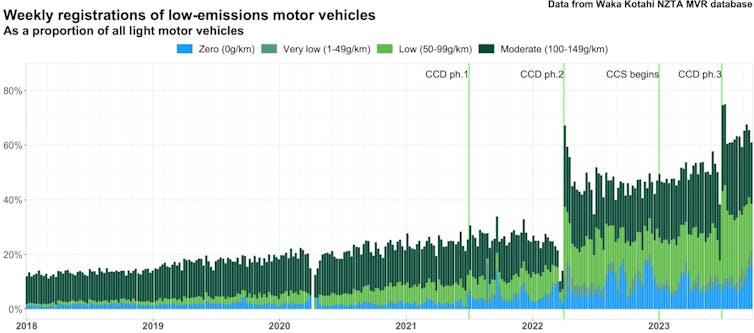
Since the introduction of the clean car discount in July 2021, sales of electric vehicles have quintupled and now have a 12% market share. The market share of all low-emission vehicles rose from 20% to 60%, easily surpassing emissions targets of the clean car standard which came into force this year.
Since the introduction of the clean car discount in July 2021, sales of low-emission vehicles rose significantly. Data from Waka Kotahi, CC BY-SA
While these rates of increase may look impressive, the actual number of EVs remains very low. Nonetheless, emissions cuts already run into hundreds of thousands of tonnes per year, a significant part of which is due to the clean car discount.
Need for more investment
New Zealand is not yet on track to meet its international pledge (known as Nationally Determined Contribution, or NDC, and covering all emissions from 2021 to 2030) or the second and third carbon budgets.
Many important policy matters are either unresolved or stuck in review: how to meet the NDC, whether and how to prioritise gross emissions reductions over tree planting, how to reduce agricultural emissions.
The actual cost of achieving emissions reduction targets and addressing risks from climate change will likely exceed the overall size of the Climate Emergency Response Fund.
Lack of an integrated plan
In the year to June 2023, oil was responsible for nearly three-quarters of fossil fuel emissions. Two-thirds of this came from transport. But transport emissions are supposed to fall 41% by 2035 – a massive task that will involve pressing hard on all three parts of the avoid/shift/improve transport framework.
Unfortunately, the framework is looking shaky.
Regarding avoidance, even the draft local plans for avoiding car travel are not yet ready. Labour and National are competing as to who can offer the most extravagant motorway plans, known to encourage driving.
When it comes to shifting modes of transport, there has been some expansion of urban cycleways. But Auckland’s city rail link will not open until 2026. And a great deal has to happen to meet the Climate Change Commission’s draft advice to “complete cycleway networks by 2030 and take steps to complete rapid transport networks by 2035”.
The National Party plans to cut public transport funding and increase fares.
As for improvement, the National Party plans to cancel the clean car discount and weaken the clean car standard. The current plan requires 30% of the entire light-vehicle fleet to be zero emission by 2035 (currently at 1.4%), which is ambitious but doable under the existing framework.
New Zealand still doesn’t have any kind of fuel-efficiency standard or coordinated policy on heavy-vehicle emissions.
Renewable energy
New Zealand’s renewable share for all energy (not just electricity) has been stuck below 30% for decades. It is supposed to reach 50% by 2035 and then continue to increase until use of fossil fuels is almost entirely eliminated.
New Zealand has untapped resources of renewable energy, wind, solar and geothermal. An even bigger supply of offshore wind is now being explored.
At the recent New Zealand wind energy conference, many massive possible projects were mooted. But delegates said they needed to be sure the electricity demand would be there before making final investment decisions.
The fate of the Climate Emergency Response Fund is of great importance, as international evidence shows:
It is the use of revenues from carbon prices, not the carbon prices themselves, which trigger change.
Depleting this fund will slow electrification and demand for renewable energy.
New Zealand’s current emissions reduction plan, which runs to 2025, is a package. Its parts support each other and attempt to balance many people’s needs. If one part is weakened, the difference has to be made up elsewhere.
The islands of Aotearoa New Zealand were the last large land mass in the world to be settled by humans. Skilled sailors and navigators, Māori arrived around 1300 AD. For millions of years previously the only mammals living on the islands were bats and, offshore, some marine species. As we know, it was a land of birds, many of which had evolved to become flightless.
This year our largest and best-known environmental organisation is celebrating 100 years of existence. As part of these celebrations, their popular Bird of the Year competition is being replaced by Bird of the Century. (75 species to choose from, of which 17 are ‘Doing OK’, 53 are ‘in trouble’, and 5 are extinct.)
These are all terrific birds, no doubt about it. But we would like to nominate our own bird: the jet aircraft.
Prior to Covid, domestic and international aviation contributed 12% of total CO2 emissions, and ever-longer international flights had been growing particularly fast, with emissions up 49% in just four years. And now international flights are now ramping up quickly again. The two largest international flows are incoming tourists and outgoing New Zealanders taking holidays and visiting friends and family. And because we have such poor long distance buses and trains, flying internally is also popular. So popular that the chief executives of three of our most important environmental organisations commute to work by plane. (Whatever happened to the old slogan, ‘The personal is the political’?)
And somehow, despite daily news about the climate crisis, we stand on the verge of an unprecedented expansion of airport capacity. Aviation stands out as the only sector of the economy that is actively planning to increase emissions.
Our largest airport, Auckland, has plans to increase passenger traffic from 20 million per year to 40 million by 2044. Wellington wants to go from 6 million per year to 12 million by 2040. At the other end of the country, the masterplan released by Queenstown airport in May 2023 suggests passenger numbers will increase by one third from 2023 to 2033. (Their CEO commented that “Airlines will fly where people want to go. The ability to leave work on a Friday in Sydney… and be in [Queenstown] for dinner, on the ski field the next day, ski all day and be on the plane the next day, there is high appeal in that.”) Nelson airport also plans to double passenger numbers by 2050. There is also a large new international airport proposed at Tarras in Central Otago, which would be New Zealand’s third airport for wide-body jets.
At Forest & Bird’s Centennial conference, Kiri Hannifin, Chief Sustainability Officer at Air New Zealand, talked about its decarbonisation plans. In an honest assessment, Hannifin told the conference, “We can’t keep going with the status quo given the harm that we’re seeing now in a 1.2 ºC world which, as you can see in Europe, is intolerable.” And that offsets are not the answer: “You cannot plant enough trees to offset your flight.”
Air New Zealand is being guided by the Science-Based Targets Initiative. This aims to provide climate-safe benchmarks for corporates. Consistent with the IPCC pathways and IEA NZE, the SBTi cross-sector pathway reduces gross emissions by at least 42% by 2030. Air New Zealand’s target is to reduce emissions intensity 28.9% by 2030. It is not at all clear how this will be achieved: electric planes and sustainable aviation fuel are discussed, even if not potentially available at scale for many years. Air New Zealand is also committed to not knowingly using biofuels from crops or palm oil. But Hannifin suggested airlines cannot do this on their own.
“We’ve done the roadmap, the board’s signed it off, we need a lot of people to help us, governments in particular, we need to be regulated, we need to be regulated, so that’s good when businesses are asking to be regulated, right?”
So how do we get this regulation?
Strengthening the Zero Carbon Act and the Emissions Reduction Plan is our best bet. The Climate Change Commission is preparing to advise on bringing international aviation into this framework, and the government has signed several international agreements pledging ambitious action.
While many new technologies will be tried, including new aircraft and sustainable aviation fuels, they will not be easy, quick, or cheap; we are doubtful that they can be delivered in time, or that all airlines will bring them in voluntarily. Rock solid regulation is needed, including an end to air travel’s current tax-exempt status and a strictly falling cap on emissions. And until that is in place, there must be a moratorium on airport expansions.
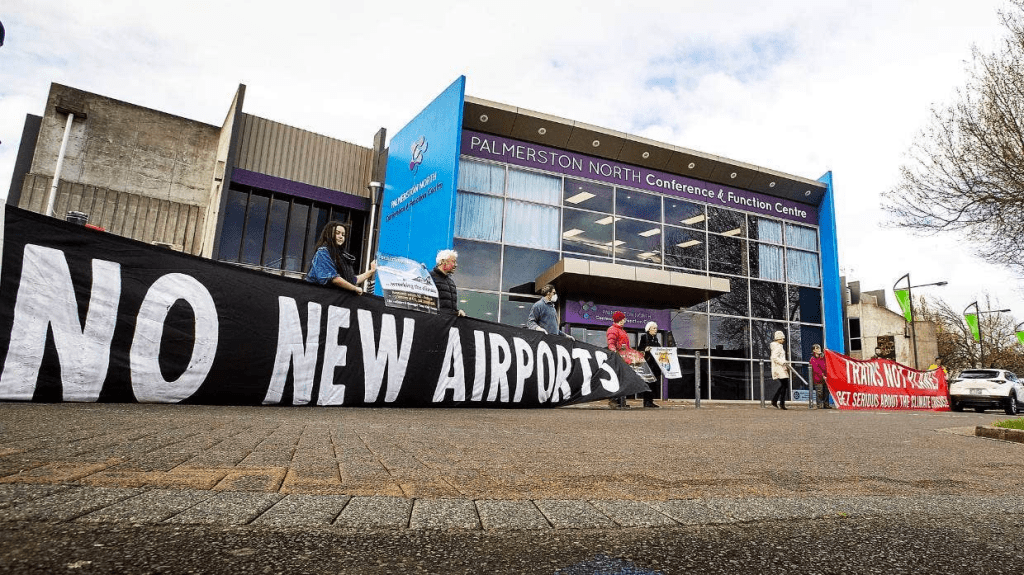
Protest at the NZ Airport Conference, Palmerston North. Photo: Warwick Smith, Stuff.
Forest & Bird is right to be alarmed that so many New Zealand birds are threatened. Climate change threatens almost every bird, plant, human and life form in New Zealand. To help them, stop making the problem worse.
Adapting to New Zealand conditions, the kiwi became flightless. Perhaps instead of the kiwi, New Zealanders should look to the pūkeko for inspiration. Having self-introduced from Australia a few hundred years ago, pūkeko certainly know how to fly. But they prefer to walk.
Have you ever thought a climate scientist hypocritical for flying to a climate change conference? Or wondered whether even if there was some hypocrisy, which did undermine the scientist’s message, it was perhaps still not the main point? Or have you ever found the hypocrisy charges themselves kind of annoying, and not always made in a genuine attempt to help save the world?
And why is the destination (a climate conference) and the passenger (a scientist) relevant at all? The emissions are the same even if the scientist is just on holiday, or if the passenger is a teacher or a civil servant. Is this just a psychological illusion, or is the value of the trip the fundamental part?
I have at different times have all of these ideas cross my mind, although without coming to a definite conclusion. It’s been a live issue for decades. It sailed into New Zealand in Shaun Hendy’s 2019 book #NoFly: Walking the Talk on Climate Change. Hendy’s year off from flying (he later started again) brought a personal flavour to the book and attracted a lot of publicity.
In a recent article, Should climate scientists fly? A case study of arguments at the system level, Jean Goodwin, a Professor of Communication at North Carolina State University, comes to my aid. She looks into the question not to try and answer it, or to assess the correctness of the different sides, but to understand how it has evolved as an argument. It’s been around so long, with so many people participating, that keen protagonists know all the arguments already and can anticipate which way things might go.
Here’s a recent entry into the genre, from well-known environmentalist George Monbiot, writing for the campaign Flight-Free UK:
I think your ability to change people’s minds is a function of your credibility, and your credibility is a function of the extent to which you live your values. You have to show people that you mean it. If people don’t think you mean it, and they don’t think you’re serious, they’re not going to follow you… what we need is structural and systemic change. However, we are much more likely to achieve that change if we live our values and show our commitment to the world we want to see. If the message we send out is that everyone else has got to change but not me, we’re far less likely to achieve that structural change.
Professor Goodwin analysed a sample of 100 opinion pieces and hundreds of thousands of tweets from 2010 to 2020, uncovering the main camps and their arguments. Ideas are passed around, picked up, and remixed. The whole thing is lumped together as “the hypocrisy argument”. She calls the three main groups the Skeptics, FlyLess, and SystemChange.
The Skeptics’ arguments are broken down into different types, which can be used individually or all at once:
Don’t believe: “Why do any climate scientists still fly? It’s almost as if they don’t really believe that there’s a CO2 climate crisis.”
Self-interest: “Yes all those scientist that will absolutely be out of job if there is no longer a climate crisis, but go ahead all the while those making all the money off this fly around in private jets have multiple mansion and continue to live like they don’t care but certainly want you to!”
Hoax: “No-one in the activist camp actually believes that catastrophic planetary warming will result from unchecked CO2 emissions. This may seem a weird thing to say in view of the public pronouncements, but look at what they do…”
Hypocrites: “That’s all the Big Climate Change Politicians, Scientists and actors do….. they all fly in big planes and drive big cars, biggest hypocrites on our planet.”
Elite: “Celebs & scientists fly around the world to latest climate meetings but we must live in mud huts.”
Double standard: “Hypocrites always have an excuse why they should be excused from the rules that they wish to impose on the rest of society. If you actually thought carbon dioxide was a problem, you could always telecommute. Then again, your actions show that you don’t believe CO2 is a problem either.”
Not credible: “You have a credibility problem when the climate scientists travel in private jets.”
No emergency: “When ‘climate scientists’ like David Suzuki who own multiple homes and constantly fly all over the world start living as if we’re in any sort of danger I’ll start believing them.” “I will believe it’s a crisis, when the people telling me it’s a crisis, start acting like it’s a crisis.”
The skeptics deal with the apparent walk/talk inconsistency by arguing either that (a) the scientists do not believe that there is an emergency, or that they are bad people for either (b) not living up to their beliefs, (c) belonging to out-of-touch elites, as evidenced by their flying, or (d) their self-interest – or often, all of these at once.
In recent years, especially since the rise of Greta Thunberg and the Flygskam movement, the skeptics have been joined by a climate activists, making similar claims:
“There are still “climate scientists” who fly to “climate conferences” seeking career-review/peer-review. What’s that? Oh sorry – Nearly all “climate scientists” propose that career (status) out-weighs the destruction of all careers & all states. Dear “climate scientist”, why not write down your thoughts on paper & then distribute them by post?… Otherwise, for you, I send this ancient curse – a plague on all your houses.”
The most common response has been to describe all of the skeptics’ arguments either as logical fallacies, or to counter that the skeptics themselves do not believe their arguments; that is, if the scientists did not fly, the skeptic would not suddenly recant:
“Some climate scientists and campaigners don’t ever fly. But that’s hardly the point, stupid to say that you cannot participate in the system while attempting to reform the system. Your logical fallacy is a few of these including ad hominem & straw man https://yourlogicalfallacyis.com.”
“If climate scientists fly the mitigation sceptics will call them hypocrites. If climate scientists do not fly the mitigation sceptics will call them activists. As always, the best advice is to ignore what the unreasonable will say.”
“Zero of the climate movement’s enemies are arguing in good faith, if they ever were. That means anything the leaders do will be spun. If you’re not a hypocrite who flies you’re a judgmental hair- shirty preachy bore who doesn’t.”
There’s even a more sophisticated variant, that one philosopher called “tu quoque [hypocrisy] judo“: namely, the extreme difficulty of the scientist not flying the the conference itself illustrates the severity of the situation. (When Noam Chomsky was charged with hypocrisy for arguing that we should hold our investments to high ethical standards, while not following the advice himself, he replied, “What else can I do? Should I live in a cabin in Montana?”)
The second camp, FlyLess, emerged in the mid-2010s, and is exemplified by the websites FlyingLess.org (“Reducing academia’s carbon footprint” – the most recent post describes an overland conference trip from Boston to Mexico) and NoFlyClimateSci.org, founded by JPL scientist Peter Kalmus, who now has a significant profile as an academic activist. (Here’s his influential FlyLess article.) The FlyLess camp have accepted most of the skeptic’s arguments – all except the hoax/conspiracy ones, and that flying scientists are bad people – and developed them at length. They argue that flying less lends credibility, sends a costly signal, and can be a catalyst for system change.
“I cannot be credible as a climate scientist if I don’t align my own behavior with what I’m saying one has to do. So this is not a per- sonal choice of stopping to fly because I don’t feel comfortable about it, but it’s a professional choice of reducing my emissions because I want to remain credible and I want to keep the trust of society.”
“When we get on a plane, what we’re saying is: this flight is more important for me and for the climate than the damage that’s being caused by it. And there’s a— there’s a certain arrogance in that; that “We are a special elite that should be allowed to have higher carbon footprints than other people because what we are doing is so important.”
“It is both arrogant and ineffective to point to the need for others to deliver major change if we are not willing to demonstrate how such changes can be viable within our own community. Leading by example may add not to the veracity of our research— but from experience it certainly adds to the credibility.”
“Because there’s no carbon-free alternative to flying, its symbolic power becomes that much greater. By flying less or refusing to fly as scientists, we’re stating that the crisis is bad enough to merit moving away from business-as-usual practices to address it.”
“I’ve realized that the main impact of reducing our emissions isn’t the emissions reduction itself: by modeling change, we tell a new story of what’s possible, shifting the culture and opening space for large-scale change.”
The final group, SystemChange, was exhibited recently in New Zealand, at a public event in which a climate scientist urged the audience not to feel guilty about not living the best possible life, because it’s system change that is needed. In other venues, it’s been put that the whole argument is fallacious, a distraction and a waste of time, and a tool of the fossil-fuel industry.
“It’s a hill away from the main battle lines and they want us there rather than facing economic climate solutions head on which will take resolve and compromise from both sides of the political spectrum. Climate deniers would rather have us as far away from that as possible.”
“There is an attempt being made by [the fossil fuel industry] to deflect attention away from finding policy solutions to global warming towards promoting individual behaviour changes that affect people’s diets, travel choices and other personal behaviour. This is a deflection campaign and a lot of well-meaning people have been taken in by it. We should also be aware how the forces of denial are exploiting the lifestyle change movement to get their supporters to argue with each other. It takes pressure off attempts to regulate the fossil fuel industry. This approach is a softer form of denial and in many ways it is more pernicious.”
In the final stage, which Professor Goodwin describes as a circular firing squad, the SystemChangers accuse FlyLess of being aligned with the Skeptics, while the Skeptics circulate SystemChange essays as evidence for their cause. She concludes:
[W]e count on controversies to form reasoned public opinion and produce public justifications on the most pressing issues of our communities… Participating in a controversy, arguers start to recognize how to argue in this controversy: they start to see who else is participating, what is in issue, what standpoints can be taken, who has the burden of proof, what evidence is available, what arguments can be made, what objections those arguments deserve.
After all that, I can hardly be expected to land a killer blow in this argument. For what it’s worth, the FlyLess argument on credibility does have some experimental support (although that’s probably not why its supporters believe in it). By now we are well into the next stage, which is to ask if climate scientists should be activists. Going to prison, now that really is costly signalling.
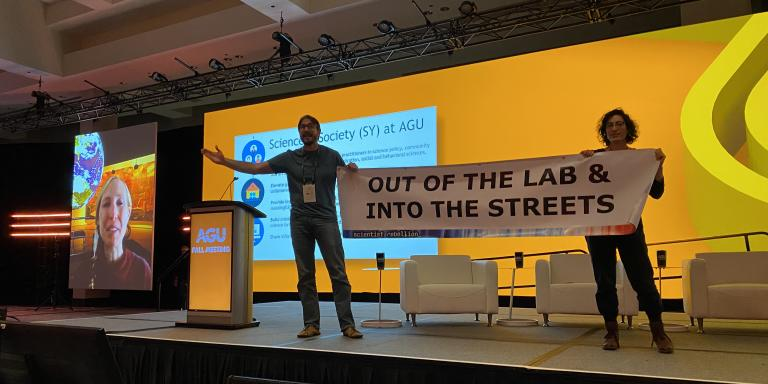
On 15 December 2022, Rose Abramoff and Peter Kalmus briefly interrupted an American Geophysical Union conference. AGU removed their research presentations from the meeting, banned them from participation, launched a misconduct inquiry, and complained to Abramoff’s employer, Oak Ridge National Laboratory. Kalmus and Abramoff further claimed that AGU threatened to have them arrested if they returned to the meeting. Abramoff was subsequently fired by Oak Ridge. In January 2023, 1500 scientists signed an appeal to object to what happened to their colleagues. Photo: Dwight Owens.







 Planetary Ecology