By Robert McLachlan
Thanks to The Post for publishing this article, and for making it free to read.
https://www.thepost.co.nz/nz-news/350179050/casualties-governments-declaration-war-evs
They didn’t include my graph, though, so I include it here:

Planetary boundaries, climate change, biodiversity
By Robert McLachlan
Thanks to The Post for publishing this article, and for making it free to read.
https://www.thepost.co.nz/nz-news/350179050/casualties-governments-declaration-war-evs
They didn’t include my graph, though, so I include it here:
By Robert McLachlan
In the Manawatū region of New Zealand where I live, the Horizons Regional Council plans for climate change impacts under the high-emission “RCP8.5” scenario. This is a scenario in which no attempts are made to reduce emissions – the track we were on for decades. In this scenario, emissions triple by 2100 and coal burning expands by a factor of six.
This is now considered highly unlikely. So why is it still used for planning?
The Ministry for the Environment recommends
using the middle-of-the-road scenario (RCP4.5) and the fossil-fuel intensive development scenario (RCP8.5), and screening hazard and risk assessments for longer-term coastal impacts up to 2130 (RCP8.5).
RCP4.5 reflects moderate emissions and implementation of current global emissions reduction policy settings. It represents limiting the rise in global air temperature to 2.7°C by 2100.
RCP8.5 broadly aligns with emissions-reduction practice over the past few decades. It reflects high emissions, limited mitigation measures and no global emissions reduction policy settings. This scenario represents a rise in global air temperature to 4.4°C by 2100. RCP8.5 enables local government to understand the full extent of possible climate risk. It is particularly important for developments with a long timeframe (more than 100 years), especially for climate-sensitive projects and coastal planning activities, due to the very long time-lag (from decades to centuries) between sea level rising and seeing the effects on developments.
Ministry for the Environment. 2022. National adaptation plan and emissions reduction plan. https://environment.govt.nz/assets/publications/national-adaptation-plan-and-emissions-reduction-plan-guidance-note.pdf
RCP8.5 is relevant not just as a worst-case scenario of emissions. The key point is that it gives an idea of a bad-case outcome for the climate response even under moderate emissions. For that reason, only RCP8.5 should be used for planning; RCP4.5 still allows a completely unacceptable level of risk.
Climate change predictions are highly uncertain. One measure is the “Equilibrium Climate Sensitivity”, the increase in temperature in response to a doubling of CO2, after short- and medium-term feedbacks have entered equilibrium. (“Medium-term” means decades to a few centuries). This has long been estimated at 2–4.5 ºC, with an average of 3 ºC. We are currently at just over half a doubling, resulting in 1.3 ºC of warming, although not all those feedbacks have yet run to equilibrium.
2–4.5 ºC is a wide range, and that’s only the “most likely” values – a 66% probability. If the sensitivity is actually on the high side, then even moderate emissions will lead to much greater impacts.
There are two fundamental reasons why the uncertainty is so large and has proven difficult to reduce.
First, there are many climate feedbacks. Some lead to more warming and some to cooling. Each is hard to predict accurately because of the long time scales and complicated interactions of the atmosphere and ocean.
Combining effects of the same sign needn’t increase uncertainty:
A = 10 ± 1 (10% uncertainty)
B = 10 ± 1 (10% uncertainty)
A + B = 20 ± 2 (10% uncertainty)
But combining effects of opposite sign always increases uncertainty:
A = 10 ± 1 (10% uncertainty)
B = –5 ± 0.5 (10% uncertainty)
A + B = 5 ± 1.5 (30% uncertainty)
Secondly, the uncertainty is worse on the high side:

Here the most likely response is 3 ºC, but very large values (6 ºC or even higher) are possible. In the most recent IPCC report (AR6) the most likely range was reduced somewhat, to 2.5 ºC–4 ºC. However, this was due in part to discarding a number of “hot models” that showed higher sensitivity. (In those models, forecasts of less clouds meant less sunlight reflected directly back to space, and hence more warming.) And that was done for a good reason, namely that the mid-range models fit the observed warming extremely well:

The takeaway message is that even under moderate emissions, there is still a pretty decent chance of catastrophe.
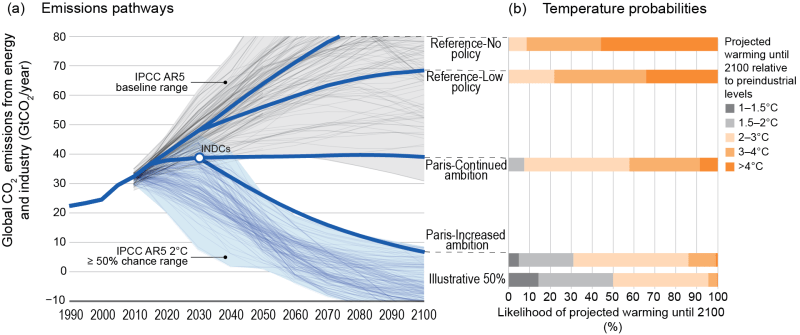
Here the “no policy” scenario (RCP8.5) gives a 90% chance of more than 3 ºC of warming by 2100. But even “Paris–continued ambition” (which assumes that all countries in the world achieve their 2030 targets and continue decarbonising at the same rate) has a 42% chance of exceeding 3 ºC. Only “Increased ambition”, in which decarbonisation accelerates greatly after 2030, gives a decent 14% chance of avoiding 3 ºC. That’s an “extreme climate change” scenario, with up to 60% of the global population at risk of starvation.
Risk is a funny thing. For aircraft, we think a 1-in-10 million chance of a crash is an acceptable level of risk. If a crash is linked to a design flaw, the entire global fleet of that model is grounded indefinitely. For flooding, we’ve settled on a 1-in-500 annual risk of catastrophic urban flooding in any given location. (In Palmerston North, stop banks were upgraded to that level just in time to survive the 2004 floods.) For climate change, a 50-50 risk of complete annihilation is met with “that’s the best we can do”.
By Roshni Mathew, 350 Aotearoa
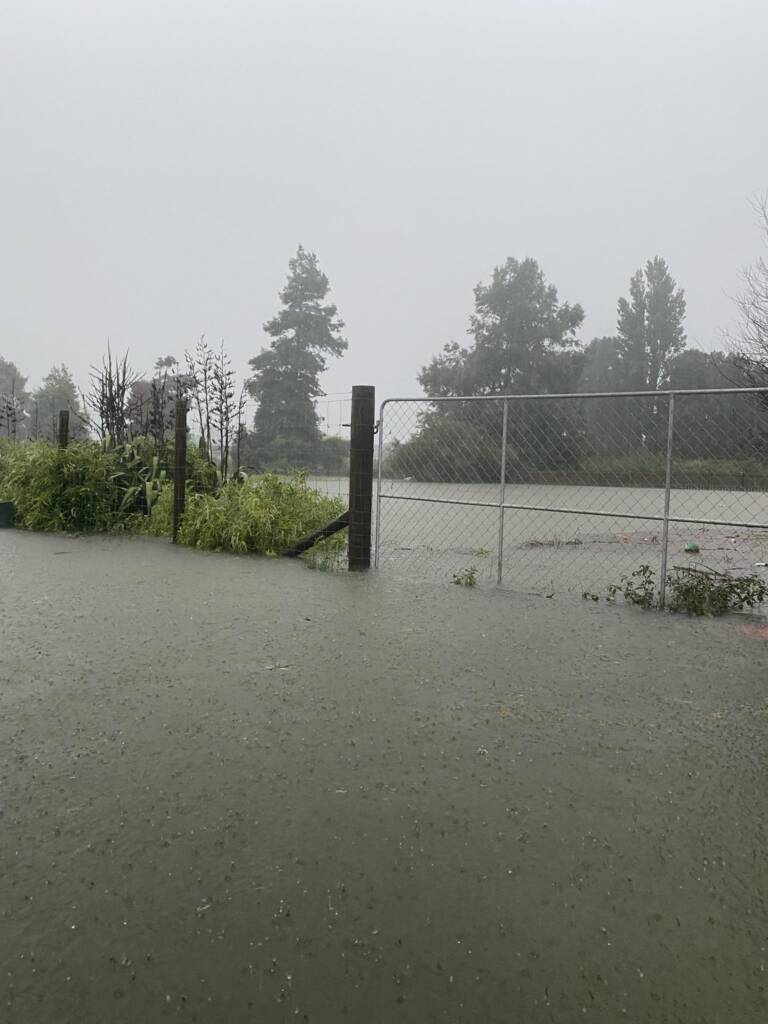
As the climate crisis escalates, stories are what connect us. Here, 350 Aotearoa board member Roshni Mathew shares her experience of Māngere being flooded in January 2023 and the power of mobilising community activism.
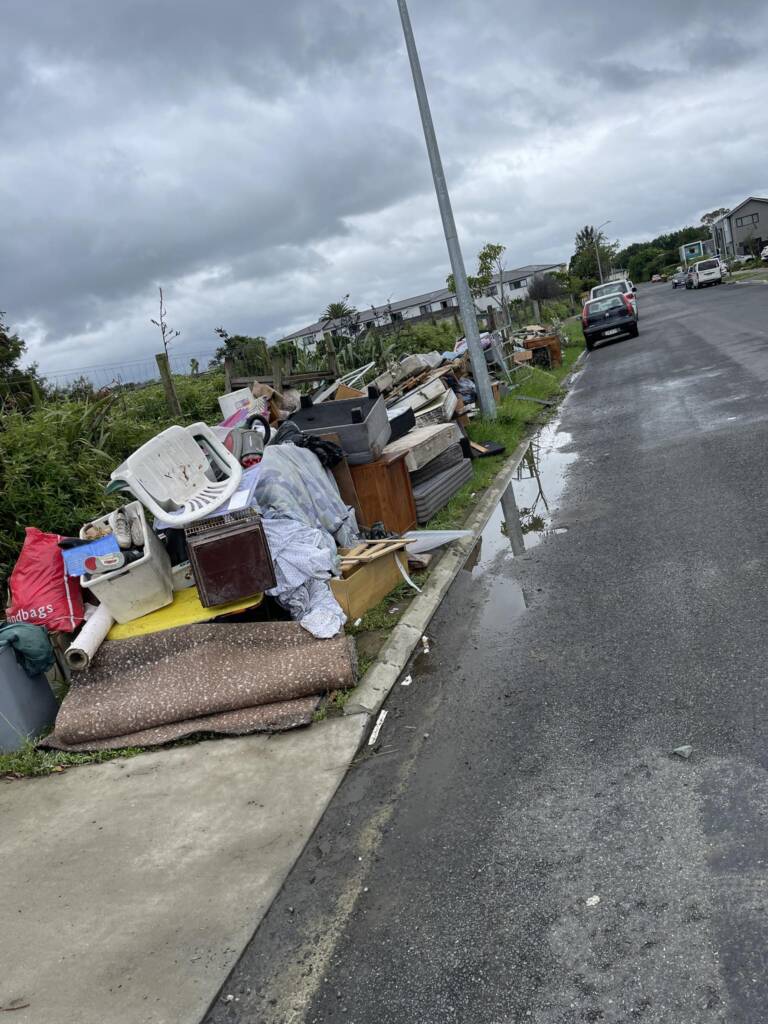
In January of 2023, a marine heat wave, set up by La Niña and turbocharged by climate change triggered severe flash flooding in Tāmaki Makaurau. A combination of factors: The water temperature being six degrees higher than average and a deceptive atmospheric river meant that a storm brewed, with a state of emergency declared late in the evening. This deluge disproportionately affected several suburbs across the city, including Māngere. Among those affected were residents – Olsen Palaamo and Farasat Shafi Ullah, both of whom have experienced the devastating consequences of recent floods. As we delve into the heart of this community, we uncover tales of resilience, unity, and determination to forge a brighter future. This is the untold story of Māngere’s climate warriors, outraged but optimistic, rising together even above waters.
Just before midnight, Olsen and his wife decided to navigate waist-deep water, cradling their four-month-old daughter amid intense rainfall, fearing “if the water level continues to rise, what will we do next?”. Personal treasures—photographs, books, cherished mementos; succumbed to the deluge. The trauma of that night lingers, compounded by the arduous process of dealing with insurers, who were overloaded by thousands of flood-related claims, the mammoth task of cleaning up the aftermath and the uncertainty of their home’s future. But even if their homes were fully restored, a cloud of unease lingers: “we’re worried about when the next weather event will occur and how badly our area would be affected”. Much of Māngere, similar to many other gentrified areas around the country, sits on flood-prone land, and there are few resiliency measures being implemented to mitigate the risk. Scientists and climate activists warn that flooding and other extreme weather events will only continue to exacerbate with the current rate of greenhouse gas emissions. Despite this, some of Aotearoa New Zealand’s biggest emitters which include Fonterra, Silver Fern Farms, Affco and Alliance contribute to the agriculture sector accounting for 51% of emissions and are largely exempt from Climate laws such as the Emissions Trading Scheme. Leaving them free to pump out atmosphere-torching methane to their heart’s (and shareholders) content. With global temperatures continuing to rise both at home and around the globe, so does the number of natural disasters with recent catastrophes in Morocco, Libya, Pakistan, Canada and Turkey – disproportionately affecting communities on the front line.
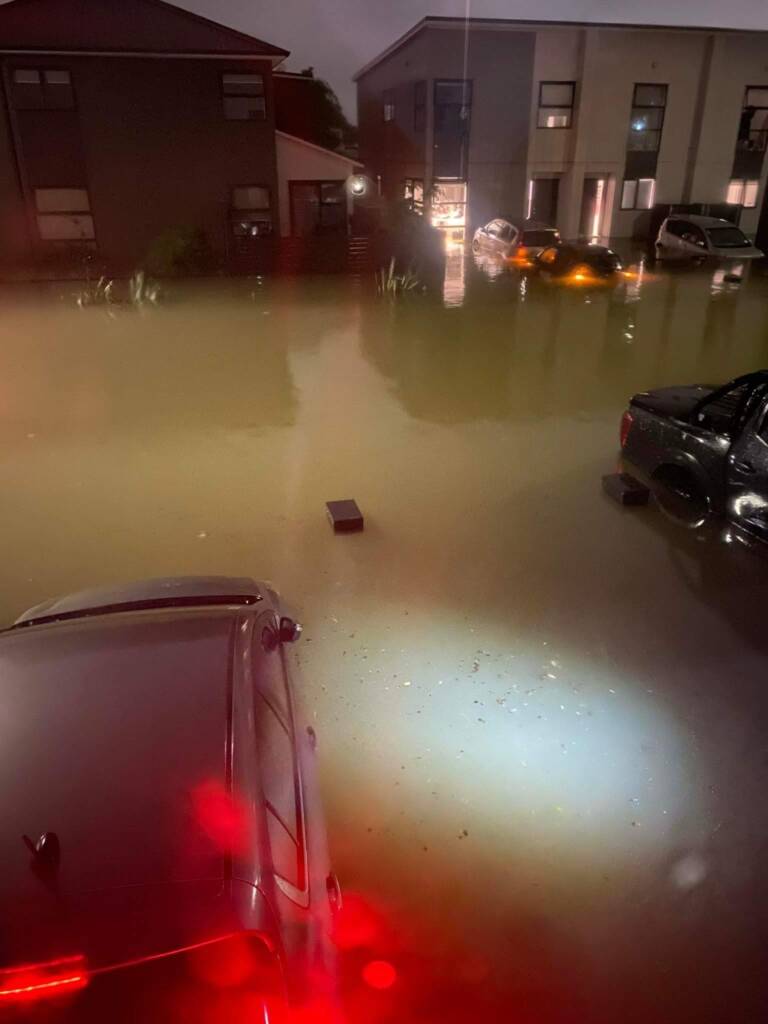
Similarly, for Farasat’s family, January 27th is etched into their memory as a “once-in-a-blue-moon” incident that turned their lives upside down. As new homeowners in Aotearoa New Zealand, they were eager to assimilate into their new neighbourhood. However, the floods exposed the ill-planned infrastructure and challenged their dreams of a flourishing future. Enduring the chaos of the floods and navigating a night of uncertainty, they found solace in their local community’s support. Amidst the chaos, Māngere’s residents banded together, sharing their concerns, progress on home repairs, and the weight of their experiences. Their collective strength and determination to seek solutions have become a beacon of hope for the wider region, with existing groups such as I Am Māngere delivering food parcels and other tools to residents . Olsen, Farasat and their newly created neighbourhood group “Thrive in Māngere” have recognised the importance of addressing the local Te Ararata Stream and stormwater drain management to mitigate future flooding risks, with their “Sort Our Stormwater (SOS)” campaign. The group has successfully reached out to local governing bodies – Auckland Council, Watercare and Healthy Waters for the maintenance of culverts before/after significant weather events, upgrades to stormwater system designs and infrastructure modelling to handle climate change impacts of today and for the future with the aid of Government funding throughout the city.
A year on, communities are still feeling the pressure. As waters recede and scars heal, the need for change, unity, and resilience becomes clear. Through collective action, we can confront climate challenges and forge a resilient, hopeful tomorrow.
Reproduced with permission from 350.org.nz.
By Robert McLachlan

Today James Renwick, James Higham and myself have released the first of three reports, making available key findings about Central Otago residents’ views on a number of topics.
The research, conducted late last year, covers five topics: Central Otago lifestyle, climate change, infrastructure and growth, tourism, and air travel and airports. Respondents chosen at random from right throughout the Queenstown Lakes and Central Otago districts were asked over 70 questions, and were also given the opportunity to comment openly on all topics.
The survey revealed a strongly unified population sharing many values, beliefs and concerns. 89% of respondents lived in or visited the region for its ‘lifestyle’; other natural factors, such as climate and landscape, also figured extremely highly. Other factors, such as ease of travel and work opportunities, were regarded as less important. There was a high level of concern about climate change and environmental sustainability in the region, and strong support for a greater focus on the value of visitors rather than the volume.
63% of respondents were opposed to the proposed Central Otago Airport (and 51%, strongly opposed) compared to 22% in favour. This level of opposition was found right across the Central Otago and Queenstown Lakes districts, in contrast to the statement from Christchurch Airport’s Michael Singleton that “the community is equally divided between supporters, opponents, and the undecided.”
The proposal to build an international airport at Tarras is not just a local issue as it is significant for New Zealand as a whole. It’s a national issue that can only be resolved by a national plan for aviation emissions that meets our international agreements.
Professor James Higham of Griffith University and the University of Otago commented that there were strong themes running through the responses. “There is no doubt that people choose to live in Central Otago for the same reasons that tourists want to visit. It is a superbly beautiful, unspoilt and tranquil place. It’s clear from our research that sustainability is now a very high priority for the people of Central Otago, and they also very clearly understand the impact of tourism that the region benefits from. This study shows that they want better tourism with less impact, rather than more tourists.”
Professor James Renwick of Victoria University of Wellington said that the impacts of climate change are clearly on Central Otago residents’ radar, which is consistent with research conducted elsewhere. “People are conscious that we have to do everything we can to get New Zealand to net-zero, and that we all have to play our part. We’re seeing people do that in numerous ways including solar energy, reducing waste to landfill and reducing unnecessary travel. Aviation can be a significant portion of people’s footprints – especially where flights are medium to long haul.”
The second report, due out next month, will present an analysis of the extensive and detailed written responses. A third report, scheduled for April 2024 will represent the results of bivariate analyses to uncover the relationships between responses to different questions.
The report can be downloaded at https://informedleaders.com/central-otago-study/.
The Rings of Saturn, a 1995 novel by W. G. Sebald, has been called the first novel of the Anthropocene, even though that era was not proposed until five years later. Ostensibly a walking tour of East Anglia with copious historical digressions and reflections, its global, far-reaching view is certainly more obvious today. Here is an extract from Chapter 7.

It had grown uncommonly sultry and dark when at midday, after resting on the beach, I climbed to Dunwich Heath, which lies forlorn above the sea. The history of how that melancholy region came to be is closely connected not only with the nature of the soil and the influence of a maritime climate but also, far more decisively, with the steady and advancing destruction, over a period of many centuries and indeed millennia, of the dense forests that extended over the entire British Isles after the last Ice Age. In Norfolk and Suffolk, it was chiefly oaks and elms that grew on the flatlands, spreading in unbroken waves across the gently undulating country right down to the coast. This phase of evolution was halted when the first settlers burnt off the forests along those drier stretches of the eastern coast where the light soil could be tilled. Just as the woods had once colonized the earth in irregular patterns, gradually growing together, so ever more extensive fields of ash and cinders now ate their way into that green-leafed world in a similarly haphazard fashion. If today one flies over the Amazon basin or over Borneo and sees the mountainous palls of smoke hanging, seemingly motionless, over the forest canopy, which from above resembles a mere patch of moss, then perhaps one can imagine what those fires, which sometimes burned on for months, would leave in their wake. Whatever was spared by the flames in prehistoric Europe was later felled for construction and ship-building, and to make the charcoal which the smelting of iron required in vast quantities. By the seventeenth century, only a few insignificant remnants of the erstwhile forests survived in the islands, most of them untended and decaying. The great fires were now lit on the other side of the ocean. It is not for nothing that Brazil owes its name to the French word for charcoal. Our spread over the earth was fuelled by reducing the higher species of vegetation to charcoal, by incessantly burning whatever would burn. From the first smouldering taper to the elegant lanterns whose light reverberated around eighteenth-century courtyards and from the mild radiance of these lanterns to the unearthly glow of the sodium lamps that line the Belgian motorways, it has all been combustion. Combustion is the hidden principle behind every artefact we create. The making of a fish-hook, manufacture of a china cup, or production of a television programme, all depend on the same process of combustion. Like our bodies and like our desires, the machines we have devised are possessed of a heart which is slowly reduced to embers. From the earliest times, human civilization has been no more than a strange luminescence growing more intense by the hour, of which no one can say when it will begin to wane and when it will fade away. For the time being, our cities still shine through the night and the fires still spread. In Italy, France and Spain, in Hungary, Poland and Lithuania, in Canada and California, summer fires consume whole forests, not to mention the great conflagration in the tropics that is never extinguished. A few years ago, on a Greek island that was wooded as recently as 1900, I observed the speed with which a blaze runs through dry vegetation. A short distance from the harbour town where I was staying, I stood by the roadside with a group of agitated men, the blackness behind us and before us, far below at the bottom of a gorge, the fire, whipped up by the wind, racing, leaping, and already climbing the steep slopes. And I shall never forget the junipers, dark against the glow, going up in flames one after the other as if they were tinder the moment the first tongues of fire licked at them, with a dull thudding sound like an explosion, and then promptly collapsing in a silent show of sparks.

By Paul Callister and Robert McLachlan
After a pause during Covid, aviation is once more on a growth path. There have been significant orders of new planes by many airlines and in Aotearoa there are plans to expand many airports. Christchurch airport continues to progress its plans to build a new large international airport at Tarras in Central Otago.
Despite much talk of future emission reduction strategies, the industry is still powered almost entirely by fossil fuels. The use of Sustainable Aviation Fuels (SAF) remains mainly for demonstration flights and no electric planes are yet carrying commercial passengers. Supplies of SAF remain insignificant compared with overall fuel use and rapidly expanding production of these fuels is a difficult challenge.
With the growth of flying, unless action is taken it seems inevitable that emissions will increase both globally and locally in the short to medium term. This is at a time when almost other sectors are working hard to reduce emissions.
The recently released advice from the Climate Change Commission relies heavily on new technology to reduce emissions from aviation. It argues that
within the second emissions budget period, the biggest opportunity for reducing emissions within aviation is likely to come from sustainably produced drop-in biofuels as a component of aviation fuels.
There are real challenges in producing sustainable biofuels, particularly if a goal is to not compete with food production. In an analysis of the use of crops for biofuel, primarily through the production of ethanol, Hannah Ritchie suggests that under some growth projections, the world would need around 300 million hectares of cropland to feed the planes. That is an area the size of India. Yes, sustainable aviation fuels will be an important part of decarbonising aviation. But other strategies are needed too.
In a new report with Kirsty Wild and Alistair Woodward from the University of Auckland, we identify seven key strategies that would help drive down our aviation emissions. These are 1) improved pricing, 2) carbon budgets for aviation; 3) improved emissions intensity; 4) limiting and targeting public investment; 5) public communications; 6) pausing airport expansion; and 7) investment in low-carbon domestic transport infrastructure. Our analysis is based on the Avoid-Shift-Improve framework of transportation planning and on the parallel contributions of passenger numbers, flight distance, and emissions intensity to overall emissions from the sector.
As we conclude,
No professor, chief executive, airline sustainability champion, or climate activist is under any
illusion about the challenges involved in regulating a source of pollution. But the ICAO
declaration, the ongoing Paris Agreement process, and the worsening climate crisis all point to
a rapidly closing window of opportunity for genuine action on aviation. Aotearoa, as a stand-out
beneficiary of aviation, has more to gain from timely and orderly action, and may also, through
its State Action Plan and other diplomatic efforts, foster more coordinated global action.
James Higham, Griffith University
On the same day last week that Air New Zealand announced the purchase of its first fully electric aircraft, Christchurch Airport announced it had reached “a new standard for decarbonisation”. On the face of it, great news for reducing aviation emissions in Aotearoa.
The reality is a little more complex – and risky. As the climate warms, so too is the temperature in boardrooms and courtrooms. The aviation industry is under increasing scrutiny for its sustainability claims, and climate litigation is on the rise.
At the same time, “net zero” strategies in general are being challenged. The United Nations High-Level Expert Group was established at last year’s COP27 summit, as Secretary General António Guterres explained, because “net zero suffers from a surplus of confusion and a deficit of credibility”.
The expert group has put forward a set of net-zero guidelines to put a “red line through greenwashing”. The guidelines underpin the UN’s approach to net zero, which requires corporate entities to advance ambitious climate mitigation actions based on rigorous and comprehensive science-based targets.
Among other things, the targets must include emissions reductions from the entity’s full value chain and activities. These include emissions from sources the entity owns and controls directly (known as scope 1); emissions the entity causes indirectly (scope 2); and emissions not produced by the entity itself, but arising up and down its value chain (scope 3).
The expert group also notes that voluntary carbon credits (offsets) cannot be counted towards interim emissions reductions required on the pathway to Net Zero 2050. This is because carbon offsetting has been shown to be troublesome at best, and in many cases a scam.
Key players in the global aviation industry that make unsupportable claims have become targets for climate litigation.
A recent greenwashing complaint to the European Commission, for example, was filed by consumer groups in 19 countries against 17 airlines. Virgin Atlantic and British Airways are facing formal complaints filed by a climate charity and law firm over sustainable flight claims.
Advertisements for Air France, Lufthansa and Etihad have been banned in the UK for greenwashing, following complaints to the UK Advertising Standards Board that phrases such as “protecting the future”, “sustainable avitaion” and “low-emissions airline” are misleading consumers.
Delta faces a class action lawsuit for claiming to be “the first carbon neutral airline on a global basis” in a case brought by a California resident claiming the airline has grossly misrepresented its climate impact.
And KLM is being sued for greenwashing by law firm Client Earth, which successfully argued the Dutch airline’s “Fly Responsibly” campaign consitutes misleading advertising under EU law while KLM is growing its number of flights rather than reducing emissions. https://www.youtube.com/embed/09IW75K6Tu4?wmode=transparent&start=10
Cases like these raise questions about Air New Zealand’s “Flight NZ0” strategy and marketing, which focuses on sustainable aviation fuel and next-generation aircraft (including its recently bought electric Beta Alia), complemented by carbon offsetting and operational efficiency.
The focus on sustainable fuel will have to overcome significant scientific, energy, scalability and cost barriers. Solutions to these complex problems are likely to be decades away at least.
While Air New Zealand promotes the Beta Alia – with its inherent altitude, payload and range limitations – it also aims to significantly increase its long haul network, and is setting its sights on the “ultra long haul experience”.
The contradiction between long-haul growth and decarbonisation strategies is expressed in the airline’s own 2017 sustainability report, in which the sustainability advisory panel chair wrote:
And that’s the dilemma for anyone who cares passionately about addressing the multiple threats of climate change: either stop flying altogether (the logical but somewhat unworldly idealist’s position), or fly as little and as discriminatingly and responsibly as possible (the often uncomfortable pragmatist’s position).
As consumers and environmentalists focus more on the validity of climate claims and the viability of carbon reduction strategies, Air New Zealand may find it harder to defend its net zero pathway.
The environmental claims of other players in the wider aviation system – notably airports – are also likely to attract critical attention.
Airports Council International (ACI) is the global industry body for airports, with over 550 airports taking part in its Airport Carbon Accreditation program, including many in New Zealand (most recently Invercargill Airport).
Christchurch Airport has been in the program for longer, and makes significant climate claims. In April 2022, it announced “another world class sustainability achievement”, going “beyond carbon neutral, to become climate positive”.
But this doesn’t account for scope 3 emissions, mainly associated with flights in and out of the airport, which make up 95.39% of total emissions. Airports can only appear to be climate-neutral by not accounting for the high and growing emissions of the planes that are their core business.
Key stakeholders are also exposed to any potential accusations of greenwashing. Christchurch City Council own 75% of the airport through a holding company, and the government owns 25%. Both have declared climate emergencies and made emissions reduction commitments.
Industry groups are involved, too. Tourism Industry Aotearoa, which represents businesses across the tourism industry, last month announced Christchurch Airport the winner of its Tourism Environment Award.
It cited the airport’s “climate positive” status and hailed it as being “at the forefront of airport environmental initiatives globally”. Such claims can be technically true if one accepts the limited parameters used to measure them.
But the Tourism Industry Aotearoa will need to ensure its environmental awards keep pace with developments in this rapidly changing field – including the increasing risk of litigation over unsustainable claims about sustainability.
James Higham, Professor of Tourism, Griffith University
This article is republished from The Conversation under a Creative Commons license. Read the original article.
The recent general election has resulted in sweeping changes in climate policy in New Zealand, but the commitments to the Zero Carbon Act, to meeting the climate budgets, and meeting our Paris Agreement target, remain. When the article below was published in short form in the newspaper, the editor chose the headline “The good news on climate change – and the rest“. This led to some debate online. Was it really good news? Or could the title equally well have been “The bad news”? I thought that for an international audience “New Zealand votes for a higher carbon tax” would have been a good lead.
Regardless of that, here is the full article from the November 2023 issue of Policy Quarterly.

 |
| Flood damage in Te Matau-a-Māui – Hawke’s Bay. Image by Rebekah Parsons-King, NIWA. |
By Liz Kivi, © Carbon News
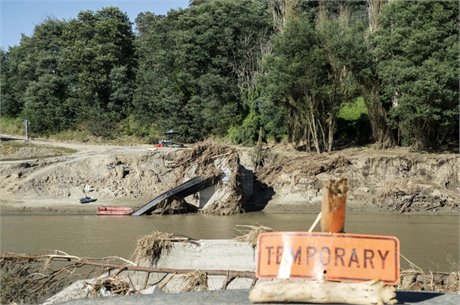
New Zealand authorities have declared a record 17 weather-related states of emergency so far this year, with insurance payments for climate-related disasters already topping $3.5 billion.
This is Aotearoa’s worst year ever for climate-related disasters, with more than twice the number of states of emergency than any other year, and insurance payouts totalling more than the combined total of the previous 14 years.
Declaring a state of emergency is a critical part of New Zealand’s response to disasters, giving authorities extraordinary powers designed to deliver a swift and effective response.

Eight of the emergency declarations were owing to Cyclone Gabrielle in February, with local emergencies declared in multiple regions, until a national state of emergency lasting 28 days was declared.
The South Island has seen only two states of emergency so far this year, with heavy rainfall and flooding in Gore and Queenstown in September, while the North Island has borne the brunt of multiple extreme weather events.
Northland, Auckland, Waikato, Bay of Plenty, Tairāwhiti and Hawke’s Bay were hit the hardest by Cyclone Gabrielle, and Auckland, Tairāwhiti, and Waikato have also forced into states of emergency because of other severe weather events.
Scientists are in no doubt that the events were exacerbated by rising temperatures caused by climate change, with a rapid attribution study concluding “with certainty” that human-induced climate change was the main driver making Cyclone Gabrielle’s extreme rainfall more likely.
Robert McLachlan, Massey University distinguished professor in Applied Mathematics, says 2023 has been exceptional in terms of global temperature rise.
The global temperature anomaly for 2002-2016 averaged +0.95ºC above the 1880-1910 baseline, while for 2017-2022 it was +1.18ºC. However, for the first nine months of 2023 that was much higher, with the global temperature anomaly +1.39ºC above the baseline.
“So 2023 is highly exceptional and may indicate what a ‘normal’ year looks like in 10 or 15 years’ time.”

McLachlan’s analysis drives home the relentless rise in payouts for climate-related disasters. “The 2004 floods in the lower North Island were exceptionally bad. So bad that the insured damage for the entire year was not exceeded until 2017, McLachlan says. “Since then it has been exceeded every year. The total for 2023 exceeds that for the previous 14 years.”
Going back further, the single most expensive previous event in the Insurance Council’s records was the Wahine storm. “That cost $13.5m in 1968, equivalent to $300m today,” McLachlan says.
The previous government had planned to introduce a Climate Adaptation Bill as part of their package of Resource Management Act reforms, but this was delayed. “Questions of climate adaptation and its financing and risk sharing will now pass to the new government,” McLachlan says.
Jonathan Boston, Victoria University of Wellington emeritus professor and climate adaptation expert, says that 2023 had a “highly unusual” number of extreme weather events. While stressing that he is not a meteorologist, Boston says the weather events were partly driven by the end of three years of a La Niña weather pattern in the Pacific and high ocean temperatures.
“In all likelihood there will not be as many severe weather events over the next year or two, with an El Niño weather pattern in the tropical Pacific. This will likely shift the focus of severe weather away from those parts of New Zealand that were badly affected this year.”
However, over time the costs and disruption from severe weather events will increase, Boston says. “This will be exacerbated by sea level rise, which will intensify coastal erosion and coastal inundation, and the damage caused by storms.”
The incoming government will need to make the right decisions to put Aotearoa in the best position to face challenging times ahead. “It should follow the advice in the recent report of the Expert Working Group on Managed Retreat, of which I was a member,” Boston says.
by James Bradley, in conversation wth Kim Stanley Robinson
There is no question Kim Stanley Robinson is one of the most important writers working today. Across almost four decades and more than twenty novels, his scrupulously imagined fiction has consistently explored questions of social justice, political and environmental economy, and utopian possibility.
Robinson is probably best known for his Mars trilogy, which envisions the settlement and transformation of Mars over several centuries, and the ethical and political challenges of building a new society. Yet it is possible his most significant legacy will turn out to be the remarkable sequence of novels that began with 2312. Published across less than a decade, these six books reimagine both our past and our future in startlingly new ways, emphasizing the indivisibility of ecological and economic systems and placing the climate emergency center stage.

The most recent, The Ministry for the Future, published in 2020, is a work of extraordinary scale and ambition. Simultaneously a deeply confronting vision of the true scale of the climate crisis, a future history of the next fifty years, and a manifesto outlining the revolutionary change that will be necessary to avert catastrophe, it is by turns terrifying, exhilarating, and finally, perhaps surprisingly, guardedly hopeful. It is also one of the most important books published in recent years.
This interview was conducted between January and March 2021, beginning in the immediate aftermath of the attack on the United States Capitol and the inauguration of President Biden, and ending as a second wave of the COVID pandemic began to gather pace in many countries around the world. As we bounced questions back and forth across the Pacific, a drumbeat of impending disaster grew louder by the day: atmospheric carbon dioxide reached 417 ppm, a level 50 percent higher than preindustrial levels; a study showed the current system responsible for the relative warmth of the Northern Hemisphere—the Atlantic meridional overturning circulation—at its weakest level in a thousand years; and Kyoto’s cherry blossoms bloomed earlier than they have at any time since records began in the ninth century CE.
JB: In several of your recent novels, you’ve characterized the first few decades of the twenty-first century as a time of inaction and indecision—in 2312, for instance, you called them “the Dithering”—but in The Ministry for the Future, you talk about the 2030s as “the zombie years,” a moment when “civilisation had been killed but it kept walking the Earth, staggering toward some fate even worse than death.” I wonder whether you could talk a little bit about that idea. What’s brought us to this point? And what does it mean for a civilization to be dead?
KSR: I’m thinking now that my sense of our global civilization dithering, and also trying to operate on old ideas and systems that are clearly inadequate to the present crisis, has been radically impacted by the COVID pandemic, which I think has been somewhat of a wake-up call for everyone—showing that we are indeed in a global civilization in every important sense (food supply, for instance), and also that we are utterly dependent on science and technology to keep eight billion people alive.
So 2312 was written in 2010. In that novel, I provided a timeline of sorts, looking backward from 2312, that was notional and intended to shock, also to fill the many decades it takes to make three centuries, and in a way that got my story in place the way I wanted it. In other words, it was a literary device, not a prediction. But it’s interesting now to look back and see me describing “the Dithering” as lasting so long. These are all affect states, not chronological predictions; I think it’s very important to emphasize science fiction’s double action, as both prophecy and metaphor for our present. As prophecy, SF is always wrong; as metaphor, it is always right, being an expression of the feeling of the time of writing.
So following that, The Ministry for the Future was written in 2019, before the pandemic. It expresses both fears and hopes specific to 2019—and now, because of the shock of the pandemic, it can serve as an image of “how it felt before.” It’s already a historical artifact. That’s fine, and I think it might be possible that the book can be read better now than it could have been in January 2020 when I finished it.
Now I don’t think there will be a period of “zombie years,” and certainly not the 2030s. The pandemic as a shock has sped up civilization’s awareness of the existential dangers of climate change. Now, post COVID, a fictional future history might speak of the “Trembling Twenties” as it’s described in The Ministry for the Future, but it also seems it will be a period of galvanized, spasmodic, intense struggle for control over history, starting right now. With that new feeing, the 2030s seem very far off and impossible to predict at all.
JB: In The Ministry for the Future, the thing that finally triggers change is the catastrophic heat wave that opens the book. It’s a profoundly upsetting and very powerful piece of writing, partly because an event of the sort it depicts is likely to be a reality within a decade or so. But as somebody whose country has already experienced catastrophic climate disaster in the form of fire and flood and seen little or no change in our political discourse, I found myself wondering whether the idea such a disaster would trigger change mightn’t be too optimistic. Do you think it will take catastrophe to create real change? Or will the impetus come from elsewhere?
KSR: People are good at imagining the catastrophe will always happen somewhere else and to other people. Thus in Australia, people will tend to think, “But it never could happen in Sydney, in Melbourne, in Perth.” Even though it could.
So it won’t be catastrophe per se that changes people’s politics and their votes. The impetus comes from ideology, from one’s invented imaginary relationship to the real situation. Here the discursive battle is paramount. The stories we tell each other will make the difference. The scientific community keeps telling us a story: that if we continue burning carbon into the atmosphere, and otherwise wrecking the biosphere, we will crash as a species. This story is making headway; I’ve seen the headway, everyone has, in the last two decades. A tipping point will arrive soon where it is the obvious story that everyone accepts as real; it will become hegemonic. And the sooner the better.
The radically cold temperatures hitting the US as I write this are located in many of the “red states” that voted for Trump, especially Texas. Voting Republican now is in effect a vote against science, a denial of science. So as I write, everyone in those regions without electrical power has to contemplate that in fact they depend completely on science and technology to stay alive. Will that change their thinking and their votes? Probably not—not all of them, and not immediately. But repeated shocks from reality will soon change the window of acceptable discourse, and then the hegemonic space. We are utterly dependent on the science and technology that is both civilization’s invention and its enabling device. This story needs to be insisted on. One way I try to do this is to remind everyone that when you’re sick and scared for your life, you run to a scientist, which is to say your doctor. That’s proof of what you really believe, more than your vote or your words.
In Australia, I can only say I’m mystified. Thirty million is a small population to include so many science deniers. An advanced, developed, rich nation, but also an island that can feel separate from the rest of the world—who knows? No one can understand other political entities from the outside. Even inside them, they are mysterious. But I’d have expected your science deniers and coal burners to be defeated at the polls by now. Maybe that will happen. Maybe electing an idiot like Trump helped to speed the process here.
JB: Part of the process of change has to be about rethinking our relationship with the past and the future. The idea of how we reimagine our relationship with the future is one you return to often: in The Ministry for the Future, your characters discuss the way economists discount the value of future lives when making decisions now, and the entire plot of Aurora is driven by the failure of people in the present to consider the effect of their actions on the lives of their descendants. But in an odd way, aren’t these questions about the future the easy ones? Because it’s the poisonous legacies of the past, of racism, slavery, colonialism, and extractivism, and their human and environmental costs, that are really intractable. Can we solve those questions of the future without solving the problems of the past? Or is that a false dichotomy?
KSR: This question reminds me of a slogan one sees in Marx, also Tolkien: we have to deal with the historical situation we’ve been given. Things could have been different, but they’re not—so on we go, free to act, and obliged to act, but not in a situation of our choosing.
That’s not to suggest we ignore history. Studying it teaches a lot (maybe everything) about where we are now. Seeing how we got to this moment—which is to say arguing about how we got to this moment—is part of the discursive battle about what to do now.
So there are indeed poisonous legacies of the past, inscribed into current practices, hegemonic beliefs, structures of feeling, and laws. The dead hand of the past, trying to strangle the new baby future that we, in the present, midwife. What I often feel that one can see very clearly is two major strands, braided together although often in direct conflict. I call it science versus capitalism. It’s like Australian economist Dick Bryan once said to me about finance and the state: they are hand in hand, but they’re arm-wrestling for control.
So the project becomes to strengthen the strand that is working for justice and a sustainable balance with the biosphere—I call that science, though it has to be admitted that this is a signaling word for a whole strand of history, which includes in it democracy, justice, progress, etcetera. Then, against that, there’s capitalism, again a signal word for feudalism, patriarchy, and all the older power systems of the few over the many, most of which emerged with agriculture about ten thousand years ago. That power system has an ancient lineage and is hard to beat.
Into this mythic dualism, lots of elements of history can be slotted, but it is a view from space, or a sock puppet play, very Manichean, and maybe often unhelpful. Maybe it’s my own false dichotomy, but I still feel it has some explanatory power. So it’s not the future over the past, except as a version of this: it’s science over capitalism.
JB: I’m interested by your decision to define the conflict as science versus capitalism, because it forces us to think about a lot of these questions differently and to recognize that many things we don’t usually think of as technologies— economic policy, finance, social justice, education, and all the other drivers of social change—can be usefully treated as precisely that. But doesn’t it also demand we recognize the real challenge isn’t electrifying the grid or rolling out solar panels, it’s a much more fundamental realignment of political power?
KSR: Yes, I think that’s right. Technology can be thought of as machinery only, but here computers are really helpful as an analogy; they have to have both hardware and software. In civilization as a technology, as with computers, the software is crucial; otherwise it’s just an inert hunk of metal and plastic. So in this case, we need to focus on software technologies like finance, economics, law, and politics. Then justice becomes a technology, and language itself. This blows up questions like, “Can there be a technological solution without political reform?” Maybe people are there asking, “Could we just make new machines that would overcome the disastrous effects of our unjust and unsustainable political economy, which is to say neoliberal capitalism?”
I think the answer to that is no. We need to change our political economy so that a single index, profit, isn’t our measure of doing well. We need to figure out a financial system that pays us for doing things good for the biosphere, including all its citizens, human and not—this would be safest, and indeed it’s necessary for humans—rather than rewarding activities that hurt people and biosphere, which profit-seeking will do.
Capital gets invested at the highest rate of return. That’s the law, often literally the law. Repairing the biosphere and creating justice among humans is not the highest rate of return now. So it won’t happen. End of story.
Or beginning of new chapter. This is what we’re seeing in new terms like Modern Monetary Theory, full employment, carbon quantitative easing, the social cost of carbon, universal basic income and services, Half Earth plans, and wage parity. Also in the return of older terms like socialism, or social security. All these ideas or systems or software technologies are being proposed to get out of the death spiral of neoliberal capitalism. What I find interesting and really encouraging is that these ideas are being discussed by people in the central banks and the national governments and the international diplomatic community. Even among economists, who for the most part have devoted all their work to an analysis of capitalism. These are no longer marginal or science fictional ideas; they are on the table as potential legislation.
JB: Those ideas and that sense a new world is being brought into being around us is very much a part of The Ministry for the Future, which, despite the grief and anger that make it so wrenching to read, shares the essentially utopian vision of your work in general. But it’s often not easy to see how much change is afoot, if only because, as Mark Fisher put it, capitalism occupies the horizons of the thinkable. Do you think this difficulty contributes to the sense of despair and powerlessness so many people feel at the moment?
KSR: Yes. I think of it in terms known to many now: ideology, hegemony, structure of feeling, capitalist realism: “There is no alternative.” And so on. It’s been forty years of a dominant political economy, following a couple of centuries of expanding capitalist power over world history, so it’s hard to imagine how that could change. Thus the famous Jameson/Zizek slogan: “Easier to imagine the end of the world than the end of capitalism.”
But I think now there’s also a widespread feeling that it can’t go on. And what can’t go on won’t go on. Capitalism is breaking the system, meaning people’s lives and the biosphere. We’re on the brink of causing a mass extinction event that will hammer humans, too; it’s not just climate change, which can be imagined as a matter of turning down the thermostat, but a much wider habitat collapse—our only habitat.
Given that feeling, people are looking for a way out of the current system and also for some ideas as to what that next system might look like. Even at the heart of the capitalist order—which is to say the central banks, the big corporations and investment firms, and in governments from local to nation-state level—there is talk of change. Of course, very often many of those speaking are hoping to manage change while retaining power. But some very interesting changes are part of that discussion. So I think the feeling of a massive immovable system has begun to creak, shift, crack, and let in new light.
JB: There’s a question here about how the change takes place, though, isn’t there? Especially given the power of the interests that oppose it. In New York 2140, you imagine a kind of Velvet Revolution, a peaceful reorganization of society and the economy, but in The Ministry for the Future you quote Keynes’s line about the euthanasia of the rentiers. Do you think we’ll see an acceleration of violent resistance as the climate crisis intensifies? And how should we think about that?
KSR: I’m not sure about this. In The Ministry for the Future, I described all kinds of political violence and also sabotage against fossil fuel or antihuman infrastructures. The novel was an attempt to describe the next three decades in terms that were antidystopian, but also plausible given the world of stark disagreements that we live in. If people see their families die as a result of climate change impacts, then the slow violence of capitalism will spark the fast violence of spasmodic revolt. Very often these violent acts of resistance do little good; the resistance fighters are killed or jailed, and the oppressive system doubles down in its oppression.
So I am among many who are trying to imagine ways of gaining the good results of a revolution without going through the trauma of old-style violent revolutions, which very often backfire anyway. Some better way to a better situation, which can be imagined in the realms of the discursive battle (Can we get more persuasive?); the political battle (Can we win a working majority?); the legislative battle (Can we pass laws that will help?);and then, also, sabotage of life-destroying machinery, mass civil disobedience, and alternative systems of governance that are simply lived outside the current nation-state system—and so on. The list could be extended.
My objections to violent resistance are both moral and tactical: First, it isn’t right to hurt other human beings, if not being attacked by them and defending oneself. Then, tactically, violence often seems to backfire and increase the misery being resisted. This is either because the state monopoly on violence is jealously held (and possibly a good thing) or because even if you seem to succeed by violence, you fail in the long run because the effort has used bad means, and the most violent among the revolutionaries tend to seize power and then use that same violence against any dissent of any kind.
This isn’t the whole story of history, obviously, but it’s the way it feels to me now, in our current situation. So a very rapid, stepwise, legal reformist revolution seems to me the best thing to try now. Later, if we get into the 2030s without meaningful progress on the various justice and sustainability fronts, I think more violent forms of resistance are more likely and maybe more justified. We’re in a closing window of opportunity for peaceful tactics to work.
JB: That closing window of opportunity means some very radical ideas are now on the table, some of which—such as proposals to dim the sun or seed the oceans with iron—are likely to have significant side effects. The idea humans might terraform or reengineer the environment in this way is central to your Mars trilogy and plays a big role in 2312, Green Earth, and The Ministry for the Future. Do you think we’re now at a point where some of these sorts of schemes have to be seriously entertained? And to what extent should we see them as a symptom of the failure of democratic means?
KSR: We’re in an all-hands-on-deck situation, so all these radical ideas need to be explored to see if they might help in safe ways. Geoengineering has been defined in advance as “doing dangerous things to save capitalism,” so naturally people tend to be wary of it. But everything humans do at scale has planetary effects and could be called geoengineering in some literal sense. Maximizing women’s education and political power worldwide could be called geoengineering because it would slow the population rise as a result of increased human agency, and this would have biosphere effects we could measure. As it’s a good and needed thing in and of itself, its ancillary benefits to the biosphere make it a double good.
So at that point the term geoengineering is exploded, and if you wanted to discuss it further it should be on a case-by-case basis. Deflecting some sunlight away by casting dust into the atmosphere (solar radiation management), if the dust were not volcanic but chosen for its inertness (like limestone dust), would reduce temperatures slightly for a few years—then the dust would fall to Earth, and the results of the act could be evaluated. If it was done by international agreement, then it would be the result of representative governments. It would be an experiment. Seeding the ocean with iron dust to create algal blooms, which would then die and fall to the sea floor, taking their carbon with them—well, the oceans are already sick because of our carbon burn, plastic pollution, bottom dragging, and overfishing. Doing more to it seems stupid to me, but on the other hand, a single experiment wouldn’t change much and might teach us some things. On this particular tactic, I’m like most people in thinking there’s got to be a better, safer way.
But this discussion is part of what it means to be in the Anthropocene— we’ve damaged the biosphere so badly that we now have to work at repairing it, without knowing enough to be sure how to do that well. Still, some actions are obvious. Stop emitting carbon dioxide into the atmosphere. Stop destroying habitat. Invent regenerative agriculture. End poverty and extend equal rights and education to all. These good acts will all have positive biosphere effects. The various emergency actions being discussed are marginal to these big, obvious things we need to do. You asked if I thought we were already at the point where we will need to do these things; I don’t think so. But we’re close. And if millions die in a wet bulb 35°C heat wave, then the nation-state where that happens may take matters into their own hands. No one in the developed world will have any right to object to that.
JB: The vision of our future you articulate in The Ministry for the Future is deeply confronting, but also, ultimately, hopeful in that it runs counter to the growing belief in the developed world that collapse is inevitable. Do you see hope as an imperative?
KSR: Yes, I do. Also, it’s very natural and biological; life hopes, hunger is a hope. Again, it’s too big a word to help much. Is it good to be alive? Do you hope to go on living therefore? That kind of hope is very persistent.
But then also there is fear. And there are reasons for fear. Is there a growing belief in the developed world that collapse is inevitable? I’m not so sure. And what would collapse mean? That you have to live like people in the Global South live now? Or that three-quarters of all humans will suddenly die in a spasm of civilizational incompetence? These are very different kinds of collapse. So hopes and fears, we always have them in a great overflow.
What I like about science is the way it tries to get particular. Is enough food being grown to feed everyone on Earth? Yes. Is it automatic that that continues? No. Is wilderness a good idea or a bad one? (This is one I’m thinking about now.) Well, scientists involved would ask which of the eight or ten definitions of wilderness you’re talking about. I like that kind of specificity.
But I think with this question you’re inquiring about our culture’s structure of feeling, the vibe, how the young feel, what the internet is saying if you just link around reading, and so on. There, in the realm of the general intellect or the feeling of our time, we’re inside a ringing bell. There is a great roaring, a cacophony. You can pull out the sounds you want to hear and call it an accidental symphony of sorts, and then get on with what needs doing. Your hopes and fears will still keep you awake at night. Meanwhile, the work goes on. People want their children to have a good life. Capitalism isn’t working, and what can’t go on won’t go on. So we’ll be experimenting our way into a different political economy. Hopefully we’ll dodge a mass extinction event, and then all kinds of good possibilities will open up. I think it really is a crux moment in history. The 2020s are going to be wild.
© James Bradley and Kim Stanley Robinson, 2022. First published in Jonathan Strahan (ed), Tomorrow’s Parties: Life in the Anthropocene, MIT Press, 2022. Republished with permission. Kim Stanley Robinson updated his views (now less pessimistic!) in an interview with Kim Hill on Radio New Zealand on 7 October 2023.

