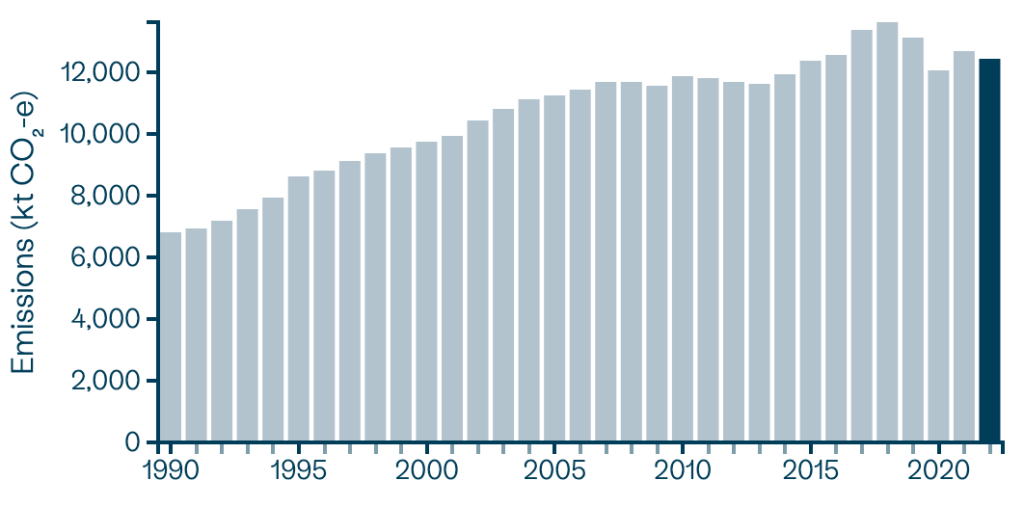
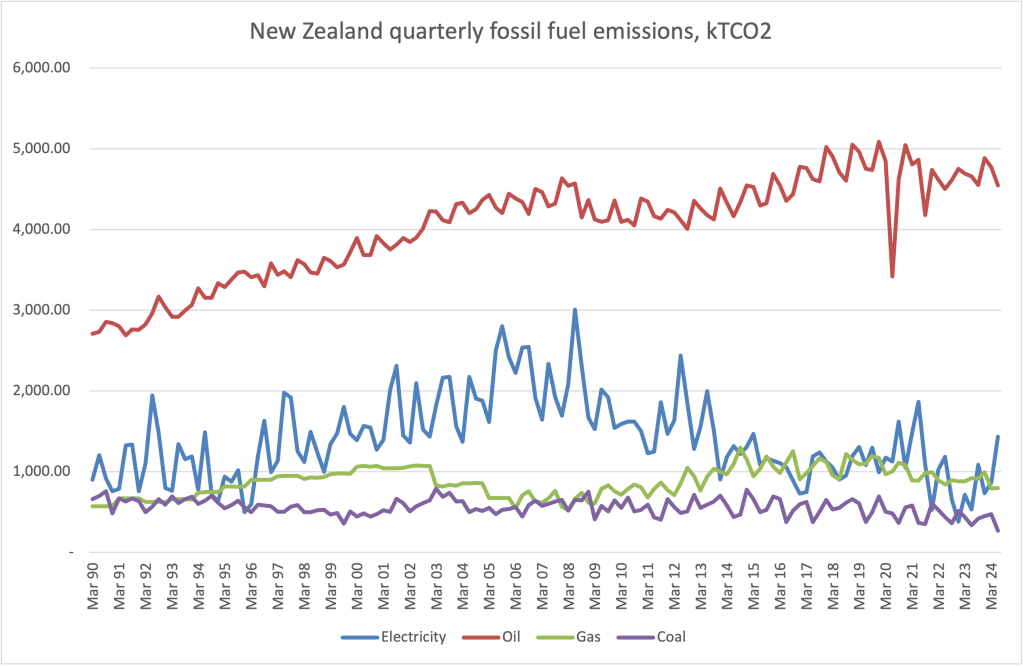
Every three months the Ministry of Business, Innovation and Employment puts out a useful document called the Energy Quarterly. It provides up-to-the-minute data on fossil fuel emissions, well in advance of the more detailed submissions for the UN which currently only run up to 2022. It’s where I get the data for graphs like this one:
My point is to make regular reminders that addressing climate change means phasing out fossil fuels and that we are only just starting on that task. But the details are important and interesting, too, such as the recent upswing in electricity emissions due to the record-low lake inflows. This serves as a reminder that the ‘dry year’ problem isn’t yet solved, and that without the significant new wind and geothermal plants that were completed in 2023 and 2024 we really would have had an energy crisis.
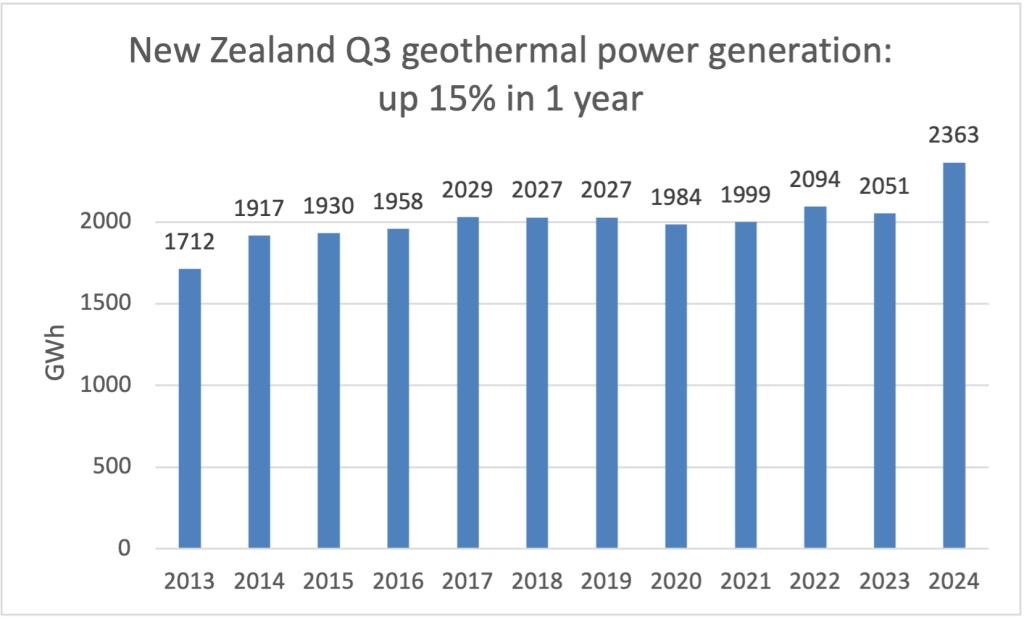
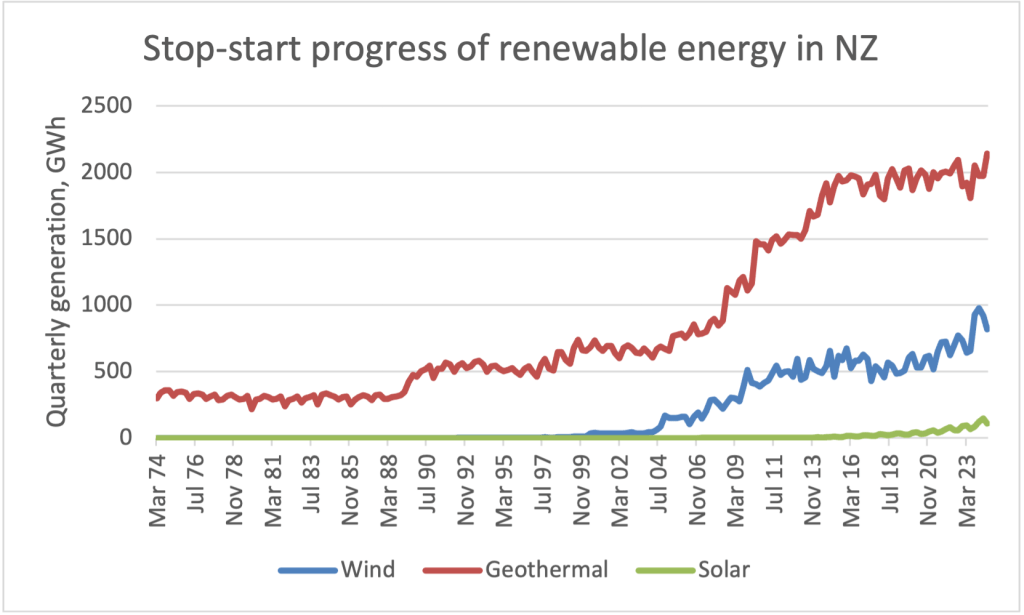
The electricity generation data in the Quarterly also shows that a long static period in New Zealand’s power generation is coming to an end. The biggest trigger for investment was the passage of the Climate Change Response (Zero Carbon) Amendment Act in 2019; projects that started construction in the following years are now operating.
However, future growth depends on anticipated future demand from climate action – phasing out fossil fuels and ‘electrifying everything’. The energy and transport sections of the final Second Emissions Reduction Plan do nothing to promote electrification, placing this recent growth at risk.
But what about the big picture on energy?
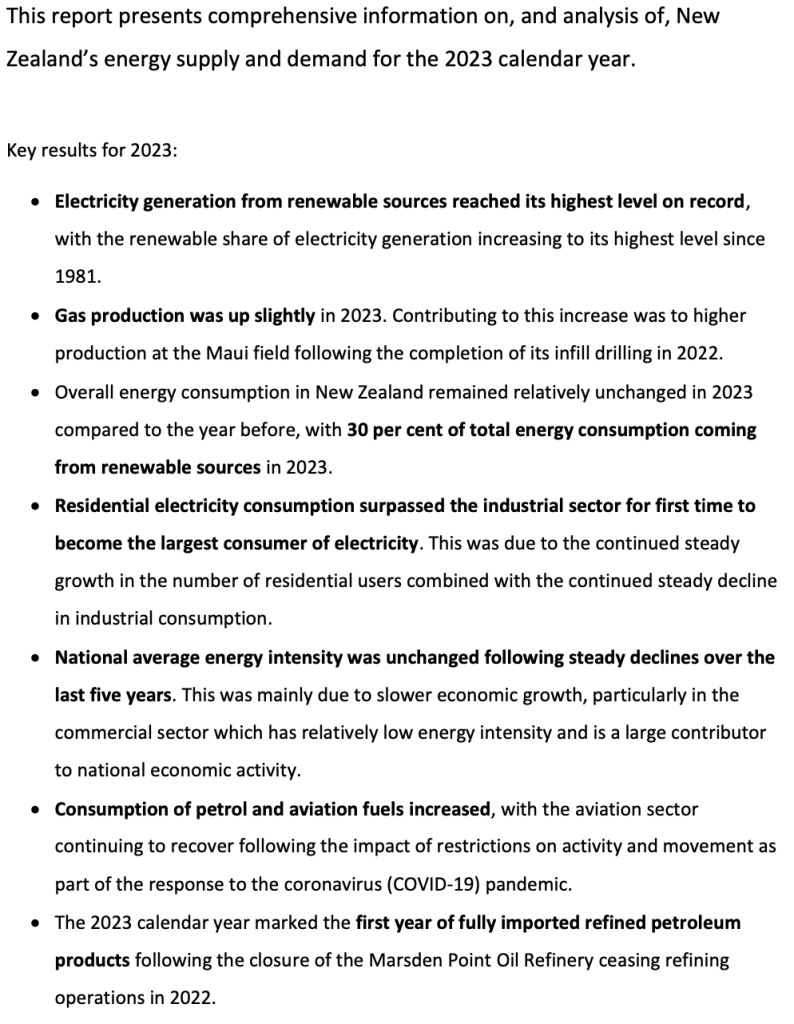
In addition to the Quarterly, MBIE produces an annual report, the latest being New Zealand Energy 2024. Here’s their summary:
The report includes many graphs, but not one showing what to me is the most striking development: total energy use has been falling for six years, and is now down nearly 10% from its peak in 2017.
Here ‘renewable’ energy is made up of hydropower (46%), geothermal (25%), biofuel (mostly wood – 23%), wind (6%), and solar (1%). Modern renewable electricity generation (wind, geothermal, and solar) was 41 PJ in 2023 or 6% of final energy demand. Here energy is what MBIE calls ‘final energy demand’, which includes the full energy content of fossil fuels and electricity but not the waste heat component of geothermal. The ‘substitution method’ used by Our World in Data (which upscales renewable energy to compensate for the thermal inefficiency of burning fossil fuels) is not used.
Coal, gas, oil, and even renewables are all down from their peaks. Looked at per capita, the effect is even more striking:
Energy use per person has been declining fairly steadily since 2001, and is now down 28% from peak. Is twenty-two years long enough to call it a trend?
There are probably many factors at play here that would be hard to untangle. At first sight the data doesn’t fit either of the convenient narratives on energy, ‘transition’, in which modern renewable energy gradually replaces fossil, or ‘more and more‘, in which new energy sources simply add to humanity’s rapacious demands.
Most likely a combination of factors – energy efficiency, deindustrialisation, and behaviour change – are at work. Initial indications are that all three of those effects were still in play in 2024, as energy-intensive industries shut down or scaled back. When we do get started on mass electrification and serious behaviour change, the energy decline will accelerate.
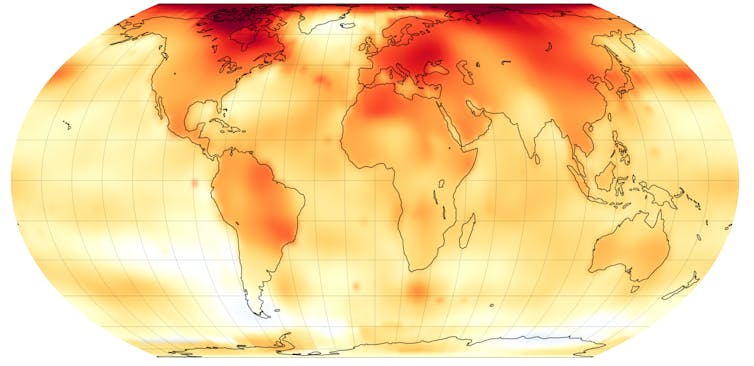
It’s now official. Last year was the warmest year on record globally and the first to exceed 1.5°C above pre-industrial levels. This doesn’t mean it’s too late to rein in further warming, but the ambition required rises with each delay in action.
New Zealand is no exception. Current climate policies are no longer a sufficient contribution to the global effort to keep warming at 1.5°C, according to the Climate Change Commission’s first review of the country’s 2050 climate target.
New Zealand’s current 2050 target has two components. Methane emissions from livestock must be cut by 24% to 47% below 2017 levels and emissions of all other greenhouse gases must reach net zero. But the commission has made three main recommendations to raise ambition:
a net negative target for emissions of long-lived gases (carbon dioxide and nitrous oxide) by removing 20 million tonnes more from the atmosphere than is released each year
a higher target range for biogenic methane emissions to reach at least 35% to 47% below 2017 levels
and the inclusion of emissions from international shipping and aviation.
The commission says these changes would bring New Zealand closer to “net zero for all gases”, in line with what is needed to achieve the goals of the Paris Agreement.
The 2050 target review was the last effort for the commission’s outgoing founding chair, Rod Carr, who has become a significant voice for climate action. In his closing words to parliament, he said:
Those who continue to promote the combustion of fossil fuels in the open air without permanent carbon capture and storage are, in my view, committing a crime against humanity.
The threshold for recommending a change is high. The commission must consider nine key areas and find “significant” developments that justify recommending a different target.
It found three significant changes occurred since the current target was set in 2019.
1. Global action is ahead of New Zealand
While other countries’ current policies, pledges or targets are not sufficient to keep temperature rise at 1.5°C, many countries now have more ambitious targets than New Zealand.
Australia, Japan, US, Canada, EU and Ireland all adopted full net-zero targets in 2021. Finland and Germany have or are considering net negative targets. Among countries with high biogenic methane emissions, several now have full net-zero targets.
2. Scientific understanding of climate change has changed
Climate impacts are appearing sooner and with more severity than the scientific community understood when the target was set in 2019.
3. The burden shifts to future generations
The increased risks and impacts of climate change have implications for inter-generational equity. Delaying action shifts costs and risks to future generations.
The commission’s report also explores New Zealand’s reliance on large-scale commercial exotic afforestation to meet its climate targets. This is one reason why Climate Action Tracker rates New Zealand’s response as highly insufficient and commensurate with a 4°C world.
Carbon in trees is part of the biosphere and will never be stored as permanently as fossil carbon. To take a case in point, Cyclone Gabrielle in 2023 (made worse by climate change) damaged forests, farms and infrastructure, and removed the social licence for forestry in the region.
How the recommended target was set
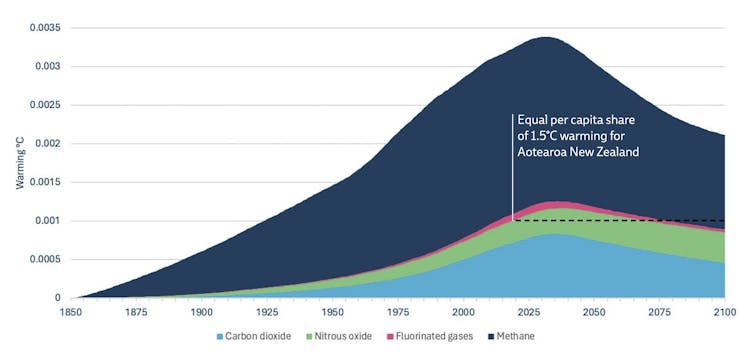
The commission’s work is tightly prescribed by law. It looked at four possible ways of sharing the global 1.5°C task: equal per capita emissions, national capacity, responsibility for historic warming and the right of all peoples to sustainable development.
New Zealand’s current target does not meet any of these standards, but the commission says the new target would at least meet the “national capacity” criterion and would be feasible and acceptable. However, it would still see New Zealand contributing two to three times its share of global warming this century.
The commission’s assessment is independent of any global warming metrics such as GWP100 (currently the UN standard). Instead, the commission computed New Zealand’s historical and future contribution to temperature rise directly. Both commonly used historical baselines, 1850 and 1990, yield similar results.
New Zealand’s government is currently particularly at odds with the commission’s recommendation on biogenic methane. It appointed a separate advisory panel last year which put forward a target consistent with causing “no additional warming” to the planet from agricultural methane emissions.
This graph shows the contribution to warming from emissions in New Zealand (1850–2100) under the current 2050 target. Climate Change Commission, CC BY-SA
But the commission rejects this idea, finding that unless the rest of New Zealand’s target were to be strengthened significantly, this would not be consistent with the Paris Agreement or the country’s own climate law.
International aviation and shipping emissions
In a quirk of climate diplomacy, international aviation and shipping emissions were excluded from the original 2050 target. But as the commission points out, they most definitely contribute to global warming and are covered by the temperature target of the Paris Agreement.
Other countries are moving in these areas and the International Civil Aviation and maritime organisations have net zero 2050 goals in place. Air New Zealand and the global shipping giant Maersk both support including these emissions in the 2050 target, which the commission finds to be achievable under multiple different pathways.
New Zealand’s dependence on shipping and air transport is a challenge. The commission puts the combined emissions from these sectors at 6.7 megatonnes – 20% of total CO₂ emissions and close to all industrial or all passenger car emissions. The aviation industry in particular is planning for growth, which, unless addressed, will blow the 1.5°C carbon budget both for New Zealand and globally.
Drawing on “net zero pathways” prepared by the international aviation and shipping industries, the commission finds that including these sources in New Zealand’s revised 2050 target would be achievable. The sectors would not necessarily have to enter the Emissions Trading Scheme, but the status quo (under which these sectors do not attract GST, fuel tax or a carbon charge) is inequitable with other sources of economic activity.
This article is republished from The Conversation under a Creative Commons license. Read the original article. The author acknowledges the assistance and contribution of Paul Callister.
Between 1892 and 2012, Statistics New Zealand published an annual yearbook. As noticed by Matt Lowrie, the 1992 Yearbook included this sidebar which departed from the usual dry style of the previous hundred years:
Plus ça change. Thirty-two years later, New Zealand still has one of the highest rates of car ownership in the world, Paris is eliminating most of its on-street parking, and Sydney has just opened another light rail line. I wonder what caused this outburst from the normally staid statistics agency. Did the new Chief Statistician, Len Cook, want to shake things up a bit?
What particularly caught my eye was this bit:
In New Zealand the average car currently manages a mileage of 100 kilometres per 10 litres. To reach the Government’s target of a 20 percent reduction in greenhouse gas emissions by the year 2000, this would have to be cut to 100 kilometres per 3.5 litres.
Even under the generous interpretation that the target here refers to new cars only, we’re still nowhere near 3.5 l/100km; the last few years hover around 6-7 l/100km. Pretty startling when you consider that the popular Honda Civic (a kind of large hatchback or small station wagon) was already delivering 5.3 l/100km in 1985, and that twenty years after the introduction of the hybrid Toyota Prius in 2001, only 2% of the light vehicle fleet was hybrid.
But enough about cars. What about that Government target of a 20% reduction in greenhouse gas emissions by the year 2000? Where did that come from? Needless to say, we’re not there yet either. Gross emissions of long-lived gases, and net emissions of all gases, are both up 40% on 1990 levels. This year, despite the downturn, 210,000 fossil-fueled cars will be imported, which if parked up would fill the entire length of State Highway 1. (Sorry, I mentioned cars again.)
To answer this I want to go back to a fascinating document from 1990, “Responding to Climate Change: A Discussion of Options for New Zealand”.
This was the year of the first IPCC report as well as of New Zealand’s first reports on climate science, climate impacts, and policy options. It was the year that both Labour and National (who defeated the incumbent Labour party in the October 1990 general election) adopted emissions targets. The May 1990 Climate Options report led to Labour adopting a target of –20% on 1990 levels by 2005. The election was to be held on 27 October; with a major international climate meeting falling on 29 October, National announced their own, more ambitious target (–20% on 1990 levels by 2000) just two days before the election.
The 1990 Climate Options Report
The report is comprehensive and offers 93 different options for consideration. They are grouped under social and behavioural measures, planning measures, market measures, legislative and regulatory measures, energy, transport, commercial buildings and households, industry, energy efficiency, agriculture, and forestry. Pretty comprehensive, and all of the options are given a balanced hearing. Any or all of them would have been a good idea.
Transport, as such a large source of emissions, is given a particularly thorough going-over. Suggestions include mandatory tune-ups, fuel efficiency standards, rebates for scrapping old vehicles, lower speed limits, fuel efficiency standards, fuel efficiency labelling, business tax incentives and levies, CO2-linked registration fees, integrated transport planning (hah!), mode shift such as rail freight, responsible town planning, staff transport, optimisation of freight routing and loading, and alternative fuels – CNG, biogas, bioethanol, electricity, and hydrogen.
One of the transport options in the 1990 report. 45 mpg is equivalent to 6.3 l/100km, a level that has still not been reached in 2024.
What’s notable is that all of these ideas were either already in use or under active consideration in many countries. The US introduced fuel efficiency standards in 1975. Norway introduced EV incentives in 1990, after the pop group A-ha had toured the country in an EV (refusing to pay tolls) the previous year. (Thirty-six years later, a quarter of the cars in Norway are electric, which gives some idea of the time and determination required for a technology transition. Per-capita transport emissions in Norway did not begin falling until 2010, and have only now returned to 1990 levels. On its present course, Norway will have decarbonised road transport by 2050, a sixty year journey.)
Morten Harket (left) and Magne Furuholmen from A-ha with Prof Rostvik (second left) and Frederic Hauge with their converted electric Fiat. (source)
So what happened? Unfortunately, from a promising start, the front fell off New Zealand’s climate response almost immediately. As Kirsty Hamilton writes,
This was particularly disappointing because most of the ingredients for a world class national response were present in New Zealand at the end of the 1980s. However, by 1997 New Zealand had gone from being in a prime position to serve as a positive catalyst in the debate, to at best sitting on the fence on key issues, and at worst becoming an impediment to the formulation of an effective international response to climate change.
Consideration of transport emissions virtually fell off the radar for years or decades. Consider the fate of just two of the policy options, fuel efficiency standards and labelling. (I lied when I said “enough about cars”.) They did not progress during the 1990s, but when Labour returned to power in 1999, standards and labelling did eventually make it into a policy document, the New Zealand Transport Strategy 2002. Labelling came into effect in April 2008, but standards fell victim to the election later that year that brought National back to power. Without standards, labelling did next to nothing. Another attempt by Labour to introduce standards in 2018 was blocked by New Zealand First; it took a further electoral cycle before standards were finally came into effect in 2023, 33 years after they were first suggested. That same year National returned and immediately weakened the standards.
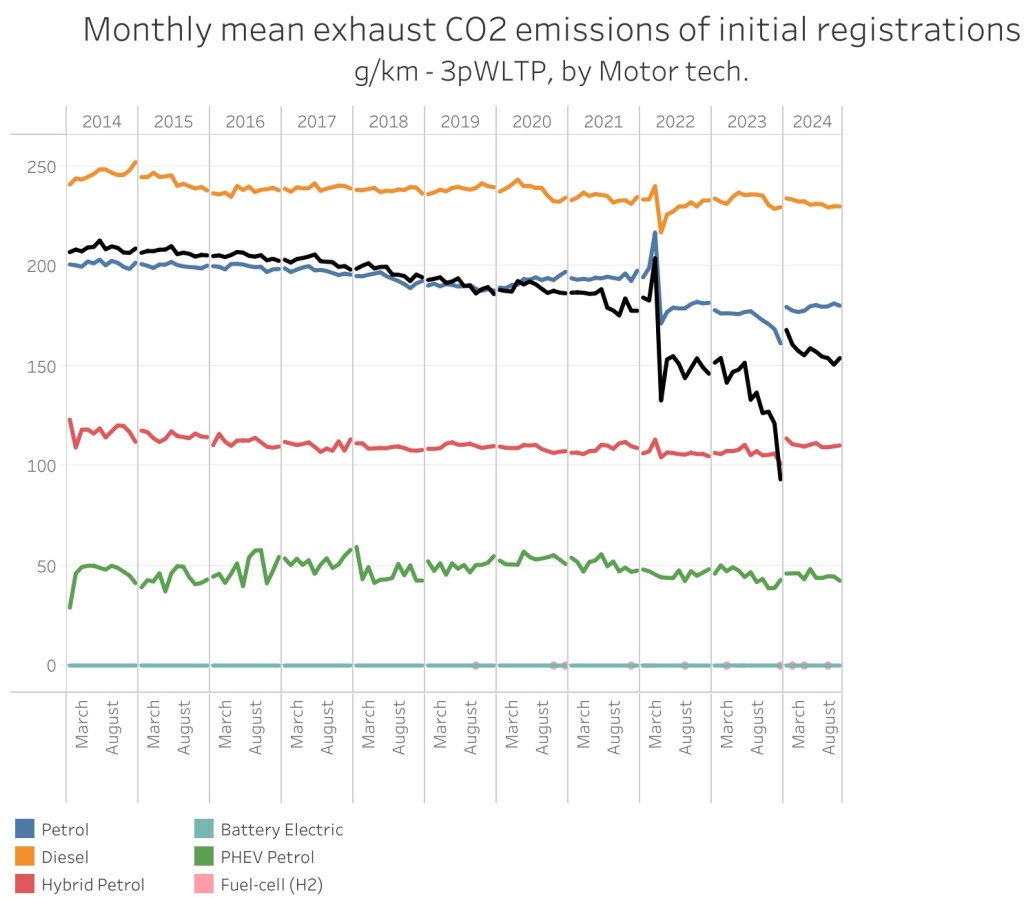
Emissions of newly registered light vehicles, 2014-2024, showing a reduction from 208 gCO2/km in 2014 (8.9 l/100km) to 156 gCO2/km in 2024 (6.7 l/100km). The Clean Car Discount (feebate) was in effect from July 2021 to December 2023. (Source)
New Zealand’s road transport emissions increased 82% from 1990 to 2022. The increase per capita is 18% (source).
It’s been a similar story of vacillation in almost every other sector. Some of the causes run wide and deep and span the entire problem of climate change itself. Rather than go through the whole history, I want to stick to the 1990 report and ask – did they miss anything? I mean, clearly the authors did not anticipate the strong, organised and persistent opposition that would be raised to virtually any suggestion on how to cut emissions. Perhaps they can hardly be blamed for that. Did they miss anything that could plausibly have been included, and if so, would it have made any difference?
I think they did. They did miss the significant impacts of population growth (57% from 1990 to 2023, faster than the world average) and economic growth (also 57% in real per capita terms, faster than the US). Efficiency gains would have to be really heroic to overcome both of those. Questioning them would have killed the report in any event. Also, the authors weren’t thinking in terms of phasing out fossil fuels entirely, but that need wasn’t widely recognised until fairly recently, and remains a stumbling block even today.
No, the big thing they missed was renewable energy. I could hardly believe it. I had to read the report twice to be sure. In a 100,000-word report (the length of a decent novel), this is all we get:
Surely the central importance of replacing fossil with renewable energy was well established by 1990? It’s even more surprising in view of New Zealand’s long-standing pride in its renewable resources (despite an unfortunate detour into gas in the 1970s). 1990 may have been a bit early for solar, but it was not too early for wind. Denmark was already generating 610 GWh a year from wind power in 1990 (similar to the Manapouri hydropower station), as was California, both having started in the 1970s. A New Zealand energy research group had published a report in 1987 outlining the feasibility of twelve 250 MW wind farms, triple what we have now in 2024. We built the first substantial geothermal power station in the world in 1958 and have never lost our world-leading expertise. Moreover, our second geothermal power station at Ohaaki (producing a sizeable 300 MWh a year) had only just opened the previous year.
I’m at a bit of a loss to explain this. Our experience in renewable energy since then has been one of repeated stops and starts, whereas the evidence from other countries is that large-scale transitions, whether in energy, transport, or otherwise, can take many decades and require sustained consistency of focus. Denmark has only largely decarbonised its electricity supply now, fifty years after their journey started.
Source: New Zealand Energy Quarterly, MBIE
I started out by calling this essay “What have we learned?”. Perhaps that was a bit ambitious. Is the lesson that comprehensive policy development and engagement is not enough? That we should have picked a smaller, more focused target and gone after it hard and fast, to bed in momentum and support? Or should we have been bolder to begin with? In the UK, the Royal Commission on Environmental Pollution (an independent agency in existence from 1970 to 2011) went really hard out in their 1994 report Transport and the Environment. They recommended doubling the price of petrol over the coming ten years, reducing total driving, and greatly curtailing road building. Even though none of that happened, their report is right on the facts, and perhaps it did set the scene for other measures which did eventually come about, and which have survived several changes of government.
Thirty-four years after our first climate report, we have at last turned the corner on emissions. In that sense we are on the way. But the harder step, of achieving a society-wide consensus on where we want to be and how to get there, still lies ahead.
Gillespie, A. (2001). New Zealand and the climate change debate: 1995–1998. In Climate Change in the South Pacific: Impacts and responses in Australia, New Zealand, and small island states (pp. 165-187). Dordrecht: Springer Netherlands.
Cherry, N. (1987). Wind energy resource survey of New Zealand: National resource assessment: summary and final report. New Zealand Energy Research and Development Committee, University of Auckland.
Under the Paris Agreement, countries periodically submit NDCs or ‘Nationally Determined Contributions’. The first one covers emissions from 2021 to 2030, and the second (covering emissions out to 2035) is due early next year.
The Ministry for the Environment is consulting on our second NDC (due 8 December 2024). The world is currently on track for up to 3 ºC of warming by 2100 and the UN has called for more ambitious near-term targets. As I wrote earlier, New Zealand is currently warming at 3 degrees per century; unless emissions reduce, we’ll blow through both 1.5 and 2 ºC in fairly short order.
Public submissions close on Tuesday 1 October on the Crown Minerals Amendment Bill which, amongst other things, will reverse the 2018 ban that limited new petroleum exploration permits outside onshore Taranaki.
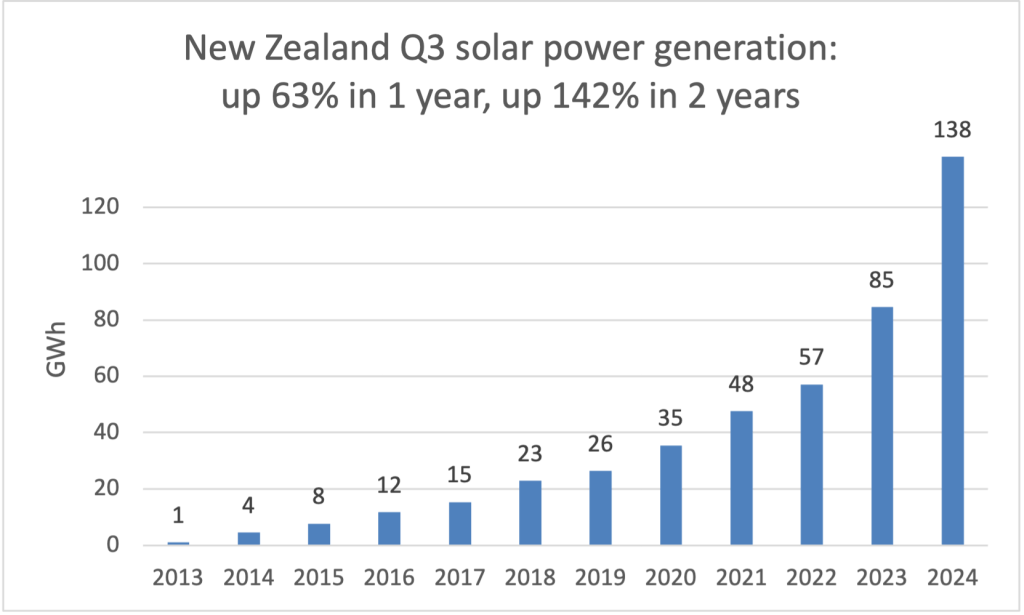
There’s a lot going on here, but one thing I would like to bring to the Government’s attention is this graph, showing how the New Zealand solar power industry has grown 46% annually for ten years in a row. It’s poised to continue, with an enormous pipeline of new projects under consideration.
But it could be stopped in its tracks by an anti-climate government. It’s happened before, with geothermal power and with wind power, both of which were stopped for a decade until the passage of the Zero Carbon Act which showed that the climate crisis was being taken seriously. It happened again with the cratering of electric car sales: anti-climate signals from the top do seem to have an effect.
For these solar projects and others like them to go ahead, developers need to know that demand for low-carbon electricity will be there. That demand comes from phasing out fossil fuel, particularly (in the context of this Bill) natural gas.
The Energy Quarterly from the Ministry of Business, Innovation and Employment reports fossil fuel emissions from electricity generation, oil, and (industrial, i.e. non-electricity) coal and gas. The June 2024 issue shows that oil, coal, and gas are all down from the previous quarter.
Electricity emissions increased, but even this is something of a good news story: despite inflows to the hydro lakes being at 90-year lows, new wind and geothermal plants completed in the last few years are avoiding 2 million tonnes of CO2 per year. As a result, we entered winter with lakes at average levels and they never fell anywhere near the warning line.
The lowest level of storage, around 1500 GWh, was not unusually low – similar or lower levels were reached in 4 of the previous 14 years.
Thus the investments triggered by the pro-climate Zero Carbon Act of 2019 meant that an electricity shortage was avoided. And annual electricity emissions, though off their lows, are still 59% below peak.
Oil accounts for two-thirds of emissions from the burning of fossil fuels. However, even oil consumption has been fairly flat for 11 quarters in a row, and remains 4% below record highs. High prices and behaviour change (and to a lesser extent EVs) are responsible. The cost of oil in real terms per capita has tripled since the 1990s.
Industrial coal use is at record lows, and now 41% below peak. Gas use is 23% below peak. Overall, annual emissions are 9% below their peak.
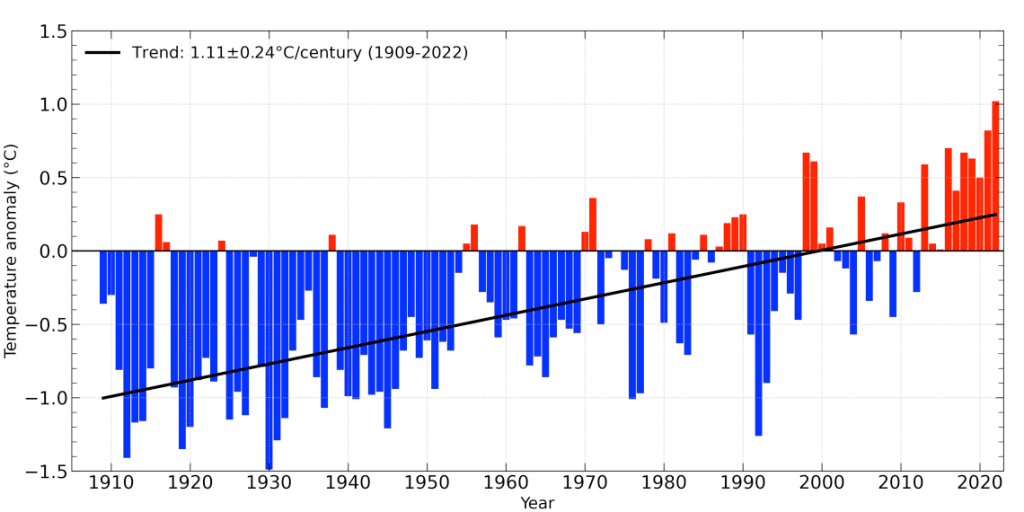
But is that straight line a sound model of the trend?
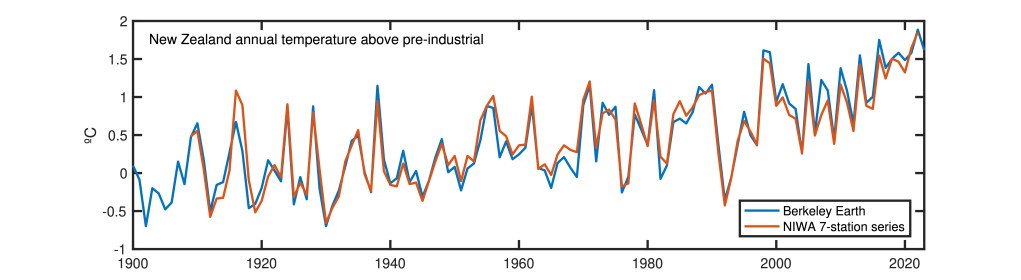
Recently, Berkeley Earth released preliminary data for all countries in the world. Although based on data from 86 sites, rather than 7, it gives very similar results to NIWA:
Some years stand out well above the trend. 1938 was particularly warm, at 1.15 ºC above pre-industrial, a record that would not be matched again until 1971. In April 1938,
So much sediment washed into the river that the Esk Valley was left covered in silt one to three metres deep when the floodwaters subsided. The water was more than two metres over the floor of the Eskdale Railway Station, and silt lay 1.6 metres deep. The silt was dug out of some houses but the old road running up the valley remains buried beneath the road since built over it. Once the silt had consolidated on farmland, new fences were installed; some posts were placed on top of the old buried posts.
Silt in Esk Valley in April 1938 (Northern Northern Advocate, 23 June 1938) and in 2023 (RNZ).
1992 was particularly cold, at –0.36 ºC, a return to pre-WWII temperatures caused by the eruption of Mt Pinatubo in the Philippines. The effect on New Zealand (1 ºC below the trend for those years) was twice the world average. Kane Hartillrecalled:
1992… Amazing year, a rigorously cold winter. I was studying geology at Canterbury, and spending plenty of time doing ski-mountaineering trips to Cook and the Canterbury ranges. It seemed most of the year was drab grey with bone chilling damp cold southerly quarter winds… On one visit to Mt Hutt in late August the snow wall on the side of the access road was just over double bus height, about 8 meters. The upper T-bar lift line was cut down deep into the snow pack, there were 4-5 meter walls of snow each side along much of the ascent. I snowboarded with ice axe in hand from the summit of Mt Rolleston down the Otira valley to beyond the footbridge >5km. Then in the summer we used to go snowboarding on the permanent ice field in the upper Otira valley… it became hollowed out with caves through the later 90’s and disappeared. Pity, the most accessible ice caves in NZ at the time, 30-45min walking track from the highway… they were stunning blue like the Iceland ones.
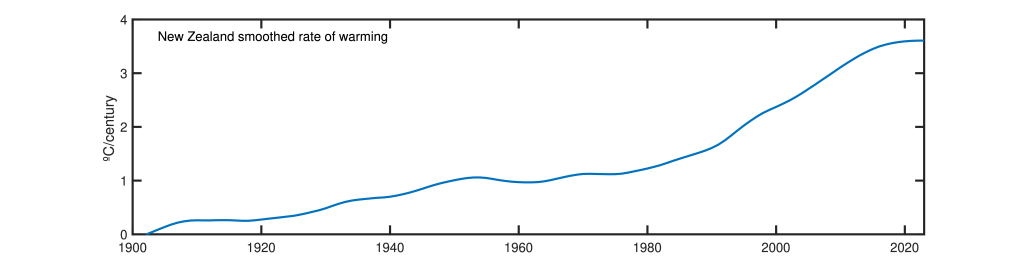
The smoothed temperature record provides an estimate of the rate of warming:
The warming appears to accelerate fairly steadily until about 1990, rising from zero to about 1 ºC/century. Then the rate of acceleration triples, with the warming rate increasing to over 3 ºC/century today. Because of the small land area and resulting variability, this estimate is pretty rough. But it is consistent with the global rate, which is also around 3 ºC/century. An acceleration to that kind of rate is expected under a medium-emissions scenario. On the other hand, warming stops when emissions stop.
Overall, New Zealand saw 0.89 ºC of warming in the 20th century, and another 0.73 ºC since 2000. The total, +1.6 ºC, is closer to the world average for land (+1.9 ºC) than for ocean (+0.9 ºC).
Submissions close on 25 August for comments on the Government’s second emissions reduction plan, which covers the period 2026-2030. You can also comment on changes to the first (2022-2025) plan, although that’s a bit of a joke because the proposed changes have already happened.
The Government now favours a “least-cost” approach, which I take to mean “least cost for a given level of risk and ambition”. But that very much depends on how you measure cost and risk. To me the plan looks high cost, high risk, and low ambition.
It’s proposed to delay decarbonisation of transport and energy by 15-20+ years – but tree planting would be at similar levels as advised by the Climate Change Commission. How does that add up?
The recent failure of a deal to deliver hydrogen-powered trucks to New Zealand, and the removal of a NZ$100 million government rebate scheme for green hydrogen users in the 2024 budget, make a transition to the much-lauded energy technology increasingly less certain.
The government had invested $6.5 million for the purchase of up to 25 heavy freight hydrogen trucks as part of a wider energy strategy due by the end of the year. But the US company Hyzon, which makes hydrogen fuel-cell trucks and had been modifying diesel trucks to use hydrogen, pulled out at short notice.
Nonetheless, interest in hydrogen for future transport and energy systems has soared globally, and New Zealand is no exception. But we argue that critical voices have been largely missing from the debate here.
In New Zealand, green hydrogen (which is produced with electricity from renewable sources) has attracted government support of $186.3 million from 2017 to 2023. This provided funding for a hydrogen refuelling network, vehicle conversions and purchases, research, and the establishment of the New Zealand Hydrogen Council (now Hydrogen New Zealand).
Proponents of green hydrogen argue it is essential for fuelling economic sectors they believe will be hard to decarbonise by direct electrification. As well as heavy road transport, this includes shipping and fertiliser production.
But opinions differ considerably on which sectors to focus on, and whether hydrogen is the best choice.
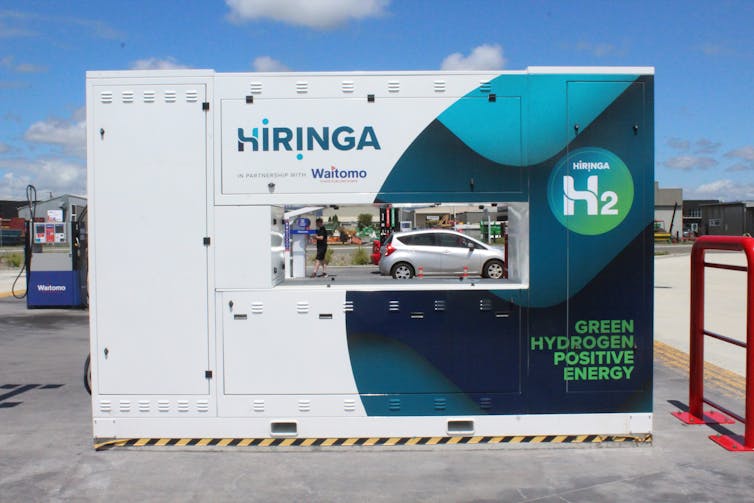
Government funding supported the development of a hydrogen refuelling network such as Hiringa Energy’s $7 million station in Palmerston North. Robert McLachlan, CC BY-SA
Evolution of the narrative
In the wake of the previous government’s ban on new offshore oil and gas exploration, the 2019 H2 Taranaki roadmap outlined a vision for the region as a leader in hydrogen production.
Former energy minister Megan Woods reinforced this, indicating her government would be interested in any associated economic opportunities. This largely positive narrative continued in two further government reports.
Hydrogen is poised to fulfil its potential as a clean alternative to hydrocarbons in the global pursuit of decarbonisation to address climate change.
Development of green hydrogen was largely implicit in the second report, the Interim Hydrogen Roadmap, which aimed to:
optimise the potential for green hydrogen to contribute to New Zealand’s emissions reductions, economic development, and energy sector to the extent compatible with our broader electrification goals.
We analysed these reports using a content analysis approach focused on identifying how often strengths, weaknesses, opportunities or threats are mentioned. This revealed the words “opportunities” and “challenges” were used frequently, while “weaknesses” and “threats” were absent.
The use of “strengths” was confined to perceived advantages of New Zealand as a location for hydrogen production. Where difficulties were identified, they were framed as challenges rather than weaknesses.
This optimistic tone is generally reflected in descriptions of several government-funded projects, including green hydrogen research at GNS Science, and international collaborations such as the German-NZ Green Hydrogen alliance.
Media reports have typically reflected the enthusiastic narrative. Of 83 articles on green hydrogen published in New Zealand between 2019 and 2023, only 15 (18%) contained any critical analysis.
Critical voices need to be heard
While some experts have voiced serious concerns about green hydrogen, this has not featured prominently in the debate in New Zealand.
For example, research by University of Cambridge engineering expert David Cebon shows battery electric vehicles are superior to hydrogen vehicles for heavy transport.
The emergence of fast (five minutes or less) automated and manual battery-swap systems, which provide an alternative to high-powered fast-charging systems, supports this point.
Since 2000, application after application of hydrogen has found it to be inefficient, ineffective and expensive compared to obvious alternatives.
A German rail company which launched the world’s first hydrogen line last year has since opted for cheaper all-electric trains. Rising costs have also forced one Austrian state to abandon plans to introduce hydrogen buses.
Recent research suggests developments in battery-run and fast-charging electric trucks could soon make hydrogen fuel cells superfluous in road transport in most cases.
UK energy analyst Michael Liebreich has quantified the immense scale, significant impracticalities, enormous subsidies and costs associated with green hydrogen.
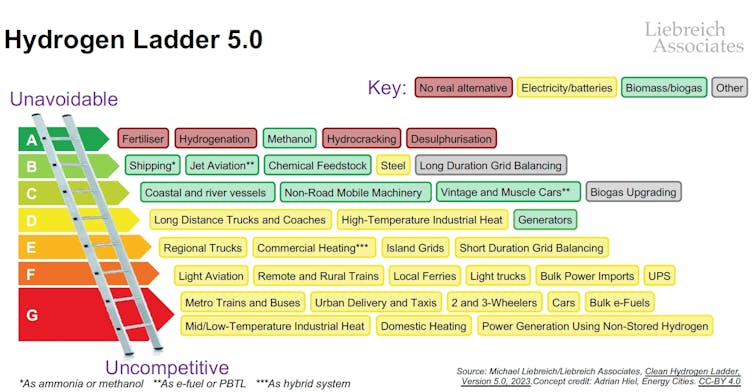
Liebreich’s “hydrogen ladder” ranks both actual and potential uses. It provides an evidence-informed guide on where to best focus attention and resources. Based on this, the previous government’s funding for the manufacture of green fertiliser (for which hydrogen is an input) was a sensible allocation.
The hydrogen ladder provides a guide on where to focus attention for the use of hydrogen. Michael Liebreich, CC BY-SA
The previous government’s commitment to finalise New Zealand’s hydrogen strategy, and to deliver an overall energy strategy, remains in place. But we need a more nuanced perspective.
This must start with an acknowledgement that hydrogen is an energy carrier (which has to be produced from other sources of energy), and not an energy resource like solar radiation, wind or hydro.
We need an approach that can continue to adapt to changes in “hard to abate” sectors of the energy system. Critiques of green hydrogen need to enter the discussion if we are to make informed choices.
Government policy on this topic must be informed by independent advice free from commercial interests. A new green hydrogen narrative will enable us to focus our limited resources on applications with the best chance of delivering on New Zealand’s decarbonisation and sustainability aspirations.
On 25 June, the Government amended the Clean Vehicles Act. This was completed in a single day under urgency, so there was no opportunity for public input. On 9 July, there was a press release saying that New Zealand would now be following Australian emission standards from 2025. On 11 July, the Ministry’s advice was released, giving us a few more details.
Vehicle emissions are reported in grams of CO2 per kilometre (gCO2/km). (For petrol vehicles, 200 gCO2/km is the same as 8.6 l/100km.) Here are the new targets:
Cars
Light commercials (vans & utes)
Previous target
New target
Previous NZ
New target
2023
145
218.3
2024
133.9
201.9
2025
112.6
112.6
155
223
2026
84.5
108
116.3
207
2027
63.3
103
87.2
175
2028
76
144
2029
65
131
The Minister talked to the Motor Industry Association (MIA), the Imported Motor Vehicle Industry Association (VIA), the Motor Trade Association (MTA) and the New Zealand Automobile Association (AA). We don’t have their reports, but, judging by what has been released, the Minister has accepted their reasoning at face value and rubber stamped their request. Neither Tesla nor Drive Electric (not members of the MIA) were consulted.
The Ministry report that their modelling of the emissions impact of this change has not been completed yet, but they do provide a rough estimate of an increase of emissions by 0.3–0.5 MtCO2 over 2024-2050. Another department, the Climate Impact of Policy Assessment, puts the increase at 1.2–1.9 MtCO2, but regards this as unreliable on the grounds that the previous targets were unlikely to be met – which is the car industry’s argument.
The car industry appears to take the position that they will do nothing whatsoever to respond to the targets, and just let the market take its course. Car importers would pay fines rather than try to meet the target. One key figure (which was also provided to Cabinet) is their estimate that this would add $5,500 to the price of every new light vehicle in 2027.
The fines are set at $45/gCO2, so the MIA are saying they’ll miss the targets by 122 gCO2 on average. The target for all light vehicles is 71 gCO2/km, so they’re saying they expect to sell vehicles averaging 193 gCO2/km in 2027, or nearly triple the target. That level (193 gCO2/km) is what we had already reached in 2021, before the introduction of the feebate and fuel efficiency standards. In 2022 the average was 167g; in 2023, 145g.
These industry and ministry figures look like nonsense, so let’s do a back-of-the-envelope calculation. Assuming no change in overall levels of sales, and that the targets are met, the annual extra emissions from vehicles sold in 2025 will be 46,000 tCO2; in 2026, 132,000 tCO2; in 2027, 120,000 tCO2. Over the 20 year life of the vehicles, the extra emissions from sales in these three years alone are 7.14 MtCO2.
That’s all assuming the targets are met. The industry says they won’t be. But one thing we did learn from the feebate experience is that both the industry and the car buying public are incredibly responsive to signals. Under the previous government, the signal was that it’s time to get serious about cutting emissions. The price signal (the rebate) was only part of that. EV sales vastly exceeded expectations, and the industry delivered. After the election, the signaling changed; the only electric ute on the market was withdrawn less than a week later.
Source: Ministry of Transport. The Clean Car Discount (feebate) was introduced progressively in July 2021 and April 2022, and cancelled in January 2024. Chart includes both new and newly imported used vehicles.
Second, missing the targets still achieves something. Fines are a deterrent and a signal to the industry. If they’re added to the price of higher-emitting vehicles, those sales will slow. Even for utes, that’s not the end of the world, it just means a slower replacement cycle until better vehicles are available. This will still prevent new, high-emission models entering the country and sticking around for decades.
There is one issue, though, which is that the fines, at $45/g, are low by international standards. They were set low because at that time, the intention was that the feebate would be doing most of the work and the Standards were mostly a backstop. In Australia, whose standards we are now adopting, the fines are $111/g, and in Europe, $170/g. (In Europe, where emissions in 2021 were already 40% below ours, not a single car company has had to pay fines for missing the targets.) Australia and Europe have extensive systems of incentives in place, which helps. New Zealand importers also have heaps of cheap credits available from overachieving in 2023 that (in another change) can now be used up until 2027.
When the Minister of Climate Change was asked about the impact on emissions, he said that “Clean car standards … have quite an insignificant impact in regards to overall emissions targets”. The relevant number to compare to here is not total emissions, but the required annual emissions cuts as we move into the late 2020s. Those are about 2 MtCO2 per year. In that context, the change due the weakening of fuel efficiency standards – 6% of so of the total effort required – is significant.
However, the Ministry has an answer there too:
In our view the proposed targets will not impact the ability for the first emissions budget (or subsequent ones) to be met. This is because transport emissions are covered by the ETS, therefore changing the Standard’s targets might change how or where emissions reductions occur from a gross perspective, but not from a net perspective.
This comes pretty close to the common argument that nothing the government or anyone else does has any impact on emissions; if I emit more, others will emit less so that the carbon budgets are met. But, they throw in an extra twist by bringing in the gross/net distinction: basically the argument is that more trees will be planted to cover the extra emissions. None of these arguments hold water, but even if we accept them at face value, actions that lead to higher emissions in one sector will definitely have an effect on those other sectors that will now have to make up the difference. For example, through a higher carbon price. However, it appears that this effect was not considered.
The new targets do get tighter over time, particularly in 2028 and 2029. If those are met, we could still be on track to end fossil-fueled vehicle sales by 2035, as in Europe. (The new UK government is reinstating a 2030 end date.) But there are two caveats. First, Australia has an election next year. The opposition could easily make emissions standards an issue, as they tried unsuccessfully to do in the last election (“Ute tax!”). A change of government could see the Australian standards weakened, as has happened here. Second, our own new standards will be reviewed again in 2026. On present performance, the MIA would only need a quiet word in the Minister’s ear to wind back the standards.
The purpose of a fuel efficiency standard is to radically change the make-up of the fleet as quickly as possible. There do have to be changes. But the whole tenor of the Ministry’s advice is that no one should have to change or pay any more, the overriding goal is that “vehicle affordability is maintained and the mix of vehicles imported meets the needs of New Zealanders.”
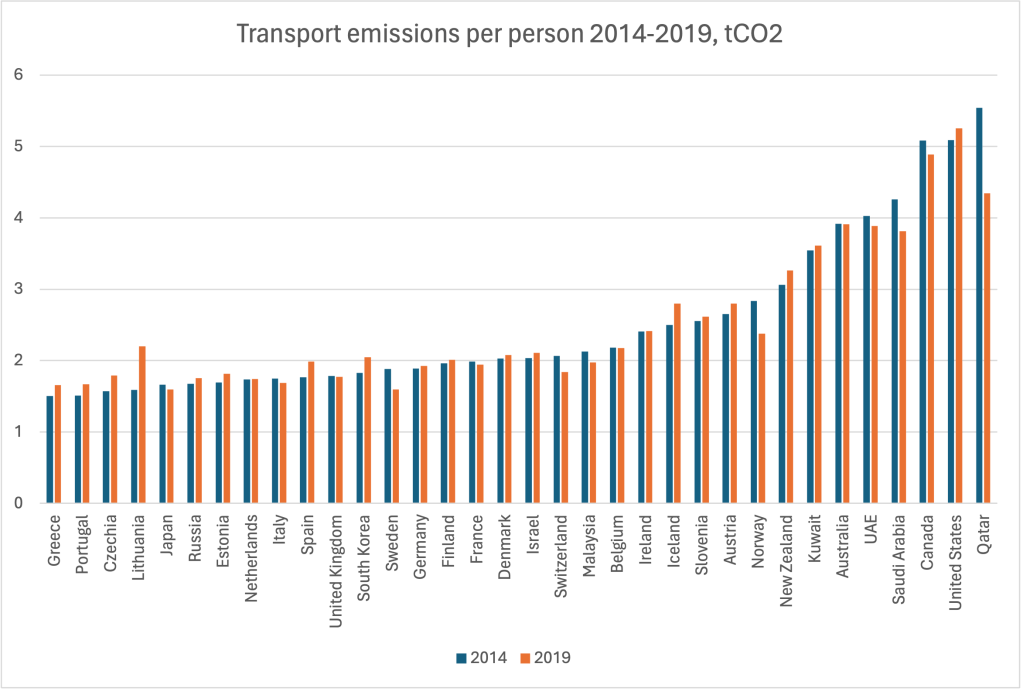
Reducing transport emissions is difficult, and it is something that many countries struggle with. But some countries are trying and are starting to see results.
Source: Our World in Data. Sweden has a target reaching of 0.6 tCO2/p in 2030.
Weakening fuel efficiency standards is the third of four parts of the Government’s “War on EVs“. Part 1 was ending the feebate; part 2 was the introduction of Road User Charges (RUC) for EVs, at a punishing rate. Iceland is the only other country in the world to try this, and there too sales have collapsed. Basically we are in uncharted waters. Part 3 is now done. Part 4 is still to happen: it’s the Government’s signaled intention to replace petrol tax with RUC for all vehicles. As petrol tax is currently equivalent to a carbon charge of $360/tCO2, this would amount to a hefty carbon tax cut and hence would also act to increase transport emissions. The extra cost of driving a hybrid (where sales are still holding up well) could be significant.
Fuel consumption l/100km
Current fuel/RUC cost cents/km
Fuel/RUC cost under an RUC-only system
0 (Battery electric)
12
12
4 (small hybrid)
10
14.5
6 (normal hybrid)
15
18
8 (normal car)
20
21.5
10 (large car)
25
25
12 (large ute)
30
28.5
Assumptions: Petrol $2.50/l, electricity 29c/kWh, RUC 7.6c/km

















 Planetary Ecology