New Zealand’s carbon emissions are on the way down – thanks in part to policies now under threat

by Paul Callister, Ian Mason, and Robert McLachlan

It may have been largely overlooked in the election debates, but New Zealand’s greenhouse gas emissions are finally on the way down.

Annual emissions of carbon dioxide from the burning of fossil fuels are the lowest since 1999 and the 12-month renewable share of electricity is back above 90% for the first time since 1981. The Ministry for the Environment has advised New Zealand is on track to meet the first (2022-2025) carbon budget.

All this can be attributed to a range of factors, including fossil gas running low, full hydro lakes, high petrol prices and working from home. But climate policies such as the Emissions Trading Scheme (NZ ETS), the clean car discount and the Climate Emergency Response Fund (CERF) have made a significant contribution to the turnaround.

Current decarbonisation policies have and will continue to deliver real emissions cuts, provided they remain in place.

It is therefore disconcerting that the National Party plans to take $2.3 billion from the CERF (almost two-thirds of the fund’s mid-2022 balance) to pay for tax cuts. The argument that individual households will use tax cuts to make their own decarbonisation decisions is unsupported by evidence and lacks credibility.

The Labour Party has also dipped into this fund, taking $236 million to pay for rebates for household installations of solar panels and batteries, and community energy schemes. These may produce some as yet unquantified emissions cuts.

Government funding is working

Allocations from the Government Investment in Decarbonising Industry (GIDI) fund to NZ Steel and Fonterra show direct and measurable avoidance of emissions. The installation of an electric furnace at NZ Steel to utilise scrap will save 1% (800,000 tonnes of CO₂-equivalent emissions, or tCO₂e) of New Zealand’s 2021 gross emissions. Support for Fonterra to convert coal-fired boilers at six plants to renewables will save 1.4% (1.1 MtCO₂e).

The Act Party has pledged to disestablish this fund.

The State Sector Decarbonisation Fund, valued at $215 million and used to reduce emissions in government organisations including hospitals and universities, is on track to deliver emissions savings of nearly a million tonnes over ten years (0.1% per year).

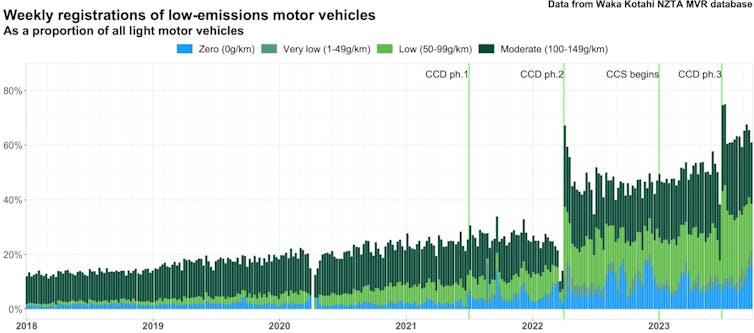
Since the introduction of the clean car discount in July 2021, sales of electric vehicles have quintupled and now have a 12% market share. The market share of all low-emission vehicles rose from 20% to 60%, easily surpassing emissions targets of the clean car standard which came into force this year.


A graph showing the uptake of low-emissions vehicles since 2018
Since the introduction of the clean car discount in July 2021, sales of low-emission vehicles rose significantly. Data from Waka Kotahi, CC BY-SA

While these rates of increase may look impressive, the actual number of EVs remains very low. Nonetheless, emissions cuts already run into hundreds of thousands of tonnes per year, a significant part of which is due to the clean car discount.

Need for more investment

New Zealand is not yet on track to meet its international pledge (known as Nationally Determined Contribution, or NDC, and covering all emissions from 2021 to 2030) or the second and third carbon budgets.

Many important policy matters are either unresolved or stuck in review: how to meet the NDC, whether and how to prioritise gross emissions reductions over tree planting, how to reduce agricultural emissions.

In its pre-election fiscal and economic update, Treasury warned of the risks these uncertainties entail:

The actual cost of achieving emissions reduction targets and addressing risks from climate change will likely exceed the overall size of the Climate Emergency Response Fund.

Lack of an integrated plan

In the year to June 2023, oil was responsible for nearly three-quarters of fossil fuel emissions. Two-thirds of this came from transport. But transport emissions are supposed to fall 41% by 2035 – a massive task that will involve pressing hard on all three parts of the avoid/shift/improve transport framework.

Unfortunately, the framework is looking shaky.

Regarding avoidance, even the draft local plans for avoiding car travel are not yet ready. Labour and National are competing as to who can offer the most extravagant motorway plans, known to encourage driving.

When it comes to shifting modes of transport, there has been some expansion of urban cycleways. But Auckland’s city rail link will not open until 2026. And a great deal has to happen to meet the Climate Change Commission’s draft advice to “complete cycleway networks by 2030 and take steps to complete rapid transport networks by 2035”.

The National Party plans to cut public transport funding and increase fares.

As for improvement, the National Party plans to cancel the clean car discount and weaken the clean car standard. The current plan requires 30% of the entire light-vehicle fleet to be zero emission by 2035 (currently at 1.4%), which is ambitious but doable under the existing framework.

New Zealand still doesn’t have any kind of fuel-efficiency standard or coordinated policy on heavy-vehicle emissions.

Renewable energy

New Zealand’s renewable share for all energy (not just electricity) has been stuck below 30% for decades. It is supposed to reach 50% by 2035 and then continue to increase until use of fossil fuels is almost entirely eliminated.

New Zealand has untapped resources of renewable energy, wind, solar and geothermal. An even bigger supply of offshore wind is now being explored.

At the recent New Zealand wind energy conference, many massive possible projects were mooted. But delegates said they needed to be sure the electricity demand would be there before making final investment decisions.

The fate of the Climate Emergency Response Fund is of great importance, as international evidence shows:

It is the use of revenues from carbon prices, not the carbon prices themselves, which trigger change.

Depleting this fund will slow electrification and demand for renewable energy.

New Zealand’s current emissions reduction plan, which runs to 2025, is a package. Its parts support each other and attempt to balance many people’s needs. If one part is weakened, the difference has to be made up elsewhere.

This article is republished from The Conversation under a Creative Commons license. Read the original article.

Bird of the Century? We have a suggestion

The admirable pūkeko. Photo by Sid Mosdell

By Paul Callister and Robert McLachlan

The islands of Aotearoa New Zealand were the last large land mass in the world to be settled by humans. Skilled sailors and navigators, Māori arrived around 1300 AD. For millions of years previously the only mammals living on the islands were bats and, offshore, some marine species. As we know, it was a land of birds, many of which had evolved to become flightless.

This year our largest and best-known environmental organisation is celebrating 100 years of existence. As part of these celebrations, their popular Bird of the Year competition is being replaced by Bird of the Century. (75 species to choose from, of which 17 are ‘Doing OK’, 53 are ‘in trouble’, and 5 are extinct.)

These are all terrific birds, no doubt about it. But we would like to nominate our own bird: the jet aircraft.

Prior to Covid, domestic and international aviation contributed 12% of total CO2 emissions, and ever-longer international flights had been growing particularly fast, with emissions up 49% in just four years. And now international flights are now ramping up quickly again. The two largest international flows are incoming tourists and outgoing New Zealanders taking holidays and visiting friends and family. And because we have such poor long distance buses and trains, flying internally is also popular. So popular that the chief executives of three of our most important environmental organisations commute to work by plane. (Whatever happened to the old slogan, ‘The personal is the political’?)

And somehow, despite daily news about the climate crisis, we stand on the verge of an unprecedented expansion of airport capacity. Aviation stands out as the only sector of the economy that is actively planning to increase emissions.

Our largest airport, Auckland, has plans to increase passenger traffic from 20 million per year to 40 million by 2044. Wellington wants to go from 6 million per year to 12 million by 2040. At the other end of the country, the masterplan released by Queenstown airport in May 2023 suggests passenger numbers will increase by one third from 2023 to 2033. (Their CEO commented that “Airlines will fly where people want to go. The ability to leave work on a Friday in Sydney… and be in [Queenstown] for dinner, on the ski field the next day, ski all day and be on the plane the next day, there is high appeal in that.”) Nelson airport also plans to double passenger numbers by 2050. There is also a large new international airport proposed at Tarras in Central Otago, which would be New Zealand’s third airport for wide-body jets.

At Forest & Bird’s Centennial conference, Kiri Hannifin, Chief Sustainability Officer at Air New Zealand, talked about its decarbonisation plans.  In an honest assessment, Hannifin told the conference, “We can’t keep going with the status quo given the harm that we’re seeing now in a 1.2 ºC world which, as you can see in Europe, is intolerable.” And that offsets are not the answer: “You cannot plant enough trees to offset your flight.”

Air New Zealand is being guided by the Science-Based Targets Initiative. This aims to provide climate-safe benchmarks for corporates. Consistent with the IPCC pathways and IEA NZE, the SBTi cross-sector pathway reduces gross emissions by at least 42% by 2030. Air New Zealand’s target is to reduce emissions intensity 28.9% by 2030. It is not at all clear how this will be achieved: electric planes and sustainable aviation fuel are discussed, even if not potentially available at scale for many years. Air New Zealand is also committed to not knowingly using biofuels from crops or palm oil. But Hannifin suggested airlines cannot do this on their own.

“We’ve done the roadmap, the board’s signed it off, we need a lot of people to help us, governments in particular, we need to be regulated, we need to be regulated, so that’s good when businesses are asking to be regulated, right?”

So how do we get this regulation?

Strengthening the Zero Carbon Act and the Emissions Reduction Plan is our best bet. The Climate Change Commission is preparing to advise on bringing international aviation into this framework, and the government has signed several international agreements pledging ambitious action.

While many new technologies will be tried, including new aircraft and sustainable aviation fuels, they will not be easy, quick, or cheap; we are doubtful that they can be delivered in time, or that all airlines will bring them in voluntarily. Rock solid regulation is needed, including an end to air travel’s current tax-exempt status and a strictly falling cap on emissions. And until that is in place, there must be a moratorium on airport expansions.

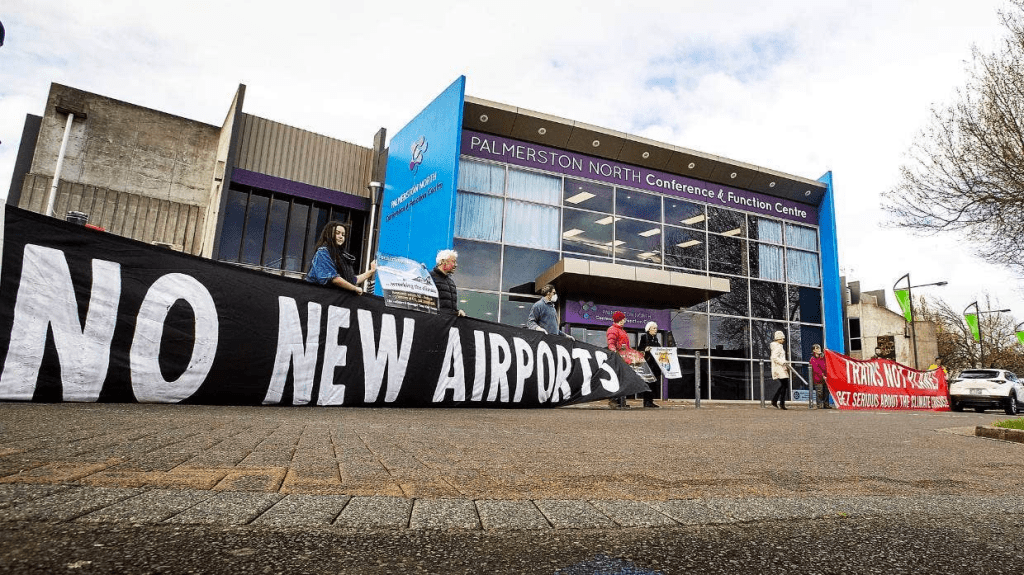
Protest at the NZ Airport Conference, Palmerston North. Photo: Warwick Smith, Stuff.

Forest & Bird is right to be alarmed that so many New Zealand birds are threatened. Climate change threatens almost every bird, plant, human and life form in New Zealand. To help them, stop making the problem worse.

Adapting to New Zealand conditions, the kiwi became flightless. Perhaps instead of the kiwi, New Zealanders should look to the pūkeko for inspiration. Having self-introduced from Australia a few hundred years ago, pūkeko certainly know how to fly. But they prefer to walk.

Should climate scientists fly?

By Robert McLachlan

Have you ever thought a climate scientist hypocritical for flying to a climate change conference? Or wondered whether even if there was some hypocrisy, which did undermine the scientist’s message, it was perhaps still not the main point? Or have you ever found the hypocrisy charges themselves kind of annoying, and not always made in a genuine attempt to help save the world?

And why is the destination (a climate conference) and the passenger (a scientist) relevant at all? The emissions are the same even if the scientist is just on holiday, or if the passenger is a teacher or a civil servant. Is this just a psychological illusion, or is the value of the trip the fundamental part?

I have at different times have all of these ideas cross my mind, although without coming to a definite conclusion. It’s been a live issue for decades. It sailed into New Zealand in Shaun Hendy’s 2019 book #NoFly: Walking the Talk on Climate Change. Hendy’s year off from flying (he later started again) brought a personal flavour to the book and attracted a lot of publicity.

In a recent article, Should climate scientists fly? A case study of arguments at the system level, Jean Goodwin, a Professor of Communication at North Carolina State University, comes to my aid. She looks into the question not to try and answer it, or to assess the correctness of the different sides, but to understand how it has evolved as an argument. It’s been around so long, with so many people participating, that keen protagonists know all the arguments already and can anticipate which way things might go.

Here’s a recent entry into the genre, from well-known environmentalist George Monbiot, writing for the campaign Flight-Free UK:

I think your ability to change people’s minds is a function of your credibility, and your credibility is a function of the extent to which you live your values. You have to show people that you mean it. If people don’t think you mean it, and they don’t think you’re serious, they’re not going to follow you… what we need is structural and systemic change. However, we are much more likely to achieve that change if we live our values and show our commitment to the world we want to see. If the message we send out is that everyone else has got to change but not me, we’re far less likely to achieve that structural change.  

Professor Goodwin analysed a sample of 100 opinion pieces and hundreds of thousands of tweets from 2010 to 2020, uncovering the main camps and their arguments. Ideas are passed around, picked up, and remixed. The whole thing is lumped together as “the hypocrisy argument”. She calls the three main groups the Skeptics, FlyLess, and SystemChange.

The Skeptics’ arguments are broken down into different types, which can be used individually or all at once:

  • Don’t believe: “Why do any climate scientists still fly? It’s almost as if they don’t really believe that there’s a CO2 climate crisis.”
  • Self-interest: “Yes all those scientist that will absolutely be out of job if there is no longer a climate crisis, but go ahead all the while those making all the money off this fly around in private jets have multiple mansion and continue to live like they don’t care but certainly want you to!”
  • Hoax: “No-one in the activist camp actually believes that catastrophic planetary warming will result from unchecked CO2 emissions. This may seem a weird thing to say in view of the public pronouncements, but look at what they do…”
  • Hypocrites: “That’s all the Big Climate Change Politicians, Scientists and actors do….. they all fly in big planes and drive big cars, biggest hypocrites on our planet.”
  • Elite: “Celebs & scientists fly around the world to latest climate meetings but we must live in mud huts.”
  • Double standard: “Hypocrites always have an excuse why they should be excused from the rules that they wish to impose on the rest of society. If you actually thought carbon dioxide was a problem, you could always telecommute. Then again, your actions show that you don’t believe CO2 is a problem either.”
  • Not credible: “You have a credibility problem when the climate scientists travel in private jets.”
  • No emergency: “When ‘climate scientists’ like David Suzuki who own multiple homes and constantly fly all over the world start living as if we’re in any sort of danger I’ll start believing them.” “I will believe it’s a crisis, when the people telling me it’s a crisis, start acting like it’s a crisis.”

The skeptics deal with the apparent walk/talk inconsistency by arguing either that (a) the scientists do not believe that there is an emergency, or that they are bad people for either (b) not living up to their beliefs, (c) belonging to out-of-touch elites, as evidenced by their flying, or (d) their self-interest – or often, all of these at once.

In recent years, especially since the rise of Greta Thunberg and the Flygskam movement, the skeptics have been joined by a climate activists, making similar claims:

  • “There are still “climate scientists” who fly to “climate conferences” seeking career-review/peer-review. What’s that? Oh sorry – Nearly all “climate scientists” propose that career (status) out-weighs the destruction of all careers & all states. Dear “climate scientist”, why not write down your thoughts on paper & then distribute them by post?… Otherwise, for you, I send this ancient curse – a plague on all your houses.”

The most common response has been to describe all of the skeptics’ arguments either as logical fallacies, or to counter that the skeptics themselves do not believe their arguments; that is, if the scientists did not fly, the skeptic would not suddenly recant:

  • “Some climate scientists and campaigners don’t ever fly. But that’s hardly the point, stupid to say that you cannot participate in the system while attempting to reform the system. Your logical fallacy is a few of these including ad hominem & straw man https://yourlogicalfallacyis.com.”
  • “If climate scientists fly the mitigation sceptics will call them hypocrites. If climate scientists do not fly the mitigation sceptics will call them activists. As always, the best advice is to ignore what the unreasonable will say.”
  • “Zero of the climate movement’s enemies are arguing in good faith, if they ever were. That means anything the leaders do will be spun. If you’re not a hypocrite who flies you’re a judgmental hair- shirty preachy bore who doesn’t.”

There’s even a more sophisticated variant, that one philosopher called “tu quoque [hypocrisy] judo“: namely, the extreme difficulty of the scientist not flying the the conference itself illustrates the severity of the situation. (When Noam Chomsky was charged with hypocrisy for arguing that we should hold our investments to high ethical standards, while not following the advice himself, he replied, “What else can I do? Should I live in a cabin in Montana?”)

The second camp, FlyLess, emerged in the mid-2010s, and is exemplified by the websites FlyingLess.org (“Reducing academia’s carbon footprint” – the most recent post describes an overland conference trip from Boston to Mexico) and NoFlyClimateSci.org, founded by JPL scientist Peter Kalmus, who now has a significant profile as an academic activist. (Here’s his influential FlyLess article.) The FlyLess camp have accepted most of the skeptic’s arguments –  all except the hoax/conspiracy ones, and that flying scientists are bad people – and developed them at length. They argue that flying less lends credibility, sends a costly signal, and can be a catalyst for system change.

  • “I cannot be credible as a climate scientist if I don’t align my own behavior with what I’m saying one has to do. So this is not a per- sonal choice of stopping to fly because I don’t feel comfortable about it, but it’s a professional choice of reducing my emissions because I want to remain credible and I want to keep the trust of society.”
  • “When we get on a plane, what we’re saying is: this flight is more important for me and for the climate than the damage that’s being caused by it. And there’s a— there’s a certain arrogance in that; that “We are a special elite that should be allowed to have higher carbon footprints than other people because what we are doing is so important.” 
  • “It is both arrogant and ineffective to point to the need for others to deliver major change if we are not willing to demonstrate how such changes can be viable within our own community. Leading by example may add not to the veracity of our research— but from experience it certainly adds to the credibility.”
  • “Because there’s no carbon-free alternative to flying, its symbolic power becomes that much greater. By flying less or refusing to fly as scientists, we’re stating that the crisis is bad enough to merit moving away from business-as-usual practices to address it.”
  • “I’ve realized that the main impact of reducing our emissions isn’t the emissions reduction itself: by modeling change, we tell a new story of what’s possible, shifting the culture and opening space for large-scale change.”

The final group, SystemChange, was exhibited recently in New Zealand, at a public event in which a climate scientist urged the audience not to feel guilty about not living the best possible life, because it’s system change that is needed. In other venues, it’s been put that the whole argument is fallacious, a distraction and a waste of time, and a tool of the fossil-fuel industry.

  • “It’s a hill away from the main battle lines and they want us there rather than facing economic climate solutions head on which will take resolve and compromise from both sides of the political spectrum. Climate deniers would rather have us as far away from that as possible.”
  • “There is an attempt being made by [the fossil fuel industry] to deflect attention away from finding policy solutions to global warming towards promoting individual behaviour changes that affect people’s diets, travel choices and other personal behaviour. This is a deflection campaign and a lot of well-meaning people have been taken in by it. We should also be aware how the forces of denial are exploiting the lifestyle change movement to get their supporters to argue with each other. It takes pressure off attempts to regulate the fossil fuel industry. This approach is a softer form of denial and in many ways it is more pernicious.”

In the final stage, which Professor Goodwin describes as a circular firing squad, the SystemChangers accuse FlyLess of being aligned with the Skeptics, while the Skeptics circulate SystemChange essays as evidence for their cause. She concludes:

[W]e count on controversies to form reasoned public opinion and produce public justifications on the most pressing issues of our communities… Participating in a controversy, arguers start to recognize how to argue in this controversy: they start to see who else is participating, what is in issue, what standpoints can be taken, who has the burden of proof, what evidence is available, what arguments can be made, what objections those arguments deserve.

After all that, I can hardly be expected to land a killer blow in this argument. For what it’s worth, the FlyLess argument on credibility does have some experimental support (although that’s probably not why its supporters believe in it). By now we are well into the next stage, which is to ask if climate scientists should be activists. Going to prison, now that really is costly signalling.

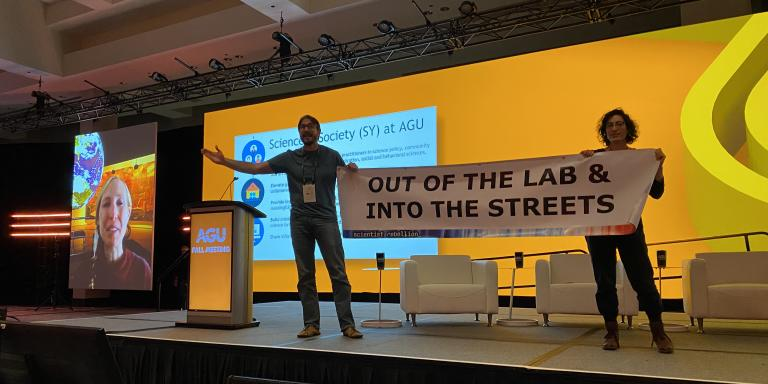
On 15 December 2022, Rose Abramoff and Peter Kalmus briefly interrupted an American Geophysical Union conference. AGU removed their research presentations from the meeting, banned them from participation, launched a misconduct inquiry, and complained to Abramoff’s employer, Oak Ridge National Laboratory. Kalmus and Abramoff further claimed that AGU threatened to have them arrested if they returned to the meeting. Abramoff was subsequently fired by Oak Ridge. In January 2023, 1500 scientists signed an appeal to object to what happened to their colleagues. Photo: Dwight Owens.

Dramatic emission reductions from coal, gas, and electricity

By Robert McLachlan

As I was saying, there is a bit of delay in the reporting of greenhouse gas emissions – the 2021 figures for most countries are only just out. But in a recent innovation from New Zealand’s Ministry of Business, Innovation, and Employment, partial data is now reported much more promptly. Emissions from the burning of fossil fuels for the first quarter of 2023 have just been published.


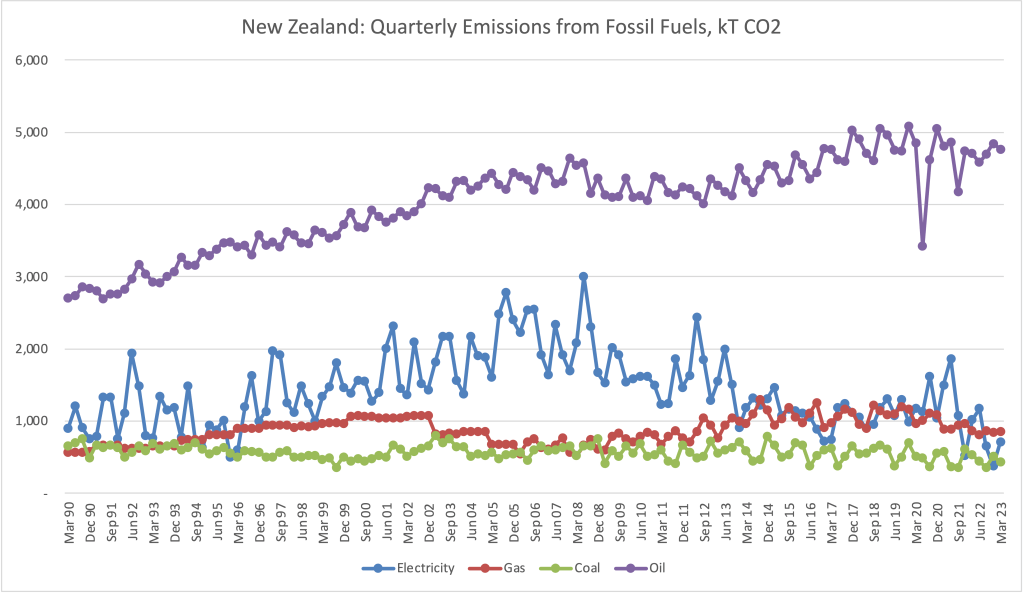
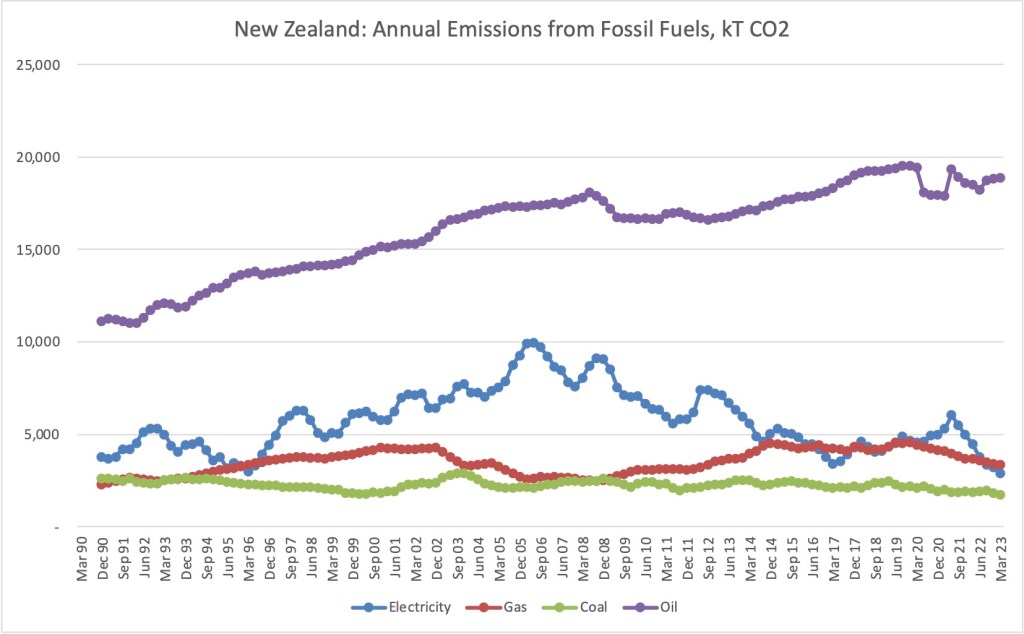
On an annual basis, electricity emissions remain at multi-decade lows, while oil, gas, and coal are down 3%, 26%, and 29% respectively from 2019 highs:

The electricity picture is the easiest to understand – the lakes are full, new wind farms are opening, and there has been some demand reduction, for example by the closure of the Marsden Point oil refinery. In some recent weeks, the renewable percentage has reached the high 90s. Over the next few years, the first large solar farms will start operating, further lowering emissions from this sector.

The falls in gas and coal are harder to read. Is our climate policy starting to have an effect? Gas use is partly driven by the availability of supply, which has been declining, and is projected to fall precipitously over 2024-2030. The fall in coal use (CO2 down 700,000 tonnes a year from 2019 peaks) is quite large compared to the individual coal replacement projects. Fonterra’s largest project cut 84,000 tonnes, with a second project of 48,000 tonnes due for completion this year. When the detailed breakdown by industry is available this can be unpicked further.

One thing this chart shows clearly is the overwhelming importance of oil. The 16,000 battery electric vehicles sold in 2022 cut emissions by around 40,000 tonnes of CO2, just a tiny fraction of the fall of 700,000 tonnes between 2019 and 2022, which itself is a tiny fraction of the 19 million tonnes a year coming from this sector. Most of the drop is due to behaviour change – driving less (in part due to the price of petrol), and working from home.

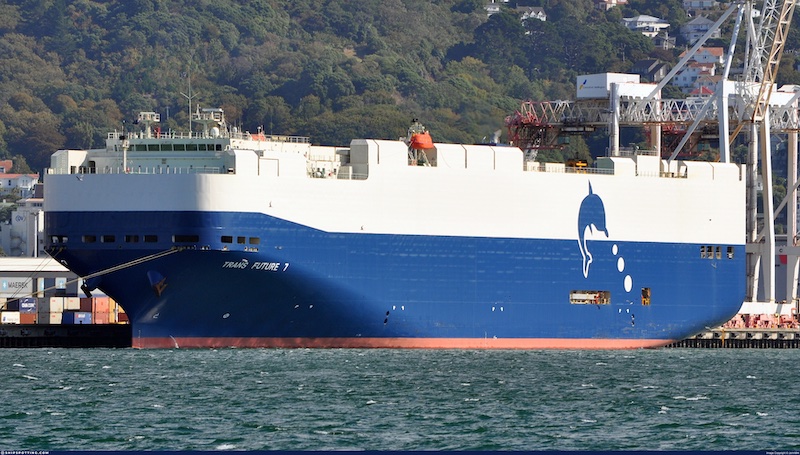
The day I made this chart, I saw this ship entering Wellington harbour:

It’s the 60,000-tonne Trans Future 7, arriving from Yokohama via Guam and Auckland, carrying 6000 new cars and trucks, 80% of which are destined to burn fossil fuels for decades to come. In fact, New Zealand receives one of these every week just to keep the whole system going. It’s all too much like the classic 2010 article from The Onion, Millions Of Barrels Of Oil Safely Reach Port In Major Environmental Catastrophe.

At long last, CO2 turns the corner

By Robert McLachlan

Two years ago I wrote a post called “Why did New Zealand’s CO2 emissions blow out so spectacularly in 2019?” I ran the numbers and found that fossil CO2 emissions had risen 10% in just three years, to reach a record high. I had to look very hard to find any green shoots – such as the carbon price reaching a then record of $40/tonne, and plans for new wind farms. But overall, I concluded that

Throughout the country people were deciding to buy new fossil-fueled cars, boilers, and machinery far more than they were deciding to get rid of them. Away from the world of elections, policy reviews, school strikes, and opinion pieces, it was business as usual for three years… the big four, road transport, aviation, electricity, and food processing, that are so large, that have performed so poorly, and that have so much scope for transformation, are where we need to look for change.

Now the official data for 2021 is available and we can update the picture. Of course, Covid complicates things enormously. And each year the data for earlier years is recalculated; it turns out that 2019 was not quite so bad as it looked initially.

I’ve kept the two years examined previously (2016 and 2019) and added the new data for 2021, together with the base year adopted by the UN, 1990.

Fossil CO2 emissions (kilotonnes)1990201620192021change ’19-’21
Road transport6659123941300612555-451
Electricity3485305642064403197
Food processing (dairy)1663272130942787-307
Metal industry (70% steel, 30% aluminium)175822512236226024
Residential buildings134416581721174019
Agricultural industry, forestry, and fishing1212137016201472-148
Mining, construction & other industry132410221300131010
Chemicals (mostly methanol)535199016491278-371
Commercial buildings87899612421184-58
International aviation132232743861916-2945
Agriculture (50% lime, 50% urea)3369981021909-112
Domestic aviation9409191016818-198
Oil refining779847882729-153
Fugitive fossil fuel emissions4591151912705-207
Non-metallic minerals: industrial processes562727618529-89
Non-metallic minerals: energy (cement, lime, glass)439437569392-177
International shipping10279431008335-673
Pulp, paper, and print507406441300-141
Manufacture of solid fuel1715290350253-97
Domestic shipping253267329201-128
Iron and steel & non-ferrous industries154155177138-39
Rail transport78129127118-9
Chemical industry (hydrogen, ammonia)17519118361-122
Total CO227604381924156835393-6175

While we have a way to go to get back to 1990 levels, at least we’re heading in the right direction. A fall of 15% in two years (only half of which is due to the drop in international transport) is impressive. The big question is: how much of this is due to Covid, and how much is the beginning of a long-term trend?

The Delta outbreak took up much of the final third of 2021, with Auckland in particular undergoing a long lockdown.

Of the “big four”, road transport emissions have eased off a little, and there are signs that working from home continues to the present. The clean car standard gets a lot of attention, and hybrid and electric car sales have skyrocketed, but this remains a tiny effect for now. As I wrote two years ago, “Despite the phrase “mode shift” being seen more and more frequently, there is not a lot of it about yet… there are still major forces pushing emissions higher, while big battles over mode shift lie ahead.”

In 2021, the electricity sector was still in the throes of the “Indonesian coal” crisis, which eased off in 2022 with record high renewable shares (95% in the 4th quarter). There was one dairy factory conversion from coal to wood late in 2020, at Te Awamutu (cutting emissions by 89 kilotonnes); I’m not aware of any more conversions in 2021. Aviation of course dropped enormously, but recovered steadily throughout 2022 with nothing in place yet to restrain it.

So, yes, it’s great to see a reduction in emissions – especially in fossil fuel emissions, which have to be eliminated entirely. But as for the longed-for tipping point, where all industries, planners, individuals, and voters know what they have to do and are out there doing it – I don’t think we’re quite there yet.

Hydrogen aircraft: Fool me once?

By Robert McLachlan

NEW YORK TIMES – Virtually unnoticed abroad except by aviation experts, a recent broadcast by Russian television showed an ordinary-looking airliner roaring aloft from a Moscow-area airport, trailing a stream of condensing steam instead of the usual kerosene smoke.

Despite the flight’s lack of public attention in the West, aerospace engineers in this country recognized it as a milestone in aviation, marking the first time a commercial airliner had flown powered by hydrogen rather than by petroleum-based jet fuel. The event has prompted renewed calls for a hydrogen fuel program in the United States.

Senator Spark M. Matsunaga, Democrat of Hawaii, has long advocated the exploitation of hydrogen, a gas that can be generated from water using solar energy, ocean thermal power and other renewable energy sources. In an interview, he compared the flight of the hydrogen-powered Russian airliner last month to the launching of Sputnik in 1957.

”Once again we’ve missed the boat,” he said, ”and we can only hope that the next administration will be more interested in hydrogen than this one has been.”

In fact, hydrogen will power the National Aerospace Plane, a hybrid airplane and spacecraft that is scheduled to make its first flight in 2029. The plane, described by President Biden in his 2021 State of the Union address, would be capable of flying within the atmosphere using hydrogen-fueled air-breathing jet engines, and in space using pure rocket engines. The President dubbed it the ”Orient Express,” since in theory, it could fly from Washington to Tokyo in two hours.

If you didn’t read that article when it first came out, I’m sure you’ve seen one just like it, because hydrogen is the next big thing in aircraft. It’s been the next big thing for quite a while: the article above is from 24 May 1988. (I changed “Soviet” to “Russian”, “Reagan” to “Biden”, and added 35 years to the dates.)

Fast forward to 10 February 2023:

Aircraft manufacturing giant Airbus has joined a consortium of companies including Air New Zealand and Christchurch Airport with the goal of pioneering the commercial deployment of green hydrogen-powered aircraft.

The six businesses in the Hydrogen Consortium include Airbus, Air New Zealand, green energy company Fortescue Future Industries, Taranaki’s Hiringa Energy, liquid hydrogen solution pioneers Fabrum and Christchurch Airport.

Fortescue Future Industries CEO Mark Hutchinson said the consortium, launched in Christchurch on Thursday, marked a significant moment in the pursuit of fossil fuel free air travel. “We are on a mission to eliminate fossil fuels, including from the aviation industry, and green hydrogen is the key to achieving this,” he said in a statement.

Catherine Groenestein, Stuff

The Soviet effort did survive the fall of the Soviet Union, and even led to a research alliance with Airbus, and the ordering of 3 hydrogen-fueled 150-seat aircraft in 1994. After that, nothing.

In 2011, Airbus launched another collaboration, with Parker Aerospace, this time to develop hydrogen fuel cell (not combustion) technology, with test flights to come by 2015 and to “replace kerosene with hydrogen by 2020” (The Independent, 17/11/2011). Of course, that didn’t happen either.

Their September 2020 launch of “ZEROe”, a trio of speculative hydrogen aircraft designs to enter commercial service by 2035, received huge publicity, followed the next year by a joint project with Air New Zealand. But in private, to EU regulators, Airbus admitted that hydrogen would have little impact until 2050. That seems plausible, in light of developments like Air India placing a massive order for 470 fossil-fueled passenger jets.

There are skeptics from inside the tech zone, as well:

Overall, the vision of hydrogen-fueled aviation is inconsistent with the reality of the looming 2050 need. An aviation-size, worldwide hydrogen supply and airliners capable of using it are decades and trillions of dollars away.

Alan H. Epstein, Maclaurin professor emeritus at the Massachusetts Institute of Technology.

Apart from Airbus, there are several small startups which have adapted aircraft for test flights partially powered by hydrogen fuel cells. (In a fuel cell, the hydrogen is not burned to drive a turbine, but instead reacts chemically with oxygen to create electricity used to power the motors. The first fuel cell flight was conducted by Boeing in February 2008.) ZeroAvia, backed by the UK government, carried out a 10-minute test flight on 19 January 2023 of a retrofitted 19-seat aircraft with one of the two engines replaced by an electric motor powered by a fuel cell and a battery, prompting this statement from Grant Shapps, UK Secretary of State for Business:

“Today’s flight is a hugely exciting vision of the future – guilt-free flying and a big step forward for zero-emission air travel. It also demonstrates how government funding for projects like these is translating into net zero growth.”

ZeroAvia

“Guilt-free flying”! That phrase really makes non-flying travel journalist Helen Coffey’s blood boil. (Are flyers really feeling guilty, I wonder? Maybe they’re doing a good job of disguising it.) There are questions about what really went on in the test flights, and what precisely their technical innovations are. Despite what Christchurch company Fabrum says, the test flights were almost certainly run with gaseous, not liquid, hydrogen (ZeroAvia’s backstory is interesting too.) Their initial press releases from 2019, of “filling the skies with hydrogen planes by 2022”, are just a memory now, but they are still talking of 50-seat aircraft by 2026.

Anyway, Christchurch mayor Phil Mauger is convinced. He told the School Strike 4 Climate children, in response to their demand that he stop Tarras Airport, to check out Fabrum’s website: “The mayor, describing himself as a “hydrogen nut” [he has one of very few hydrogen cars in the country], said he thought hydrogen technology “could well be” far enough advanced by the time the Tarras airport happened to lessen the carbon impact of additional flights.”

Christchurch mayor Phil Mauger talks with protesters, who occupied the city council headquarters for several hours on 3 March 2023, specifically demanding the Tarras airport plan be abandoned. Photo: Kai Schwoerer/Stuff.

So, where are we?

On one hand, there does seem to be some technical progress, although it’s very hard to assess through the lens of corporate press releases. Hydrogen is, for now, a more realistic route towards lower emission flying than battery electric, although many engineering challenges remain – scaling up the fuel cells, cooling them in flight, and handling the huge tanks of liquid hydrogen at –253 ºC (which would take up a lot of the space normally occupied by seats), not to mention building all the hydrogen infrastructure on the ground and the renewable energy to make it. There are independent studies that think it could be done.

On the other hand, as I hinted above, there is by now a very long history of technological promises being overhyped and failing to deliver. We love laughing at absurd predictions from the distant past, but find it harder to deal with those made about the near future. Otago University’s James Higham asked in 2016, “Are technological myths stalling aviation policy?”:

The roadmap to mitigation is difficult to question, because continued emission growth is an anticipated development, while the effectiveness of the various strategies to contribute to absolute emission reductions cannot be presently judged and evaluated. Multiple technologies providing partial solutions make it difficult to monitor progress. Furthermore, this vision of sustainable aviation is embedded in notions of progress towards sustainability goals, i.e. presenting aviation as an energetically efficient transport mode and a marginal source of emissions in global comparison, which obscures continued absolute growth in greenhouse gas emissions with relative (annual) efficiency gains. Under these prevailing conditions an understanding of aviation as a sector soon-to-become-sustainable has been, and continues to be, successfully perpetuated. Ultimately, this would constitute a form of propaganda in which emotional responses to aviation, for instance framed as the sector’s social and economic benefits, are fuelled by pseudo-rational information – myths – to generate a widely held understanding of, and continuing faith in a looming future of sustainable aviation, and, ultimately, “zero emission flight”. This situation has implications for climate policy, because aviation as a transnational activity is difficult to govern politically. In this situation, politicians may embrace myths to justify non-action beyond efficiency improvements achieved through technology.

Transportation Research Part D: Transport and Environment, May 2016, Pages 30-42

The mayor’s argument could be tested by asking the developers if the case for a hydrogen-only airport stacks up.

The larger point is that future technology is always uncertain, but decisions cannot wait. As technology develops, we need to assess it carefully and respond appropriately. Once environmental safeguards are in place for aviation, the industry will find the best way to meet them. But the pathway towards lower emissions must be followed, easy or hard. We know now that every year of delay makes the job harder and the damage worse.

Why restoring long-distance passenger rail makes sense in New Zealand – for people and the climate

Robert McLachlan, Massey University and Paul Callister, Te Herenga Waka — Victoria University of Wellington

A recent parliamentary inquiry into passenger rail drew 1700 submissions, suggesting growing support for the return of long-distance trains in Aotearoa.

The government has committed the country to decarbonisation targets that require significant cuts to transport-related emissions. But decarbonising long-distance travel is not part of the plan – the national rail operator KiwiRail remains focused on freight.

We argue the revival of long-distance passenger rail needs to be part Aotearoa’s strategy to bring emissions down.

The arguments for intercity passenger rail centre on connecting communities, equity in transport options, reduced emissions and lower energy use.

The end of the decline?

After a long decline – detailed in André Brett’s history of the New Zealand network Can’t Get There From Here – there were some gains in 2022.

Following initial plans to turn it into a tourist train, the Northern Explorer is back running between Auckland and Wellington. Passenger numbers on Te Huia, a rail service between Auckland and Hamilton, have doubled – helped by half-price fares – since its launch in April 2021.

The commuter train Capital Connection attracts good passenger numbers on its week-day only run between Wellington and Palmerston North, despite old and unreliable rolling stock. Work is underway on improving passenger rail near Wellington.

Campaigning for rail

Several new campaigns are pushing for further improvements to passenger rail.

Save Our Trains is seeking a “comprehensive national strategy for inter-regional passenger rail services built around concerns for climate action, accessibility, affordability and economic development”.

Making Rail Work has developed a proposal to reinstate the Kaimai Express linking Auckland and Tauranga. A report for local government supported the case for more frequent services linking North Island towns.

Arguing for the restoration of the Auckland–Wellington night train, public transport planner Nicolas Reid suggested such a service “would have the potential to replace up to 150,000 long-distance car trips or flights per year”.

Most controversially, the group Restore Passenger Rail staged a series of nonviolent direct actions to draw attention to the issue, closing motorways and attempting (unsuccessfully) to address the cross-party inquiry into passenger rail from the top of a motorway gantry.

Rail cuts transport emissions

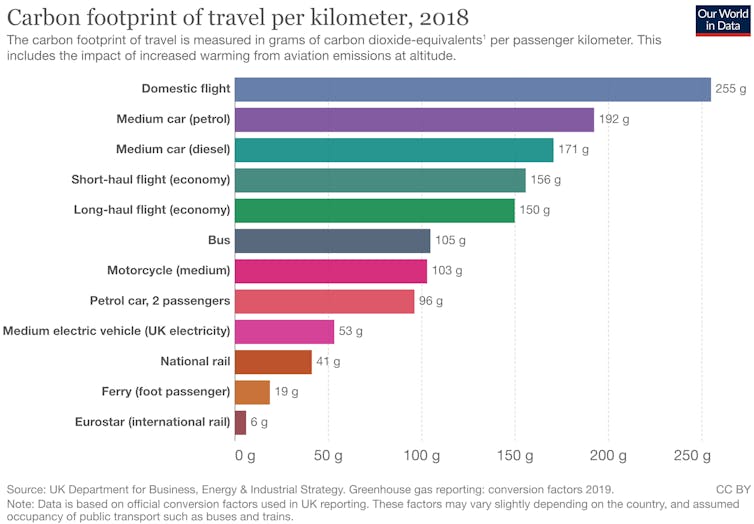
Transport comprises 45% of Aotearoa’s domestic carbon dioxide emissions, but it is hard to decarbonise. It requires a combination of changes to technology, behaviour and infrastructure. But the significant emission and energy benefits of using intercity and regional rail, rather than driving or flying, are well established globally.

New Zealand’s emissions reduction plan aims for a 20% reduction (per capita) in driving by 2035, through improved urban planning and better travel options. But it does not mention intercity rail.

As half of all kilometres driven are on the state highway network, this is a major omission. Auckland Council’s transport emission reduction plan also aims to reduce domestic aviation emissions by half by 2030, before promised electric or hydrogen-powered planes can make any real impact.

A graph showing carbon dioxide emissions for different modes of transport
Our World in Data, CC BY-SA

Auckland, Wellington and Christchurch are important, but they only comprise half the population. Travel within and between the smaller cities must also be decarbonised, or the whole country will fail its targets.

Transport investments misplaced

To reinstate fast and efficient passenger rail across Aotearoa, large capital and carbon investments are required. But that is partly because the rail network has been run down for decades, while considerable investment has gone into roads.

Yet, these new roads create more traffic. Further road building, such as an expressway between Ōtaki and Levin, is being promoted, even though we know this project has an extremely poor economic return and will induce more driving.

When good services are on offer, people tend to use them. In Auckland, the then rundown suburban train service was used by only one million people each year in 1994. But a range of improvements saw passenger numbers top 20 million in 2017, with further growth expected once the City Rail link is completed.

Demographic changes support the return of passenger rail. Aotearoa has an aging population, especially in its smaller centres. Many lack airports and driving can become problematic for older age groups. Small towns have also lost many services and visits to bigger centres for medical appointments and other services have become more important.

Most towns still have railway lines connecting them to larger centres. The remaining private coach network suffers from infrequent service, poor quality and a lack of connectivity and integrated ticketing. If, in the UK, the rich take trains and the poor take buses, we suspect in Aotearoa the rich fly or drive and the poor take the bus or don’t travel at all.

Not everyone drives, particularly children and old people; and of those who do drive, some would prefer not to. Internationally, we’ve seen a long-term decline in the number of young people gaining drivers’ licences.

For those living in larger urban centres with good public transport and biking infrastructure or in 15-minute neighbourhoods, there is far less need to own a car. To make the necessary cuts to transport emissions in our larger cities, we need to re-imagine car ownership as an option rather than a necessity.

It might be a lot to lay on the humble train, but civilisation is in a tight spot. We need to collectively halve emissions by 2030, while also laying the groundwork for a truly sustainable future. This means wise use of resources – long-lasting, economical infrastructure based on proven technology, combined with renewable electricity. Trains do that.

This article is republished from The Conversation under a Creative Commons license. Read the original article.

Environmental groups say government decision to drop biofuels mandate is an “enormous relief”

By Liz Kivi

Don’t Burn Our Future supporters dressed as “angry foods” to present a petition opposing the Sustainable Biofuels Obligation to the government in December last year.

Environmental groups, motoring and fossil fuel lobbyists, and opposition parties have all welcomed the government’s decision to drop the biofuels mandate.

But the Green Party is warning that the mandate was expected to deliver 50% of the transport-related emissions reduction target – about nine million tonnes of CO2-e by 2035. It is unclear where those savings are now going to come from.

When announcing the change last night, Prime Minister Chris Hipkins’ comments could be interpreted as putting the cost of living crisis ahead of the climate crisis. “The mandate would have increased the price of fuel, and given the pressure on households that’s not something I’m prepared to do,” he said.

Green Party transport spokesperson Julie Anne Genter said Select Committee submissions on the bill showed major concerns around the ability to source truly sustainable biofuel to meet the mandate.

“The decision to stop work on the biofuels mandate must be followed with urgent action to accelerate the shift to cleaner, more affordable transport alternatives.

“The onus is on Ministers now to come up with a plan that will rapidly accelerate investment in low carbon and affordable transport options that are good for communities and the climate.”

ACT leader David Seymour said the policy was “hare-brained” from the start. “We now ask Labour, where will that nine million tonnes of emission reduction come from, or has Jacinda’s generation’s ‘nuclear free moment’ truly passed?”

The National Party had also opposed the bill, preferring to rely solely on the Emissions Trading Scheme to combat emissions.

Environmentalists “thrilled and relieved”

Jake Roos, spokesperson for Don’t Burn Our Future, a group set up solely to oppose the bill, said the decision was an “enormous relief”. 

“We campaigned hard for months, and we’re both thrilled and relieved to have won. As we told the Environment Select Committee last week, this bill would have been all pain – in the form of increased fuel and food prices and biodiversity loss – and no gain to helping the climate crisis at all. In fact, it would have made it worse.

“The evidence from overseas tells us that such obligations cause emissions to increase through tropical deforestation triggered by the extra demand for arable land, because biofuels are made from food crops like palm oil and soy.

“The policy would have forced New Zealanders to spend billions burning food, boosting fossil fuel companies’ profits, while delaying real climate action, like more public and active transport, electric vehicles and wind and solar energy to power them,” Roos said.

Greenpeace Aotearoa had also supported the campaign, hosting a 3000-strong petition on its community platform and signing on to the Don’t Burn Our Future submission.

Energy industry says biofuels still needed

Energy Resources Aotearoa welcomed the news as giving the industry certainty, but said there was still a role for biofuels in New Zealand’s energy mix. 

John Carnegie, Energy Resources Aotearoa chief executive said that the mandate required firms to invest in processes to ensure a growing percentage of liquid fuels came from biofuels – and with the proposed mandate coming into force from April 2024, businesses were well-advanced in their plans for compliance.

“It’s likely there will be a role for biofuels in the future and the cost of biofuels is expected to come down through economies of scale when producers can increase production.

“However, until then, and given the current cost of living pressures, the Government’s focus should be on ensuring that no regulatory barriers exist to the uptake of biofuels, where they are commercially viable and meet changing consumer needs.”

MTA welcomes change

The Motor Trade Association (MTA) said the decision to scrap the biofuels mandate was a win for cash-strapped Kiwis.

In its submission on the bill last month, the MTA said the mandate was estimated to increase fuel prices by 5 to 10 cents per litre, and that.it would disproportionately affect households already on tight budgets.

Republished with permission from Carbon News

In a cost of living and climate crisis, let’s ditch reward schemes

By Paul Callister and Robert McLachlan

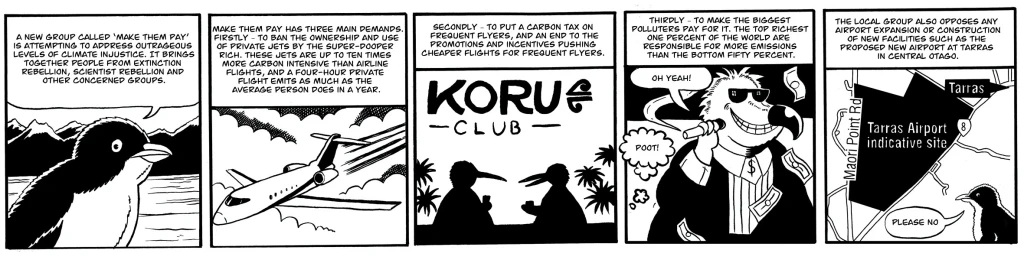
From A Change in the Weather, by Abe Hunter

We face both a climate crisis and cost of living crisis. But the pain is not being spread evenly on either front. Some families find it ever harder to put food on the table, some wonder how to pay the mortgage, while others are scarcely affected. But if you’re poor, you are very likely contributing far less to damaging climate change than if you are rich.

This can be seen especially in relation to flying. Flying is a very high emission activity for individuals and for the nation as a whole. But most of the world’s population have never been on a plane. In New Zealand, as in other wealthy countries, a small minority contribute to the majority of emissions through their frequent and long distance flying.

In the UK, the campaign Make Them Pay is targeting aviation emissions. It has three demands: to ban private jets, to tax frequent flyers and to make polluters pay. A 2019 report for the UK’s Committee on Climate Change also recommended a frequent flyer levy and a ban on air points.

While New Zealand doesn’t have that many private jets, our efforts to make polluters pay are not at all comprehensive with regards to aviation. There are many subsidies for aviation, and these tend to benefit the well off. There is no GST or fuel tax on international flights; they are not in the Emissions Trading Scheme or the carbon budgets. Yet, if a family catches the bus for a local holiday, the fuel is taxed and GST is paid on the tickets.

But a hidden problem are airline loyalty programs, such as Air New Zealand’s Airpoints, which now has 3.6 million members. Far from taxing or reducing frequent flying, these programs promote it. Credit cards are linked to the programs, so that all spending on the card earns points. In other words, the price of all other goods is pushed up to subsidise flying, the most emissions-intensive activity there is.

The link is most obvious in supermarkets, where the rising price of food subsidises flying. There’s a similar issue with Flybuys (2.4 million members), in which food subsidises other purchases, particularly petrol. (Z energy owns part of Flybuys and also sells the petrol reward.) AA Smartfuel – same problem.

If you do get a free flight, who is paying for it? The costs are spread across all goods and services sold by businesses supporting such schemes making these products more expensive. But it will be the higher-spending families who will make most use of these (tax-free!) rewards, so that poorer families not using such a card end up paying higher grocery bills to support the schemes.

Loyalty schemes are an effective and lucrative marketing tool for the airlines. In the US, the loyalty schemes of the largest airlines are valued at more than the airline itself: without them, they would be bankrupt. The rewards such as free upgrades expose travellers to ever more luxurious travel and higher emissions – business class seats, because of the extra space, are 3 to 4 times as damaging as economy class. (Travel writer Brook Sabin complained this week that he was struggling to redeem his free upgrades with Air New Zealand – no empty seats available in business class!) There’s a whole industry devoted to advising you how to optimise your ‘tier point runs’, flights devoted solely to achieving the next tier. Air New Zealand is even thinking of introducing an even higher tier, ‘Elite Plus’, which would allow you to bring a friend along for free. Where will it end?

Aviation has many aspects of being a reverse Robin Hood scheme. Taking from the poor and giving to the rich. There’s a lot of work to do to end this, but reining in the loyalty programs would be a good start.

A Change in the Weather is a climate cartoon by Abe Hunter that appears each Saturday in the Otago Daily Times. See the full series at https://artordeath.wordpress.com/2022/11/06/a-change-in-the-weather/.

An end to plastic pollution

By Robert McLachlan

This week the climate news has all been COP27, and as usual, it sounds discouraging, with delegates staying up all night wrangling over words, a process in which ‘phasing out fossil fuels’ gets progressively watered down to the (virtually meaningless) ‘phasing down unabated coal’.

So it was inspiring to hear about a different approach being taken for another challenging global pollution problem, plastic, in a talk by Massey University’s Trisia Farrelly. Soon she will be part of the first UN talks to draft an Internationally Binding Instrument to End Plastic Pollution. Just reaching this point – achieved in a UN vote on 2 March 2022 after several years of negotiations – is something of a triumph. The contrast with the Paris Agreement, which is not binding and which does not mention ending fossil fuel pollution, is striking.

One of the problems with plastic is growth.

Most of this plastic has ended up as waste.

The consequences are all too familiar.

Henderson Island, Pitcairn, SE Pacific Ocean. Source: Stuff.

The key point about the proposed agreement is that it aims to address the full life cycle of plastic pollution – from exploring for oil, extracting it, turning it into products, the health impact of those products on consumers, to disposal and remediation.

The United States is trying to form a coalition, perhaps including Japan and Australia, that would push for something weaker, something more like the Paris Agreement, in which each country is free to develop its own voluntary plan, and with its scope restricted to managing the final products.

However, a core determination of a group of 34 countries (not yet including New Zealand), the “High Ambition Coalition“, is that full lifecycle impacts can only be addressed by stopping the growth of plastic production at the source. By turning off the tap.

Their first goal is to “Restrain plastic consumption and production to sustainable levels“.

Tautoko.

Further reading

Plastics and Climate, Center for International Environment Law.

Zero Waste to Zero Emissions, GAIA.

Landmark treaty on plastic pollution must put scientific evidence front and centre, Nature editorial.

Silva Filho, C.R., Velis, C.A. (2022). United Nations’ plastic pollution treaty pathway puts waste
and resources management sector at the centre of massive change.
Waste Management &
Research, 40(5), 487-489.