By Robert McLachlan

Since 1978, diesel vehicles in New Zealand have paid road user charges (RUC) via a formula that depends on vehicle size and weight. Petrol vehicles currently pay a fuel tax instead of RUC. Electric vehicles (EVs) were granted an exemption from RUC in 2009 which expired on 1 April 2024. From that date, EV owners were required to pay RUC at the same rate as light diesel vehicles such as utes.
The government plans to shift all light vehicles onto RUC, possibly by 2027.
The current rate of fuel tax is 92 c/l. As one litre of petrol emits 2.31 kg of CO2 when burned, this is equivalent to a carbon charge of $398 per tonne of CO2. Petrol also incurs a carbon charge via the Emissions Trading Scheme (around $50/tCO2). Thus, removing fuel tax would reduce the carbon charge from $448 to $50 per tonne.
The effect would be that fuel costs of a small petrol hybrid would increase from 10c to 14c per kilometre, while that of a large car would fall from 25c to 23c. An EV would cost 11c per kilometre if charged at home on off-peak rates, or 23c per kilometre using public rapid chargers.
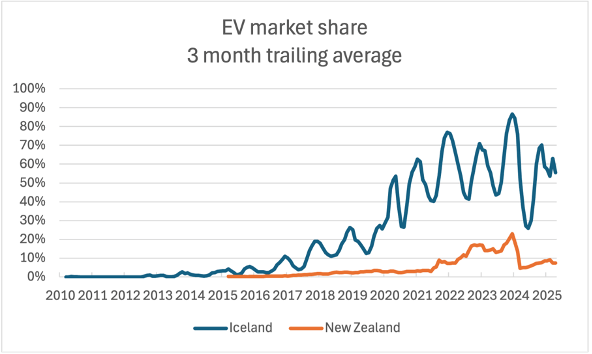
No country has tried this approach yet, although Iceland is planning to do so next year. Wisely, they will also double the carbon charge on petrol (from $100 to $200/tCO2) at the same time. They also retain other strong transport/climate policies. The purchase tax on a high-emitting car can be up to 65% of its value, and the government intends to ban the sale of fossil-fueled vehicles after 2030. In Iceland, 18% of the light vehicle fleet is already electric, compared to 3% in New Zealand.

(For more details, see my report “The emissions impact of a shift to universal road user charging in New Zealand“.)
But what about trucks?
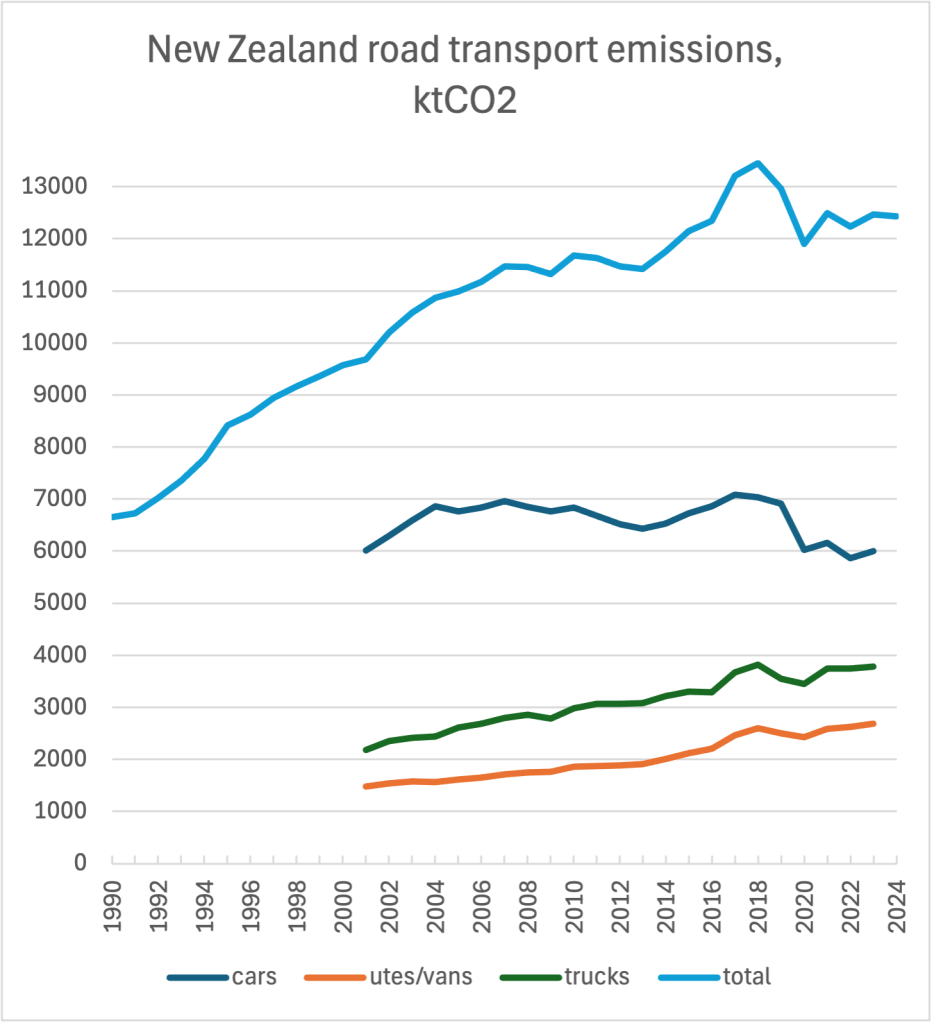
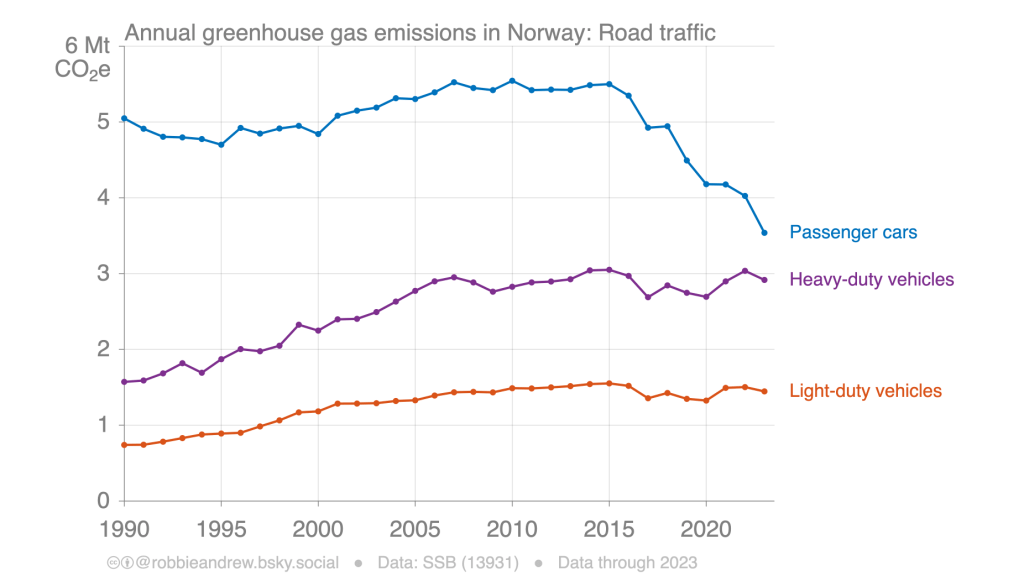
Trucks are, of course, another large source of fossil fuel emissions that needs to be phased out. At present just 0.37% of the light commercial fleet is electric (mostly vans, not utes), while the figure for heavy vehicles is 0.46% (mostly buses, not trucks – although there are 194 electric heavy trucks in the country). Diesel trucks, utes, and vans are already exempt from fuel tax and pay RUC instead. Thus, they face a much lower effective carbon tax than cars, which could be a factor in their relatively slower improvement over time. (Diesel cars have actually been getting worse in recent years.)
However, they do get one big incentive – unlike cars, they are still exempt from RUC. The exemption ends on 1 January 2026. Perhaps this is a small change in the grand scheme of things. But it is one more change in the wrong direction, with an uncertain outcome – as far as I know, no analysis or investigation of any kind has been done on this. It is possible to design a scheme under which everyone contributes fairly according to their impact, and which still incentivizes change. At the start of this year, Denmark introduced RUC for trucks, under a formula which takes into account vehicle weight and CO2 emissions. (EV trucks get an 80% discount.) The effect has been phenomenal, with EV market share for trucks jumping straight up to 25%.


 Planetary Ecology
I can’t do the sums but I feel my 1977 diesel (ex Stuttgart) costs me more to run after paying RUC than a petrol car paying taxes at the pump. (Of course you are talking about emissions not costs.)
I think that RUC, rather than tax on diesel at the pump, as it is in the UK and Europe, existed because there were very few diesel cars in NZ. (Trucks had hubometers.) The only Mercedes 300D here when I brought mine back had been imported by Cable Price for an exhibition, and was subsequently bought by the mayor of Howick, by a strange coincidence.
If I were a fundamental Christian I would likely believe God would not permit Homo bonkers to destroy his creation, but evangelicals keep their mouths shut in politics.